Category: hr

Robert Coombs and his application robot

Robert Coombs and his application robot

Robert Coombs wanted to see whether he could land a new job. He was aware that, these days, organizations often employ applicant tracking systems to progress/fail incoming applications. Hence, Robert concluded that he had two challenges in his search for a new job:

  • He was up against leaders in their field, so his resume wouldn’t simply jump to the top of the pile.
  • Robots would read his application, along with those of his competition.

Being a tech enthusiast and having some programming skills, he decided to build his own application robot, capable of sending a customized CV and resume to the thousands of jobs posted online every day, in a matter of seconds. I strongly recommend you read his full story here, but these were his conclusions:

  • It’s not how you apply, it’s who you know. And if you don’t know someone, don’t bother.
  • Companies are trying to fill a position with minimal risk, not discover someone who breaks the mold.
  • The number of jobs you apply to has no correlation to whether you’ll be considered, and you won’t be considered for jobs you don’t get the chance to apply to.

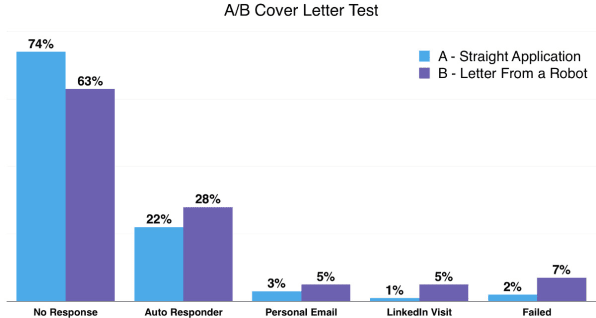
What I found most amusing is that he A/B tested one normal-looking cover letter and a letter in which he that admits right in the second sentence that it was being sent by a robot. “Now, one of those letters should have performed either a lot better or a lot worse than the other. For my purposes, I didn’t care which” he states. But as far as he could tell from the results of this experiment, it seems that nobody even reads cover letters anymore – not even the robots supposedly used in application tracking systems.
Multi-Armed Bandits: The Smart Alternative for A/B Testing

Just as humans, computers learn by experience.The purpose of A/B testing is often to collect data to decide whether intervention A or B is better. As such, we provide one group with intervention A whereas another group receives intervention B. With the data of these two groups coming in, the computer can statistically estimate which intervention (A or B) is more effective. The more data the computer has, the more certain the estimate is. Here, a trade-off exists: we need to collect data on both interventions to be certain which is best. But we don’t want to conduct an inefficient intervention, say B, if we are quite sure already that intervention A is better.

In his post, Corné de Ruijt of Endouble writes about multi-armed bandit algorithms, which try to optimize this trade-off: “Multi-armed bandit algorithms try to overcome the high missed opportunity cost involved in learning, by exploiting and exploring at the same time. Therefore, these methods are in particular interesting when there is a high lost opportunity cost involved in the experiment, and when exploring and exploiting must be performed during a limited time interval.

In the full article, you can read Corné’s comparison of this multi-armed bandit approach to the traditional A/B testing approach using a recruitment and selection example. For those of you who are interested in reading how anyone can apply this algorithm and others to optimize our own daily decisions, I highly recommend the book Algorithms to Live By: The Computer Science of Human Decisions available on Amazon or the Dutch bol.com.

Expanding the methodological toolbox of HRM researchers

Expanding the methodological toolbox of HRM researchers

Update 26-10-2017: the paper has been published open access and is freely available here: http://onlinelibrary.wiley.com/doi/10.1002/hrm.21847/abstract.  

The HR technology landscape is evolving rapidly and with it, the HR function is becoming more and more data-driven (though not fast enough, some argue). HRM research, however, is still characterized by a strong reliance on general linear models like linear regression and ANOVA. In our forthcoming article in the special issue on Workforce Analytics of Human Resource Management, my co-authors and I argue that HRM research would benefit from an outside-in perspective, drawing on techniques that are commonly used in fields other than HRM.

Our article first outlines how the current developments in the measurement of HRM implementation and employee behaviors and cognitions may cause the more traditional statistical techniques to fall short. Using the relationship between work engagement and performance as a worked example, we then provide two illustrations of alternative methodologies that may benefit HRM research:

Using latent variables, bathtub models are put forward as the solution to examine multi-level mechanisms with outcomes at the team or organizational level without decreasing the sample size or neglecting the variation inherent in employees’ responses to HRM activities (see figure 1). Optimal matching analysis is proposed as particularly useful to examine the longitudinal patterns that occur in repeated observations over a prolonged timeframe. We describe both methods in a fair amount of detail, touching on elements such as the data requirements all the way up to the actual modeling steps and limitations.


figure-bathtub-model
An illustration of the two parts of a latent bathtub model.


I want to thank my co-authors and Shell colleagues Zsuzsa Bakk, Vasileios Giagkoulas, Linda van Leeuwen, and Esther Bongenaar for writing this, in my own biased opinion, wonderful article with me and I hope you will enjoy reading it as much as we did writing it.

Link to pre-publication