Author: Paul van der Laken

Statistics Visually Explained

Statistical literacy is essential to our data-driven society. Analytics has been and continues to be a game changer in many business fields, among other Human Resources. Yet, for all the increased importance and demand for statistical competence, the pedagogical approaches in statistics have barely changed.

Seeing Theory is a project designed and created by Daniel Kunin with support from Brown University’s Royce Fellowship Program. The goal of the project is to make statistics more accessible to a wider range of students through interactive visualizations.

Using JavaScript, the researchers have made statistics both intuitive and beautiful at the same time.

seeing theory

Visualizing Employee Mobility and Turnover

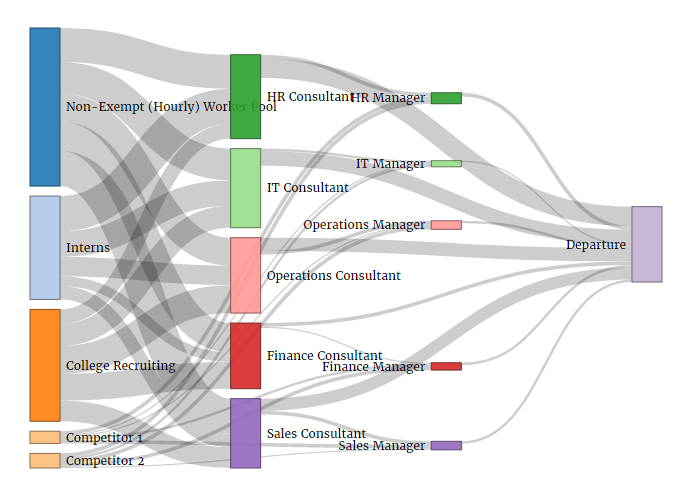
HRAnalytics101 is a website for “HR and Human Capital professionals from curious non-technical novices to confident analytics insiders“. They post interesting blogs, walkthroughs on HR-flavored data analysis. I did not want to hold this one post that presents beautiful visualizations on internal mobility streams and offers a demonstration code on how to make them. An example:

HRAnalytics101 MobilityGraph

I suggest you read the full blog article here because it is an interesting read and the visualisations are interactive!

Visualizing Employee Turnover and Movement

Veritasium: Bayes’ Theorem explained

Veritasium makes educational video’s, mostly about science, and recently they recorded one offering an intuitive explanation of Bayes’ Theorem. They guide the viewer through Bayes’ thought process coming up with the theory, explain its workings, but also acknowledge some of the issues when applying Bayesian statistics in society.

“The thing we forget in Bayes’ Theorem is that our actions play a role in determining outcomes, in determining how true things actually are.” 8.23

“A really good understanding of Bayes’ Theorem implies that experimentation is essential: if you’ve been doing the same thing for a long time and getting the same result – that you’re not necessarily happy with – maybe it’s time to change.” 8.48

The video, see below, lasts around 9 minutes.


Uber: Translating Behavioural Science to the Work Floor with Gamification and Experimentation

Uber: Translating Behavioural Science to the Work Floor with Gamification and Experimentation

Yesterday, I read the most interesting article on how Uber uses academic research from the field of behavioral psychology to persuade their drivers to display desired behaviors. The tone of the article is quite negative and I most definitely agree there are several ethical issues at hand here. However, as a data scientist, I was fascinated by the way in which Uber has translated academic insights and statistical methodology into applications within their own organization that actually seem to pay off. Well, at least in the short term, as this does not seem a viable long-term strategy.

The full article is quite a long read (~20 min), and although I definitely recommend you read it yourself, here are my summary notes, for convenience quoted from the original article:

  • “Employing hundreds of social scientists and data scientists, Uber has experimented with video game techniques, graphics and noncash rewards of little value that can prod drivers into working longer and harder — and sometimes at hours and locations that are less lucrative for them.”
  • “To keep drivers on the road, the company has exploited some people’s tendency to set earnings goals — alerting them that they are ever so close to hitting a precious target when they try to log off.”
  • “Uber exists in a kind of legal and ethical purgatory […] because its drivers are independent contractors, they lack most of the protections associated with employment.”
  • “[…] much of Uber’s communication with drivers over the years has aimed at combating shortages by advising drivers to move to areas where they exist, or where they might arise. Uber encouraged its local managers to experiment with ways of achieving this.[…] Some local managers who were men went so far as to adopt a female persona for texting drivers, having found that the uptake was higher when they did.”
  • “[…] Uber was increasingly concerned that many new drivers were leaving the platform before completing the 25 rides that would earn them a signing bonus. To stem that tide, Uber officials in some cities began experimenting with simple encouragement: You’re almost halfway there, congratulations! While the experiment seemed warm and innocuous, it had in fact been exquisitely calibrated. The company’s data scientists had previously discovered that once drivers reached the 25-ride threshold, their rate of attrition fell sharply.”

  • “For months, when drivers tried to log out, the app would frequently tell them they were only a certain amount away from making a seemingly arbitrary sum for the day, or from matching their earnings from that point one week earlier.The messages were intended to exploit another relatively widespread behavioral tic — people’s preoccupation with goals — to nudge them into driving longer. […] Are you sure you want to go offline?” Below were two prompts: “Go offline” and “Keep driving.” The latter was already highlighted.”
  • “Sometimes the so-called gamification is quite literal. Like players on video game platforms such as Xbox, PlayStation and Pogo, Uber drivers can earn badges for achievements like Above and Beyond (denoted on the app by a cartoon of a rocket blasting off), Excellent Service (marked by a picture of a sparkling diamond) and Entertaining Drive (a pair of Groucho Marx glasses with nose and eyebrows).”
  • “More important, some of the psychological levers that Uber pulls to increase the supply of drivers have quite powerful effects. Consider an algorithm called forward dispatch […] that dispatches a new ride to a driver before the current one ends. Forward dispatch shortens waiting times for passengers, who may no longer have to wait for a driver 10 minutes away when a second driver is dropping off a passenger two minutes away. Perhaps no less important, forward dispatch causes drivers to stay on the road substantially longer during busy periods […]
    [But] there is another way to think of the logic of forward dispatch: It overrides self-control. Perhaps the most prominent example is that such automatic queuing appears to have fostered the rise of binge-watching on Netflix. “When one program is nearing the end of its running time, Netflix will automatically cue up the next episode in that series for you,” wrote the scholars Matthew Pittman and Kim Sheehan in a 2015 study of the phenomenon. “It requires very little effort to binge on Netflix; in fact, it takes more effort to stop than to keep going.””
  • “Kevin Werbach, a business professor who has written extensively on the subject, said that while gamification could be a force for good in the gig economy — for example, by creating bonds among workers who do not share a physical space — there was a danger of abuse.”
  • “There is also the possibility that as the online gig economy matures, companies like Uber may adopt a set of norms that limit their ability to manipulate workers through cleverly designed apps. For example, the company has access to a variety of metrics, like braking and acceleration speed, that indicate whether someone is driving erratically and may need to rest. “The next step may be individualized targeting and nudging in the moment,” Ms. Peters said. “‘Hey, you just got three passengers in a row who said they felt unsafe. Go home.’” Uber has already rolled out efforts in this vein in numerous cities.”
  • “That moment of maturity does not appear to have arrived yet, however. Consider a prompt that Uber rolled out this year, inviting drivers to press a large box if they want the app to navigate them to an area where they have a “higher chance” of finding passengers. The accompanying graphic resembles the one that indicates that an area’s fares are “surging,” except in this case fares are not necessarily higher.”

Click the below for the full article.

Robert Coombs and his application robot

Robert Coombs and his application robot

Robert Coombs wanted to see whether he could land a new job. He was aware that, these days, organizations often employ applicant tracking systems to progress/fail incoming applications. Hence, Robert concluded that he had two challenges in his search for a new job:

  • He was up against leaders in their field, so his resume wouldn’t simply jump to the top of the pile.
  • Robots would read his application, along with those of his competition.

Being a tech enthusiast and having some programming skills, he decided to build his own application robot, capable of sending a customized CV and resume to the thousands of jobs posted online every day, in a matter of seconds. I strongly recommend you read his full story here, but these were his conclusions:

  • It’s not how you apply, it’s who you know. And if you don’t know someone, don’t bother.
  • Companies are trying to fill a position with minimal risk, not discover someone who breaks the mold.
  • The number of jobs you apply to has no correlation to whether you’ll be considered, and you won’t be considered for jobs you don’t get the chance to apply to.

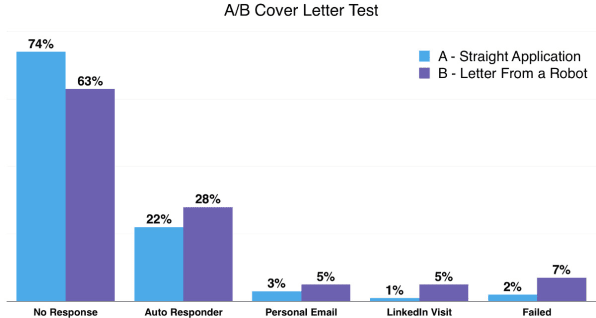
What I found most amusing is that he A/B tested one normal-looking cover letter and a letter in which he that admits right in the second sentence that it was being sent by a robot. “Now, one of those letters should have performed either a lot better or a lot worse than the other. For my purposes, I didn’t care which” he states. But as far as he could tell from the results of this experiment, it seems that nobody even reads cover letters anymore – not even the robots supposedly used in application tracking systems.

Multi-Armed Bandits: The Smart Alternative for A/B Testing

Just as humans, computers learn by experience.The purpose of A/B testing is often to collect data to decide whether intervention A or B is better. As such, we provide one group with intervention A whereas another group receives intervention B. With the data of these two groups coming in, the computer can statistically estimate which intervention (A or B) is more effective. The more data the computer has, the more certain the estimate is. Here, a trade-off exists: we need to collect data on both interventions to be certain which is best. But we don’t want to conduct an inefficient intervention, say B, if we are quite sure already that intervention A is better.

In his post, Corné de Ruijt of Endouble writes about multi-armed bandit algorithms, which try to optimize this trade-off: “Multi-armed bandit algorithms try to overcome the high missed opportunity cost involved in learning, by exploiting and exploring at the same time. Therefore, these methods are in particular interesting when there is a high lost opportunity cost involved in the experiment, and when exploring and exploiting must be performed during a limited time interval.

In the full article, you can read Corné’s comparison of this multi-armed bandit approach to the traditional A/B testing approach using a recruitment and selection example. For those of you who are interested in reading how anyone can apply this algorithm and others to optimize our own daily decisions, I highly recommend the book Algorithms to Live By: The Computer Science of Human Decisions available on Amazon or the Dutch bol.com.