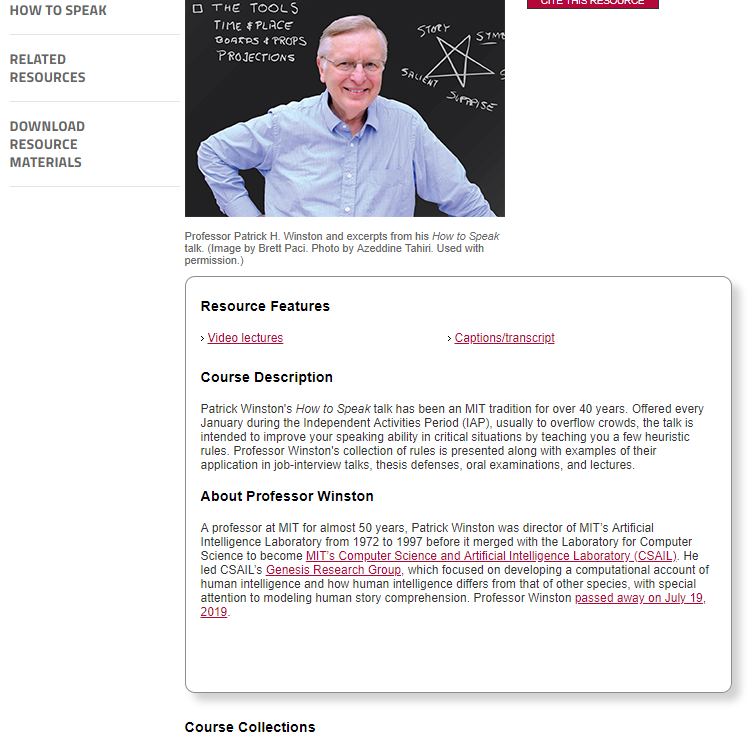
Patrick Winston was a professor of Artificial Intelligence at MIT. Having taught with great enthusiasm for over 50 years, he passed away past June.
As a speaker [Patrick] always had his audience in the palm of his hand. He put a tremendous amount of work into his lectures, and yet managed to make them feel loose and spontaneous. He wasn’t flashy, but he was compelling and direct.
I’ve written about Patrick’s MIT course on Artificial Intelligence before, as all 20+ lectures have been shared open access online on Youtube. I’ve worked through the whole course in 2017/2018, and it provided me many new insights into the inner workings of common machine learning algorithms.
Now, I stumbled upon another legacy of Patrick that has been opened up as of December 20th 2019. A lecture on “How to Speak” – where Patrick explains what he think makes a talk enticing, inspirational, and interesting.
Patrick Winston’s How to Speak talk has been an MIT tradition for over 40 years. Offered every January, the talk is intended to improve your speaking ability in critical situations by teaching you a few heuristic rules.
That’s all I’m going to say about it, you should have a look yourself! If you don’t apply these techniques yet, do try them out, they will really upgrade your public speaking effectiveness:
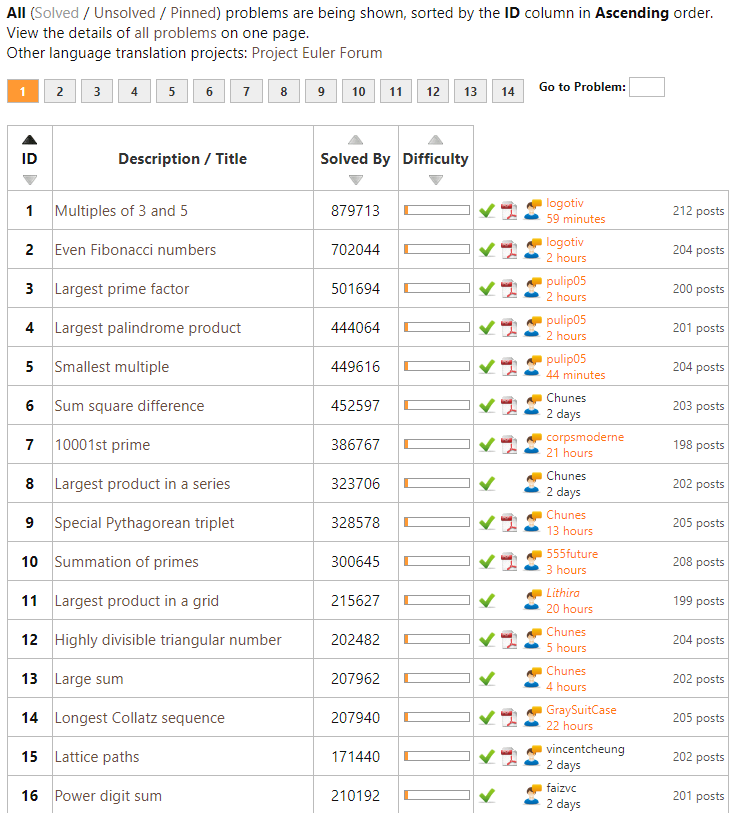
Over the last months I’ve been working my way through Project Euler in my spare time. I wanted to learn Python programming, and what better way than solving mini-problems and -projects?!
Well, Project Euler got a ton of these, listed in increasing order of difficulty. It starts out simple: to solve the first problem you need to write a program to identify multiples of 3 and 5. Next, in problem two, you are asked to sum the first thousand even Fibonacci numbers. Each problem, the task at hand gets slighly more difficult…
For me, Project Euler combines math, programming, and stats in a way that really keeps me motivated to continue and learn new concepts and programming / problem-solving approaches.
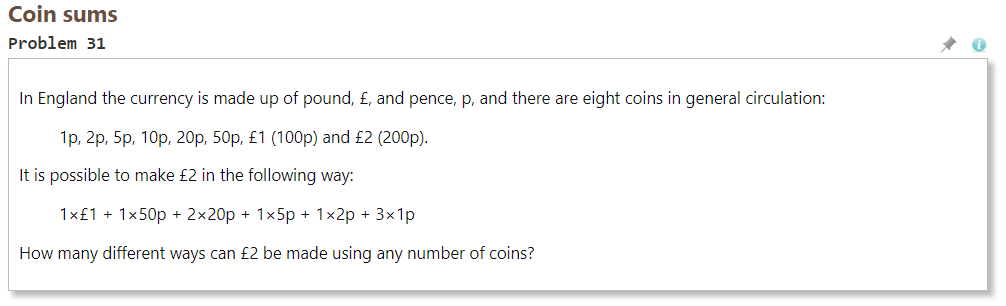
However, at problem 31, I really got stuck. For several hours, I struggled to solve it in a satisfactory fashion, even though most other problems only take 5-90 minutes.
After hours of struggling, I pretty much gave up, and googled some potential solutions. Aparently, the way to solve problem 31, is to take a so-called dynamic programming approach.
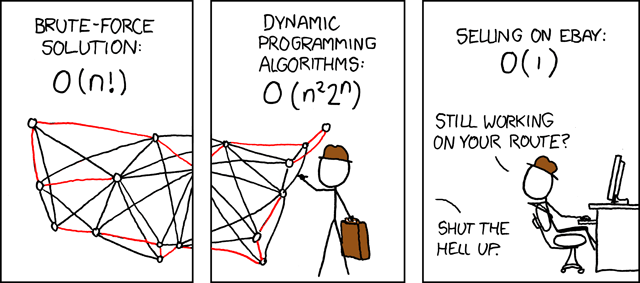
Dynamic programming is both a mathematical optimization method and a computer programming method. The method was developed by Richard Bellman in the 1950s and has found applications in numerous fields, from aerospace engineering to economics. In both contexts it refers to simplifying a complicated problem by breaking it down into simpler sub-problems in a recursive manner. While some decision problems cannot be taken apart this way, decisions that span several points in time do often break apart recursively. Likewise, in computer science, if a problem can be solved optimally by breaking it into sub-problems and then recursively finding the optimal solutions to the sub-problems, then it is said to have optimal substructure.
Now, this sounded like something I’d like to learn more about! I was already quite familiar with recursive problems and solutions, but this dynamic programming sounded next-level.
So I googled and googled for tutorials and other resources, and I finally came across this free 2011 MIT course that I intend to view over the coming weeks.
There’s even a course website with additional materials and assignments (in Python).
For those less interested in (dynamic) programming but mostly in machine learning, there’s this other great MIT OpenCourseWare youtube playlist of their Artificial Intelligence course. I absolutely loved that course and I really powered through it in a matter of weeks (which is why I am already psyched about this new one). I learned so much new concepts, and I strongly recommend it. Unfortunately, the professor recently passed away.
Massachusetts Institute of Technology (MIT) hosts their entire 2010 course on artificial intelligence / machine learning by Professor Patrick Winston on YouTube. Although some parts seem already kind of dated seven years later, the videos on several evolving topics (e.g., Neural Networks) have been updated in the fall of 2015. The tutorial assignments you can find at the course website. Requirements for the course include experience with Python programming and an understanding of search algorithms (depth-first, breadth-first, uniform-cost, A*), basic probability, state estimation, the chain rule, partial derivatives, and dot products.
Below is the first, introductory lecture, which provides a short introduction to the history and concept of artificial intelligence: AI is about algorithms enabled by constraints exposed by representations that support models targeted at loops that tie together thinking, perception and action.

 paulvanderlaken.com