Category: programming

Analysis of Media Coverage on Refugees

Analysis of Media Coverage on Refugees

Hannah Yan Han is doing #100dayprojects on data science and visual storytelling and I can only recommend that you take a look yourself. Below you find her R text analysis (#41) of UNHCR speeches and TV coverage on refugees.

Unsurprisingly, nouns like asylum, repatriation, displacement, persecution, plight, and crisis appear significantly more often in UNHCR speeches on refugees than in general English texts. The first visualization below shows the action-oriented verbs most commonly used in combination with these nouns.

This second visualization shows the most occurring verb-noun pairs.

Hannah used newsflash to retrieve the GDELT data on US TV news. Some channels seem to cover refugees more than others. I would have loved to see which topics occurred on each channel, but unfortunately she did not report on this.

Visualizing #IRMA Tweets

Visualizing #IRMA Tweets

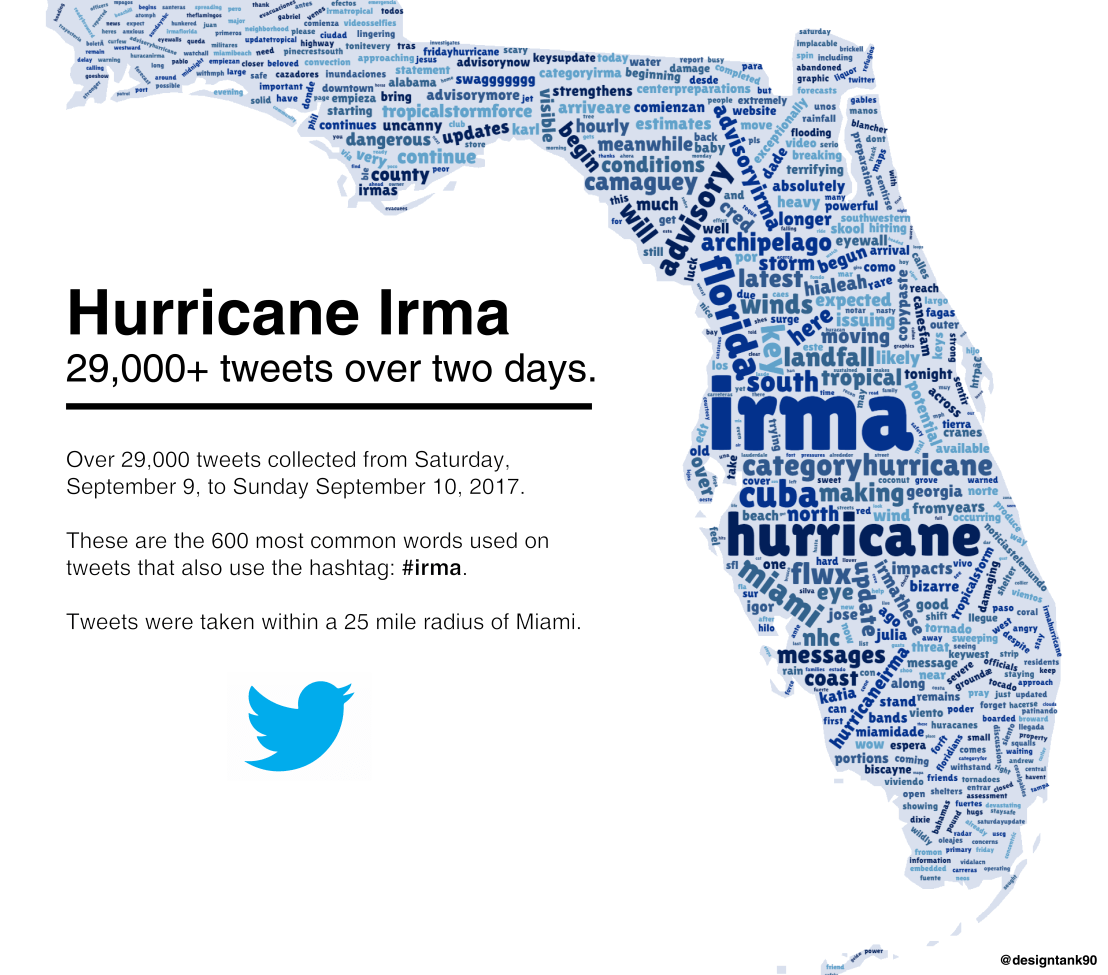
Reddit user LucasCu90 used the R package twitteR to retrieve all tweets that were sent with #Irma and a Geocode of central Miami (25 mile radius) from Saturday September 9, to Sunday September 10, 2017 (the period of Irma’s approach and initial landfall on the Florida Keys and the mainland). From the 29,000 tweets he collected, Lucas then retrieved the 600 most common words and overlaid them on a map of Florida, with their size relative to their frequency in the data. The result is quite nice!

oq41nz62balz

Coexisting Languages in Australia: An Interactive map

Coexisting Languages in Australia: An Interactive map

Jack Zhao from Small Multiples – a multidisciplinary team of data specialists, designers and developers – retrieved the Language Spoken at Home (LANP) data from the 2016 Census and turned it into a dot density map that vividly shows how people from different cultures coexist (or not) in ultra high resolution (using Python, englewood library, QGIS, Carto). Each colored dot in the visualizations below represents five people from the same language group in the area. Highly populated areas have a higher density of dots; while language diversity is shown through the number of different colors in the given area.

Good news: the maps are interactive! Here’s Sydney:

Here is the original webpage on Small Multiples and you can browse the interactive map in full screen in your browser. The below language groups are included:

  • Eastern Asian: Chinese, Japanese, Korean, Other Eastern Asian Languages
  • Southeast Asian: Burmese and Related Languages, Hmong-Mien, Mon-Khmer, Tai, Southeast Asian Austronesian Languages, Other Southeast Asian Languages
  • Southern Asian: Dravidian, Indo-Aryan, Other Southern Asian Languages
  • Southwest And Central Asian: Iranic, Middle Eastern Semitic Languages, Turkic, Other Southwest and Central Asian Languages
  • Northern European: Celtic, English, German and Related Languages, Dutch and Related Languages, Scandinavian, Finnish and Related Languages
  • Southern European: French, Greek, Iberian Romance, Italian, Maltese, Other Southern European Languages
  • Eastern European: Baltic, Hungarian, East Slavic, South Slavic, West Slavic, Other Eastern European Languages
  • Australian Indigenous: Arnhem Land and Daly River Region Languages, Yolngu Matha, Cape York Peninsula Languages, Torres Strait Island Languages, Northern Desert Fringe Area Languages, Arandic, Western Desert Languages, Kimberley Area Languages, Other Australian Indigenous Languages


Writing your thesis with R Markdown

Writing your thesis with R Markdown

Markdown is a great tool for integrating data analysis and report writing. Rosanna van Hespen wrote a great five-blog guide on how to write your thesis in R Markdown:

  1. Getting started
  2. Text, Citations, & Equations
  3. Figures, Code, & Tables
  4. Putting it all together
  5. Layout
Python resources (free courses, books, & cheat sheets)

Python resources (free courses, books, & cheat sheets)

Find more comprehensive Python repositories:
Vinta’s awesome Python Github repository, the easy Python docs, the Python Wiki Beginners Guide, or CourseDuck’s overview of free Python courses!

My list of Python resources is still quite short so if you have additions, please comment below or contact me! There are separate overviews for Data Science, Machine Learning, & Statistics resources in general, and for R resources and SQL resources in specific.

LAST UPDATED: 11-11-2018

Cheat sheets:

Courses:

Books: