Decision making under uncertainty is complicated. These days, many business rely on real-life experiments, or A/B tests, to reduce that uncertainty and improve their decision-making. For instance, here’s a presentation on how A/B testing helps improve business outcomes at Etsy.
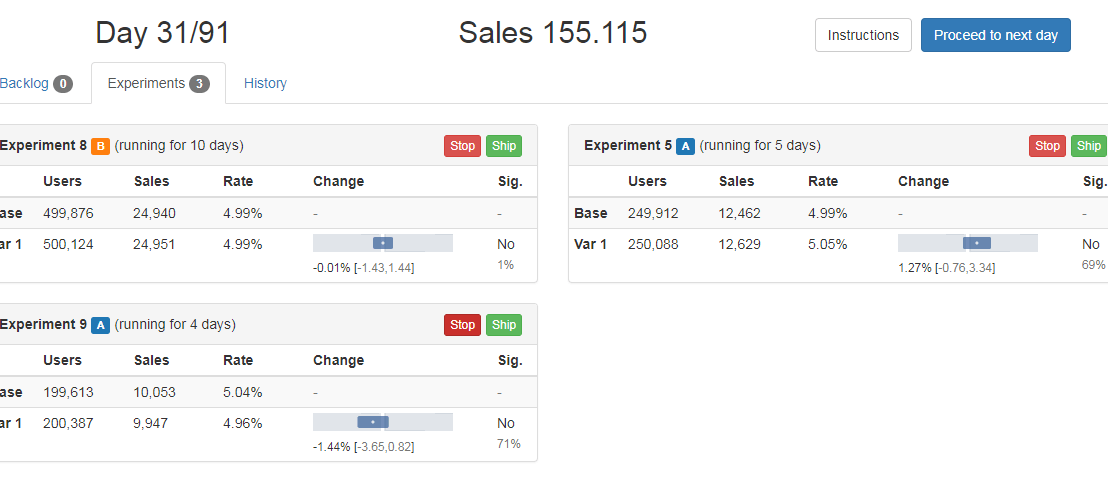
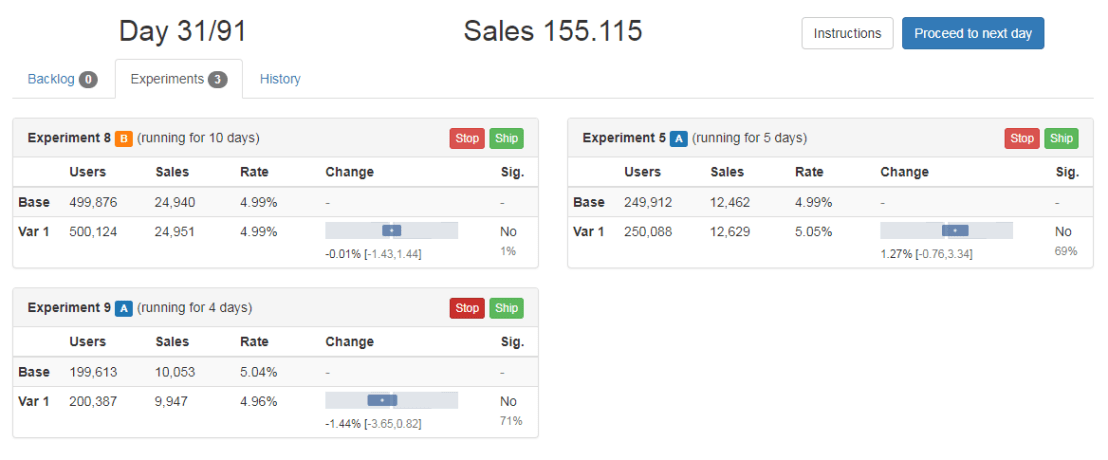
Lukas Vermeer built So You Think You Can Test, an online simulation game in which you are the decision-maker in a company. You control the backlog and running of experiments and each day you have to decide which tasks to prioritize (or deleted entirely). Your decisions affect the sales of the company, so be wise and use the experimental information to your advantage.
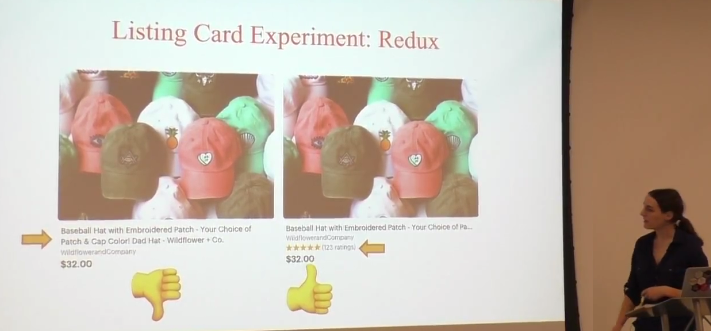
Like any large tech company, Etsy relies heavily on statistics to improve their way of doing business. In their case, data from real-life experiments provide the business intelligence that allow effective decision-making. For instance, they experiment with the layout of their buttons, with the text shown near products, or with the suggestions made after a search query. To detect whether such changes have (ever so) small effects on Etsy’s KPI’s (e.g., conversion), data scientists such as Emily rely on traditional A/B testing.
In a 40-minute presentation, Emily explains how statistical issues such as skewed distributions, outliers, and power are dealt with at Etsy, among others using bootstrapping and simulations. Moreover, 30 minutes in Emily shares her lessons when it comes to working with (less stats-savvy) business stakeholders. For instance, how to help identify and transform business questions into data questions back into business solutions, or how to deal with the desire to peek at the results of experiments early.
Overall, I can the presentation below, the slides of which you find on Emily’s GitHub.
 paulvanderlaken.com