Category: learning

Free course: SQL for Data Science

Free course: SQL for Data Science

Kirsten Kehrer from datamovesme.com does all kinds of super valuable stuff in SQL and end of 2019 she decided to share it with the world via a free SQL course.

Screenshot from youtube.com/watch?v=W5AiLYR02l8

The course is focused on data science and has 5 modules with video lectures:

Kirsten advises to take the course with dual monitors, as she also provides an online SQL query builder environment, where you can write your queries during the videos.

https://kristenkehrer.github.io/datamovesme-sqlcourse/

Moreover, Kirsten also published the slides and the code to go with the course, so you can really learn along:

A nice touch is that Kirsten simulated some data for a fictitious e-commerce company, that really allows you to get a feel for the type of data you’d be working with in practice:

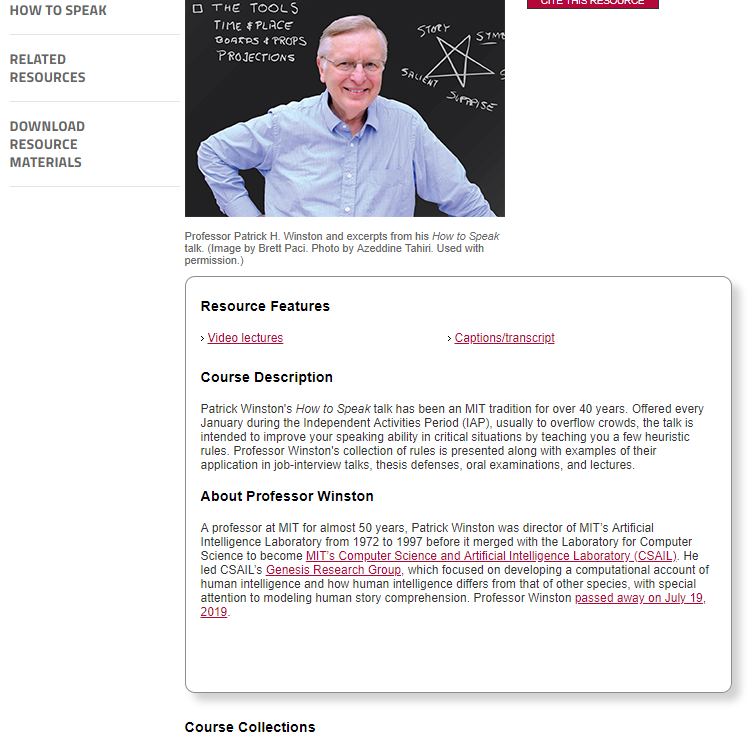
Screenshot from youtube.com/watch?v=itpvD0Eb_s4

How to Speak – MIT lecture by Patrick Winston

How to Speak – MIT lecture by Patrick Winston

Patrick Winston was a professor of Artificial Intelligence at MIT. Having taught with great enthusiasm for over 50 years, he passed away past June.

As a speaker [Patrick] always had his audience in the palm of his hand. He put a tremendous amount of work into his lectures, and yet managed to make them feel loose and spontaneous. He wasn’t flashy, but he was compelling and direct.

Peter Szolovits via http://news.mit.edu/2019/patrick-winston-professor-obituary-0719

I’ve written about Patrick’s MIT course on Artificial Intelligence before, as all 20+ lectures have been shared open access online on Youtube. I’ve worked through the whole course in 2017/2018, and it provided me many new insights into the inner workings of common machine learning algorithms.

Now, I stumbled upon another legacy of Patrick that has been opened up as of December 20th 2019. A lecture on “How to Speak” – where Patrick explains what he think makes a talk enticing, inspirational, and interesting.

Patrick Winston’s How to Speak talk has been an MIT tradition for over 40 years. Offered every January, the talk is intended to improve your speaking ability in critical situations by teaching you a few heuristic rules.

https://ocw.mit.edu/resources/res-tll-005-how-to-speak-january-iap-2018/

That’s all I’m going to say about it, you should have a look yourself! If you don’t apply these techniques yet, do try them out, they will really upgrade your public speaking effectiveness:

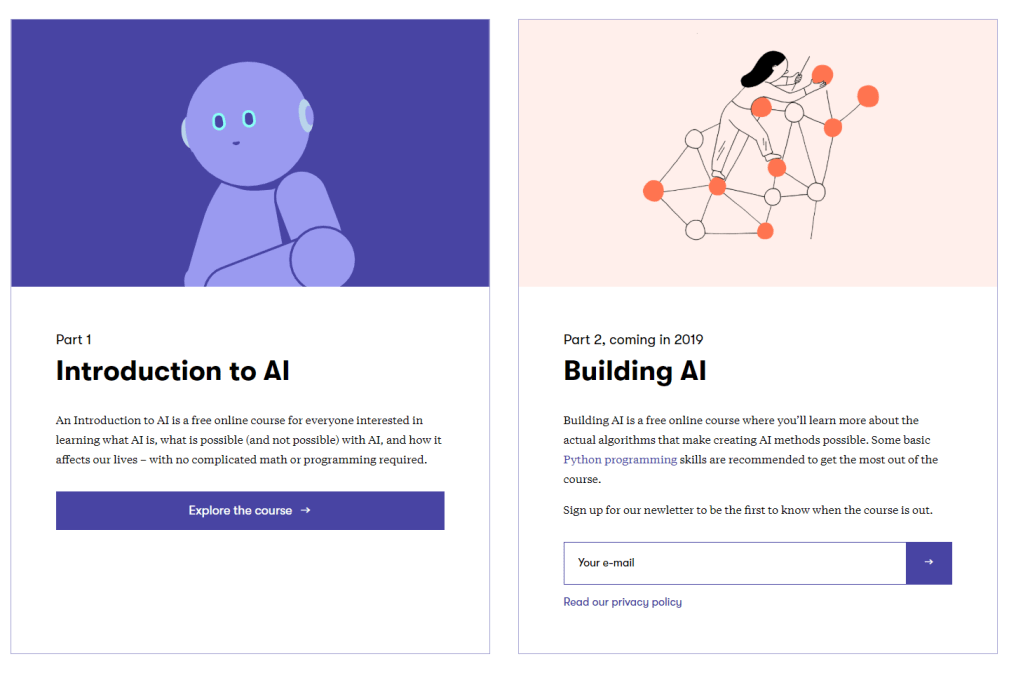
Finland’s free online AI crash course

Finland’s free online AI crash course

Finland developed a crash course on AI to educate its citizens. The course was arguably a great local success, with over 50 thousand Fins taking the course (1% of the population).

Now, as a gift to the European Union, Finland has opened up the course for the rest of Europe and the world to enjoy.

All pictures are screenshots taken from the website

The course is even being translated into several local languages. At the time of writing, five Northern European languages are already supported, but additional translation efforts are still in progress.

Elements of AI takes six weeks and functions as a crash course and beginner introduction to the field of AI:

Anomaly Detection Resources

Anomaly Detection Resources

Carnegie Mellon PhD student Yue Zhao collects this great Github repository of anomaly detection resources: https://github.com/yzhao062/anomaly-detection-resources

The repository consists of tools for multiple languages (R, Python, Matlab, Java) and resources in the form of:

  1. Books & Academic Papers
  2. Online Courses and Videos
  3. Outlier Datasets
  4. Algorithms and Applications
  5. Open-source and Commercial Libraries/Toolkits
  6. Key Conferences & Journals

Outlier Detection (also known as Anomaly Detection) is an exciting yet challenging field, which aims to identify outlying objects that are deviant from the general data distribution. Outlier detection has been proven critical in many fields, such as credit card fraud analytics, network intrusion detection, and mechanical unit defect detection.

https://github.com/yzhao062/anomaly-detection-resources

Quick Access — Table of Contents

Online Workshop Tidy Data Science in R, by Jake Thompson

Online Workshop Tidy Data Science in R, by Jake Thompson

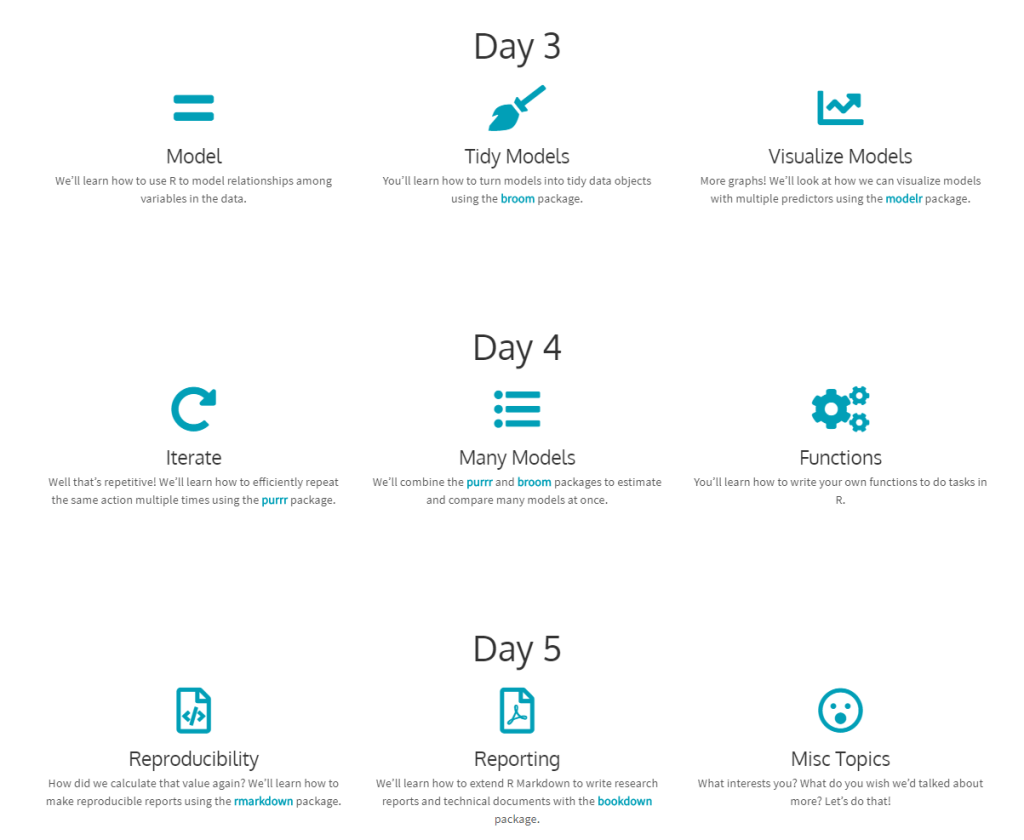
Here’s a website hosting for a five-day hands-on workshop based on the book “R for Data Science”.

The workshop was originally offered as part of the Stats Camp: Summer Statistical Institute in Lawrence, KS and hosted by the Center for Research Methods and Data Analysis and the Achievement and Assessment Instituteat the University of Kansas. It is designed for those who want to learn practical applications of R for data analysis.

You can download the Workshop files, but I suggest you do so via the original workshop webpage.

This workshop is designed for those who want to learn how to use R to analyze data. The material is based on Hadley Wickham and Garrett Grolemund’s R for Data Science. We’ll talk about how to conduct a complete data analysis from data import to final reporting in R using a suite of packages known as the tidyverse. The two goals of this workshop are: 1) learn how to use R to answer questions about our data; and 2) write code that is human readable and reproducible. We will also talk about how to share our code and analyses with others.

You should take this workshop if you are new to R, or to the tidyverse, and want to learn how to take advantage of this ecosystem to do data analysis. You’ll get the most from the workshop if you are primarily interested in applying pre-existing R packages and functions to your own data. We will give minimal tutorials on how to write your own functions; however, the main focus will be on using existing tools, rather than building our own.

About this workshop

=

How Do I…? R Code Snippets by Sharon Machlis

How Do I…? R Code Snippets by Sharon Machlis

Sharon Machlis is the author of Practical R for Mass Communication and Journalism. In writing this book, she obviously wrote a lot of R code. Now, Sharon has been nice enough to share all 195 tricks and tips she came across during her writing with us, via this handy table.

Sharon’s list contains many neat tricks, some of which less well-known base functions, others features of more niche packages. Here’s the ones I am definitely adding to my R tricks overview and want to highlight here as well:

  • Categorize values into interval cut()
  • Convert numbers that came in as strings with commas to R numbers with readr::parse_number(mydf$mycol)
  • Create a searchable, sortable HTML table in 1 line of code with DT::datatable(mydf, filter = 'top')
  • Display a fraction between 0 and 1 as a percentage with scales::percent(myfraction)
  • Generate a vector of 1:length(myvec) with seq_along(myvec)

And as if one list was not enough, scrolling through her Twitter feed, I found another R tips and tricks list by Sharon: