Category: research

The Causal Inference Book: DAGS and more

The Causal Inference Book: DAGS and more

Harvard (bio)statisticians Miguel Hernan and Jamie Robins just released their new book, online and accessible for free!

The Causal Inference book provides a cohesive presentation of causal inference, its concepts and its methods. The book is divided in 3 parts of increasing difficulty: causal inference without models, causal inference with models, and causal inference from complex longitudinal data. Here’s the official Harvard page for the book release.

Some of the book’s (NHEFS) data is accesible too:

As is the associated computer code for the analyses, in multiple languages:

This is definitely an interesting read for epidemiologists, statisticians, psychologists, economists, sociologists, political scientists, data scientists, computer scientists, and any other person with a love for proper data analysis! 

Sam Finalyson visualized some of the Directed Acyclic Graphs (DAG) covered in the book, and these also look quite nice. The visuals and other notes and glossary items here.

Cover image via blytheadamson.com
Overviews of Graph Classification and Network Clustering methods

Thanks to Sebastian Raschka I am able to share this great GitHub overview page of relevant graph classification techniques, and the scientific papers behind them. The overview divides the algorithms into four groups:

  1. Factorization
  2. Spectral and Statistical Fingerprints
  3. Deep Learning
  4. Graph Kernels

Moreover, the overview contains links to similar collections on community detectionclassification/regression trees and gradient boosting papers with implementations.

As well as a link to relevant graph classification benchmark datasets.

Causal Random Forests, by Mark White

Causal Random Forests, by Mark White

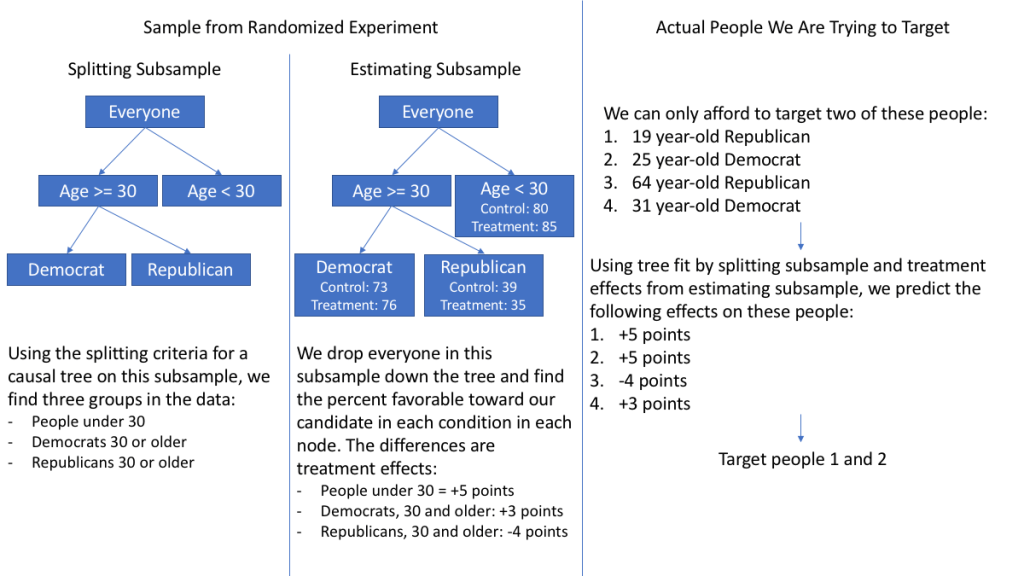
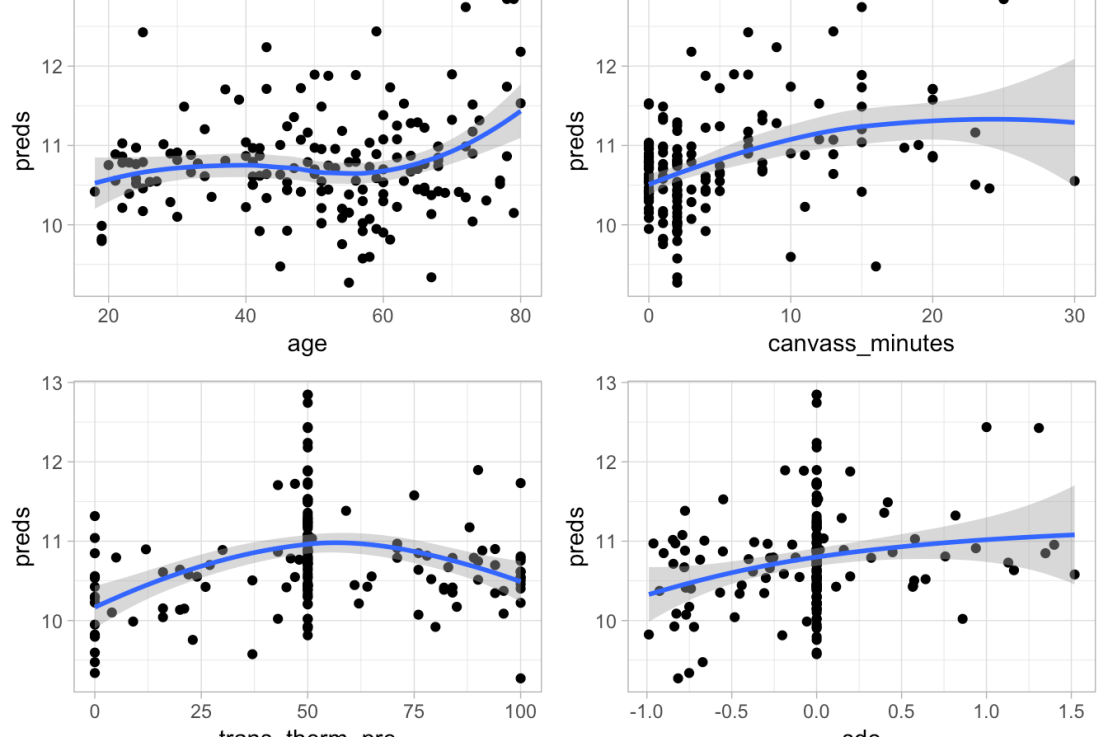
I stumbled accros this incredibly interesting read by Mark White, who discusses the (academic) theory behind, inner workings, and example (R) applications of causal random forests:

EXPLICITLY OPTIMIZING ON CAUSAL EFFECTS VIA THE CAUSAL RANDOM FOREST: A PRACTICAL INTRODUCTION AND TUTORIAL (By Mark White)

These so-called “honest” forests seem a great technique to identify opportunities for personalized actions: think of marketing, HR, medicine, healthcare, and other personalized recommendations. Note that an experimental setup for data collection is still necessary to gather the right data for these techniques.

https://www.markhw.com/blog/causalforestintro

Logistic regression is not fucked, by Jake Westfall

Logistic regression is not fucked, by Jake Westfall

Recently, I came across a social science paper that had used linear probability regression. I had never heard of linear probability models (LPM), but it seems just an application of ordinary least squares regression but to a binomial dependent variable.

According to some, LPM is a commonly used alternative for logistic regression, which is what I was learned to use when the outcome is binary.

Potentially because of my own social science background (HRM), using linear regression without a link transformation on binary data just seems very unintuitive and error-prone to me. Hence, I sought for more information.

I particularly liked this article by Jake Westfall, which he dubbed “Logistic regression is not fucked”, following a series of blogs in which he talks about methods that are fucked and not useful.

Jake explains the classification problem and both methods inner workings in a very straightforward way, using great visual aids. He shows how LMP would differ from logistic models, and why its proposed benefits are actually not so beneficial. Maybe I’m in my bubble, but Jake’s arguments resonated.

Read his article yourself:
http://jakewestfall.org/blog/index.php/2018/03/12/logistic-regression-is-not-fucked/

Here’s the summary:
Arguments against the use of logistic regression due to problems with “unobserved heterogeneity” proceed from two distinct sets of premises. The first argument points out that if the binary outcome arises from a latent continuous outcome and a threshold, then observed effects also reflect latent heteroskedasticity. This is true, but only relevant in cases where we actually care about an underlying continuous variable, which is not usually the case. The second argument points out that logistic regression coefficients are not collapsible over uncorrelated covariates, and claims that this precludes any substantive interpretation. On the contrary, we can interpret logistic regression coefficients perfectly well in the face of non-collapsibility by thinking clearly about the conditional probabilities they refer to. 

Propensity Score Matching Explained Visually

Propensity Score Matching Explained Visually

Propensity score matching (wiki) is a statistical matching technique that attempts to estimate the effect of a treatment (e.g., intervention) by accounting for the factors that predict whether an individual would be eligble for receiving the treatment. The wikipedia page provides a good example setting:

Say we are interested in the effects of smoking on health. Here, smoking would be considered the treatment, and the ‘treated’ are simply those who smoke. In order to find a cause-effect relationship, we would need to run an experiment and randomly assign people to smoking and non-smoking conditions. Of course such experiments would be unfeasible and/or unethical, as we can’t ask/force people to smoke when we suspect it may do harm.
We will need to work with observational data instead. Here, we estimate the treatment effect by simply comparing health outcomes (e.g., rate of cancer) between those who smoked and did not smoke. However, this estimation would be biased by any factors that predict smoking (e.g., social economic status). Propensity score matching attempts to control for these differences (i.e., biases) by making the comparison groups (i.e., smoking and non-smoking) more comparable.

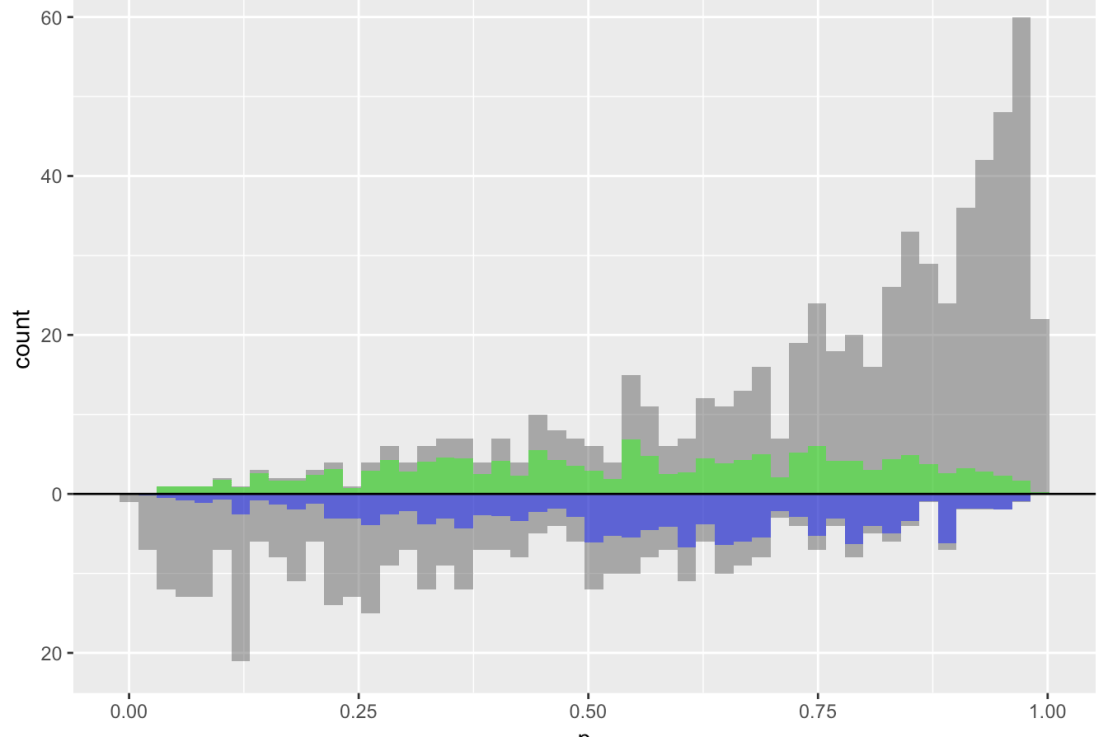
Lucy D’Agostino McGowan is a post-doc at Johns Hopkins Bloomberg School of Public Health and co-founder of R-Ladies Nashville. She wrote a very nice blog explaining what propensity score matching is and showing how to apply it to your dataset in R. Lucy demonstrates how you can use propensity scores to weight your observations in such a way that accounts for the factors that correlate with receiving a treatment. Moreover, her explainations are strenghtened by nice visuals that intuitively demonstrate what the weighting does to the “pseudo-populations” used to estimate the treatment effect.

Have a look yourself: https://livefreeordichotomize.com/2019/01/17/understanding-propensity-score-weighting/

People Analytics: Is nudging goed werkgeverschap of onethisch?

People Analytics: Is nudging goed werkgeverschap of onethisch?

In Dutch only:

Voor Privacyweb schreef ik onlangs over people analytics en het mogelijk resulterende nudgen van medewerkers: kleine aanpassingen of duwtjes die mensen in de goede richting zouden moeten sturen. Medewerkers verleiden tot goed gedrag, als het ware. Maar wie bepaalt dan wat goed is, en wanneer zouden werkgevers wel of niet mogen of zelfs moeten nudgen?

Lees het volledige artikel hier.