Tag: free

GoalKicker: Free Programming Books

This specific link has been on my to-do list for so-long now that I’ve decided to just share it without any further ado.

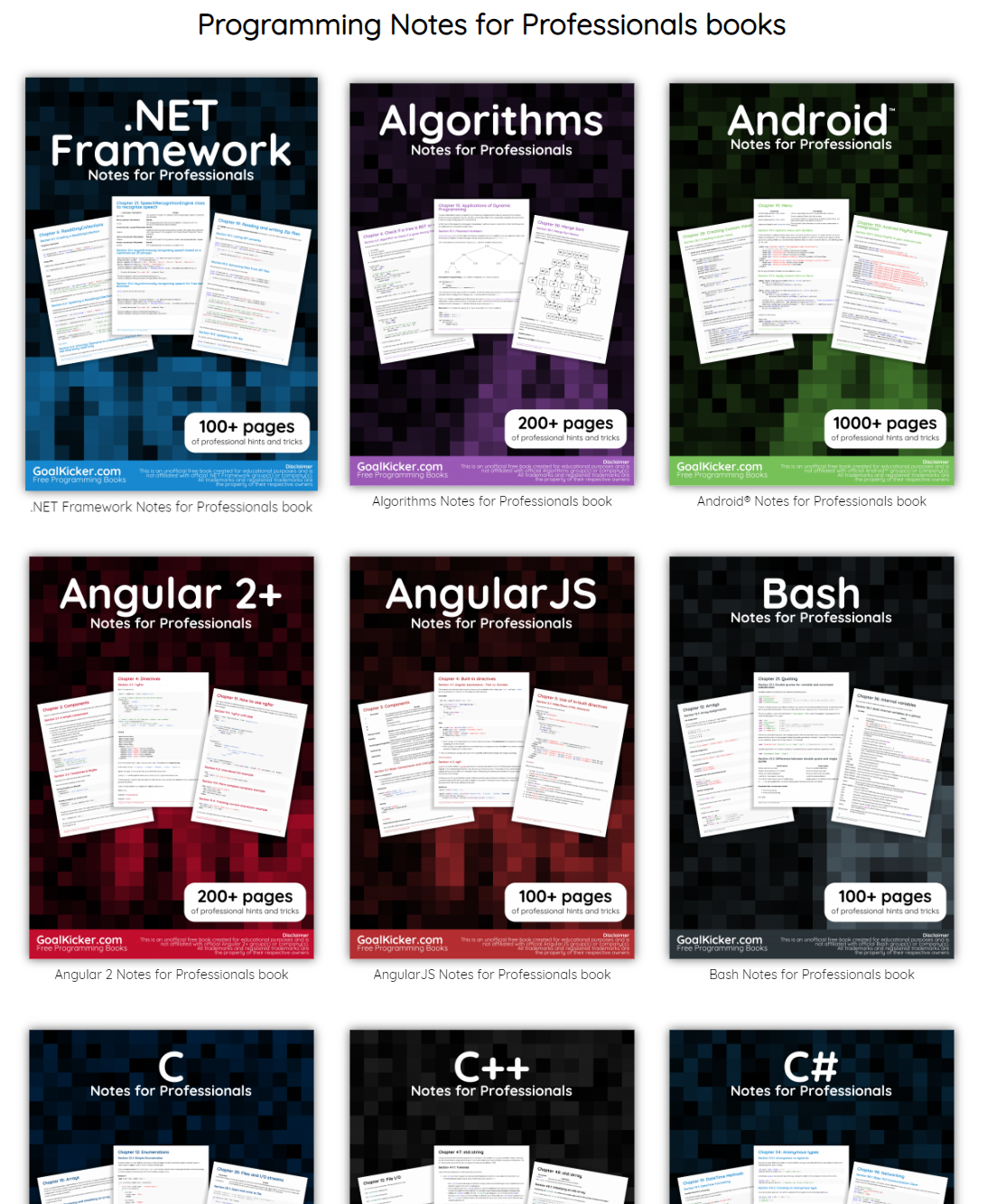
The people behind GoalKicker, for whatever reason, decided to compile nearly 100 books on different programming languages based on among others StackOverflow entries. Their open access library contains books on languages from Latex to Linux, from Java to JavaScript, from SQL to MySQL, and from C, to C++, C#, and objective-C.

Basically, they host it all. Have a look yourself: https://books.goalkicker.com/
Machine Learning & Deep Learning book

Machine Learning & Deep Learning book

The Deep Learning textbook helps students and practitioners enter the field of machine learning in general and deep learning in particular. Its online version is available online for free whereas a hardcover copy can be ordered here on Amazon. You can click on the topics below to be redirected to the book chapter:

Part I: Applied Math and Machine Learning Basics

Part II: Modern Practical Deep Networks

Part III: Deep Learning Research


AI at MIT (2010/2015): Part 1 – Introduction

AI at MIT (2010/2015): Part 1 – Introduction

Massachusetts Institute of Technology (MIT) hosts their entire 2010 course on artificial intelligence / machine learning by Professor Patrick Winston on YouTube. Although some parts seem already kind of dated seven years later, the videos on several evolving topics (e.g., Neural Networks) have been updated in the fall of 2015. The tutorial assignments you can find at the course website. Requirements for the course include experience with Python programming and an understanding of search algorithms (depth-first, breadth-first, uniform-cost, A*), basic probability, state estimation, the chain rule, partial derivatives, and dot products.

Below is the first, introductory lecture, which provides a short introduction to the history and concept of artificial intelligence:
AI is about algorithms enabled by constraints exposed by representations that support models targeted at loops that tie together thinking, perception and action.