Tag: python

t-SNE, the Ultimate Drum Machine and more

t-SNE, the Ultimate Drum Machine and more

This blog explains t-Distributed Stochastic Neighbor Embedding (t-SNE) by a story of programmers joining forces with musicians to create the ultimate drum machine (if you are here just for the fun, you may start playing right away).

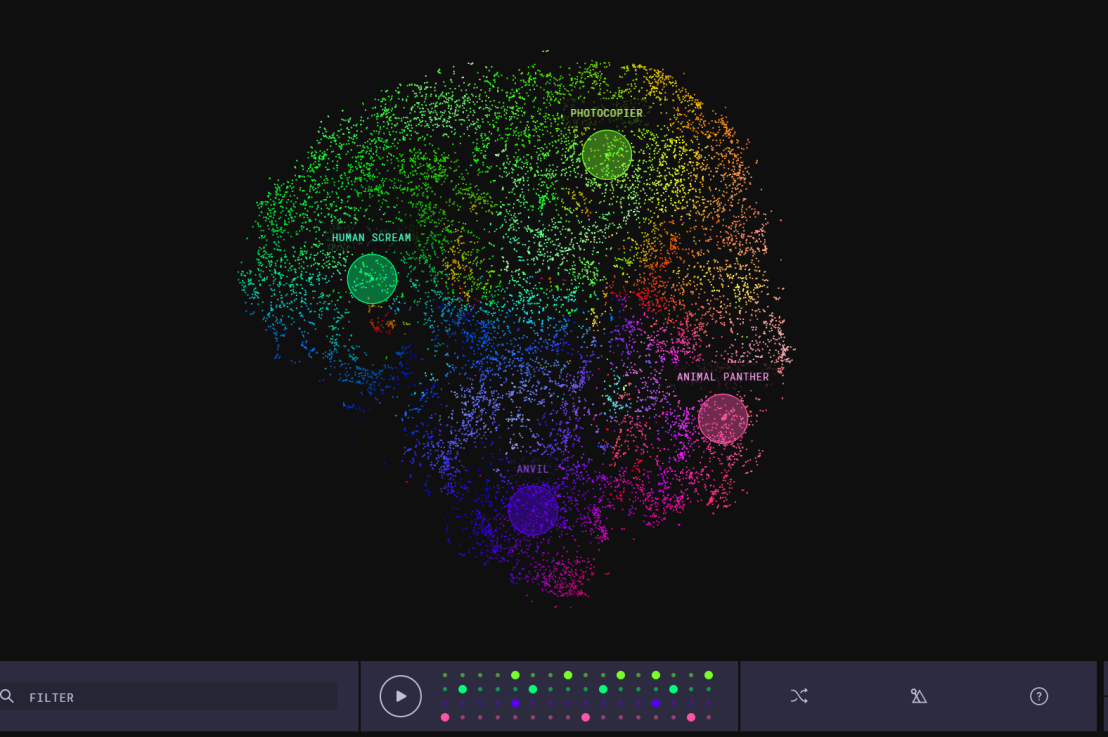
Kyle McDonald, Manny Tan, and Yotam Mann experienced difficulties in pinpointing to what extent sounds are similar (ding, dong) and others are not (ding, beep) and they wanted to examine how we, humans, determine and experience this similarity among sounds. They teamed up with some friends at Google’s Creative Lab and the London Philharmonia to realize what they have named “the Infinite Drum Machine” turning the most random set of sounds into a musical instrument.

Drum Machine.png

The project team wanted to include as many different sounds as they could, but had less appetite to compare, contrast and arrange all sounds into musical accords themselves. Instead, they imagined that a computer could perform such a laborious task. To determine the similarities among their dataset of sounds – which literally includes a thousand different sounds from the ngaaarh of a photocopier to the zing of an anvil – they used a fairly novel unsupervised machine learning technique called t-Distributed Stochastic Neighbor Embedding, or t-SNE in short (t-SNE Wiki; developer: Laurens van der Maaten). t-SNE specializes in dimensionality reduction for visualization purposes as it transforms highly-dimensional data into a two- or three-dimensional space. For a rapid introduction to highly-dimensional data and t-SNE by some smart Googlers, please watch the video below.

As the video explains, t-SNE maps complex data to a two- or three-dimensional space and was therefore really useful to compare and group similar sounds. Sounds are super highly-dimensional as they are essentially a very elaborate sequence of waves, each with a pitch, a duration, a frequency, a bass, an overall length, etcetera (clearly I am no musician). You would need a lot of information to describe a specific sound accurately. The project team compared sound to fingerprints, as there is an immense amount of data in a single padamtss.

t-SNE takes into account all this information of a sound and compares all sounds in the dataset. Next, it creates 2 or 3 new dimensions and assigns each sound values on these new dimensions in such a way that sounds which were previously similar (on the highly-dimensional data) are also similar on the new 2 – 3 dimensions. You could say that t-SNE summarizes (most of) the information that was stored in the previous complex data. This is what dimensionality reduction techniques do: they reduce the number of dimensions you need to describe data (sufficiently). Fortunately, techniques such as t-SNE are unsupervised, meaning that the project team did not have to tag or describe the sounds in their dataset manually but could just let the computer do the heavy lifting.

The result of this project is fantastic and righteously bears the name of Infinite Drum Machine (click to play)!  You can use the two-dimensional map to explore similar sounds and you can even make beats using the sequencing tool. The below video summarizes the creation process.

Amazed by this application, I wanted to know how t-SNE is being used in other projects. I have found a tremendous amount of applications that demonstrate how to implement t-SNE in Python, R, and even JS whereas the method also seems popular in academia.

Luke Metz argues implementation in Python is fairly easy and Analytics Vidhya and a visualized blog by O’Reilly back this claim. Superstar Andrej Karpathy has an interactive t-SNE demo which allows you to compare the similarity among top Twitter users using t-SNE (I think in JavaScript). A Kaggle user and Data Science Heroes have demonstrated how to apply t-SNE in R and have compared the method to other unsupervised methods, for instance to PCA.

indico_features_img_callout_small-1024x973[1].jpg
Clusters of similar cats/dogs in Luke Metz’ application of t-SNE.
Cho et al., 2014 have used t-SNE in their natural language processing projects as it allows for an easy examination of the similarity among words and phrases. Mnih and colleagues (2015) have used t-SNE to examine how neural networks were playing video games.

t-SNE video games
Two-dimensional t-SNE visualization of the hidden layer activity of neural network playing Space Invaders (Mnih et al., 2015)

On a final note, while acknowledging its potential, this blog warns for the inaccuracies in t-SNE due to the aesthetical adjustments it often seems to make. They have some lovely interactive visualizations to back up their claim. They conclude that it’s incredible flexibility allows t-SNE to find structure where other methods cannot. Unfortunately, this makes it tricky to interpret t-SNE results as the algorithm makes all sorts of untransparent adjustments to tidy its visualizations and make the complex information fit on just 2-3 dimensions.
Light GBM vs. XGBOOST in Python & R

XGBOOST stands for eXtreme Gradient Boosting. A big brother of the earlier AdaBoost, XGB is a supervised learning algorithm that uses an ensemble of adaptively boosted decision trees. For those unfamiliar with adaptive boosting algorithms, here’s a 2-minute explanation video and a written tutorial. Although XGBOOST often performs well in predictive tasks, the training process can be quite time-consuming (similar to other bagging/boosting algorithms (e.g., random forest)).

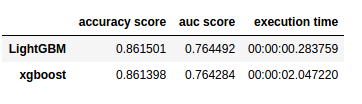
In a recent blog, Analytics Vidhya compares the inner workings as well as the predictive accuracy of the XGBOOST algorithm to an upcoming boosting algorithm: Light GBM. The blog demonstrates a stepwise implementation of both algorithms in Python. The table below reflects the main conclusion of the comparison: Although the algorithms are comparable in terms of their predictive performance, light GBM is much faster to train. With continuously increasing data volumes, light GBM, therefore, seems the way forward.

Laurae also benchmarked lightGBM against xgboost on a Bosch dataset and her results show that, on average, LightGBM (binning) is between 11x to 15x faster than xgboost (without binning):

View interactively online: https://plot.ly/~Laurae/9/

However, the differences get smaller as more threads are used due to thread inefficiencies (idle-time increases because threads are not scheduled a next task fast enough).

Light GBM is also available in R:

devtools::install_github("Microsoft/LightGBM", subdir = "R-package")

Neil Schneider tested the three algorithms for gradient boosting in R (GBM, xgboost, and lightGBM) and sums up their (dis)advantages:

  • GBM has no specific advantages but its disadvantages include no early stopping, slower training and decreased accuracy,
  • xgboost has demonstrated successful on kaggle and though traditionally slower than lightGBM, tree_method = 'hist' (histogram binning) provides a significant improvement.
  • lightGBM has the advantages of training efficiency, low memory usage, high accuracy, parallel learning, corporate support, and scale-ability. However, its’ newness is its main disadvantage because there is little community support.

Keras: Deep Learning in R or Python within 30 seconds

Keras is a high-level neural networks API that was developed to enabling fast experimentation with Deep Learning in both Python and R. According to its author Taylor Arnold: Being able to go from idea to result with the least possible delay is key to doing good research. The ideas behind deep learning are simple, so why should their implementation be painful?

Keras comes with the following key features:

  • Allows the same code to run on CPU or on GPU, seamlessly.
  • User-friendly API which makes it easy to quickly prototype deep learning models.
  • Built-in support for convolutional networks (for computer vision), recurrent networks (for sequence processing), and any combination of both.
  • Supports arbitrary network architectures: multi-input or multi-output models, layer sharing, model sharing, etc. This means that Keras is appropriate for building essentially any deep learning model, from a memory network to a neural Turing machine
  • Fast implementation of dense neural networks, convolution neural networks (CNN) and recurrent neural networks (RNN) in R or Python, on top of  TensorFlow or Theano.

R

R: Installation

The R interface to Keras uses TensorFlow™ as it’s underlying computation engine. First, you have to install the keras R package from GitHub:

devtools::install_github("rstudio/keras")

Using the install_tensorflow() function you can then install TensorFlow:

library(keras)
install_tensorflow()

This will provide you with a default installation of TensorFlow suitable for use with the keras R package. See the article on TensorFlow installation to learn about more advanced options, including installing a version of TensorFlow that takes advantage of Nvidia GPUs if you have the correct CUDA libraries installed.

R: Getting started in 30 seconds

Keras uses models to organize layers. Sequential models are the simplest structure, simply stacking layers. More complex architectures require the Keras functional API, which allows to build arbitrary graphs of layers.

Here is an example of a sequential model (hosted on this website):

library(keras)

model keras_model_sequential() 

model %>% 
  layer_dense(units = 64, input_shape = 100) %>% 
  layer_activation(activation = 'relu') %>% 
  layer_dense(units = 10) %>% 
  layer_activation(activation = 'softmax')

model %>% compile(
  loss = 'categorical_crossentropy',
  optimizer = optimizer_sgd(lr = 0.02),
  metrics = c('accuracy')
)

The above demonstrates the little effort needed to define your model. Now, you can iteratively train your model on batches of training data:

model %>% fit(x_train, y_train, epochs = 5, batch_size = 32)

Next, performance evaluation can be prompted in a single line of code:

loss_and_metrics %>% evaluate(x_test, y_test, batch_size = 128)

Similarly, generating predictions on new data is easily done:

classes %>% predict(x_test, batch_size = 128)

Building more complex models, for example, to answer questions or classify images, is just as fast.

Python

A step-by-step implementation of several Neural Network architectures with Keras in Python can be found on DataCamp. Similarly, one may use this quick cheatsheet to deploy the most basic models.

Additional resources:

Time Series Analysis 101

Time Series Analysis 101

A time series can be considered an ordered sequence of values of a variable at equally spaced time intervals. To model such data, one can use time series analysis (TSA). TSA accounts for the fact that data points taken over time may have an internal structure (such as autocorrelation, trend, or seasonal variation) that should be accounted for.

TSA has several purposes:

  1. Descriptive: Identify patterns in correlated data, such as trends and seasonal variations.
  2. Explanation: These patterns may help in obtaining an understanding of the underlying forces and structure that produced the data.
  3. Forecasting: In modelling the data, one may obtain accurate predictions of future (short-term) trends.
  4. Intervention analysis: One can examine how (single) events have influenced the time series.
  5. Quality control: Deviations on the time series may indicate problems in the process reflected by the data.

TSA has many applications, including:

  • Economic Forecasting
  • Sales Forecasting
  • Budgetary Analysis
  • Stock Market Analysis
  • Yield Projections
  • Process and Quality Control
  • Inventory Studies
  • Workload Projections
  • Utility Studies
  • Census Analysis
  • Strategic Workforce Planning

AlgoBeans has a nice tutorial on implementing a simple TS model in Python. They explain and demonstrate how to deconstruct a time series into daily, weekly, monthly, and yearly trends, how to create a forecasting model, and how to validate such a model.

Analytics Vidhya hosts a more comprehensive tutorial on TSA in R. They elaborate on the concepts of a random walk and stationarity, and compare autoregressive and moving average models. They also provide some insight into the metrics one can use to assess TS models. This web-tutorial runs through TSA in R as well, showing how to perform seasonal adjustments on the data. Although the datasets they use have limited practical value (for businesses), the stepwise introduction of the different models and their modelling steps may come in handy for beginners. Finally, business-science.io has three amazing posts on how to implement time series in R following the tidyverse principles using the tidyquant package (Part 1; Part 2; Part 3; Part 4).