Author: Paul van der Laken

Flow charts and process diagrams with Draw.io & VS Code

Flow charts and process diagrams with Draw.io & VS Code

A flowchart is a picture of the separate steps of a process in sequential order. It it super useful to organize and interpret business processes, IT systems, or computer algorithms.

Icon Process #369494 - Free Icons Library
Example of a very simple flowchart

I draw flowcharts and process diagrams all the time in my daily work as a data scientist!

Drawing out the business process is often a first step in any project, in order to really understand the underlying business workflow and problems. I feel doing so greatly facilitates opportunity finding.

Moreover, when designing a machine learning or data science architecture — with data coming from different sources, being manipulated using different workflows, and ending up in models feeding multiple business processes — drawing the whole she-bang out really helps me personally to keep overview.

There are licensed software programs such as Microsoft Visio that allow you to create flowcharts. But there are also numerous free applications that can help you draw up a flow chart.

It's easier than ever to create beautiful flowcharts from Data Visualizer -  Microsoft Tech Community
Via Microsoft Tech Community

Draw.io or app.diagrams.net is my favorite free online application.
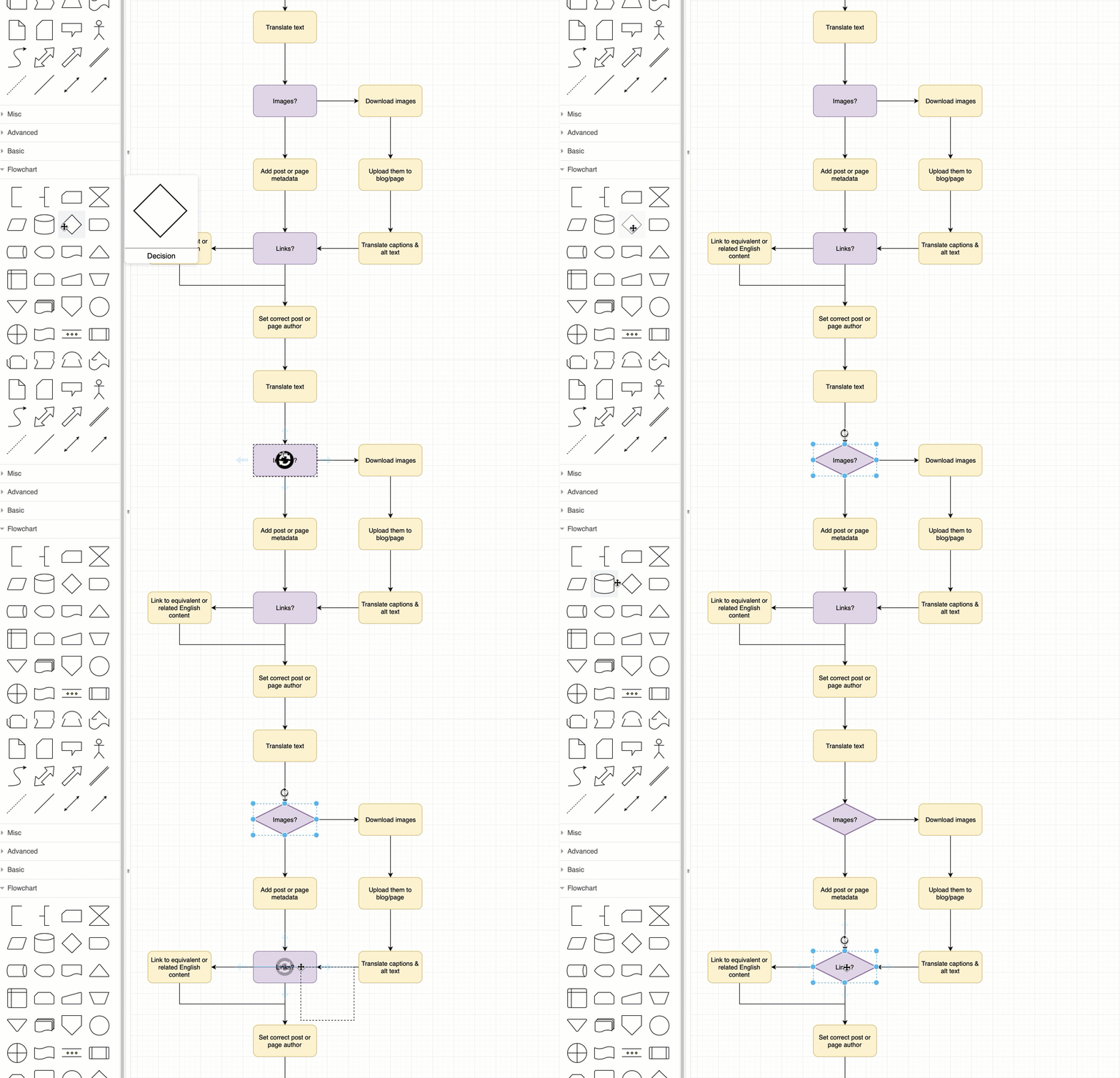
How to create flow charts in draw.io - draw.io
Via Draw.io

It allows the easy creation of beatiful flowcharts and process diagrams.

Here’s another great static example:

How to customise the draw.io interface in Confluence Cloud : draw.io  Helpdesk

Moreover, Draw.io easily integrates with other suites, like google drive, one drive, et cetera.

Now, some fellow geek out there — Henning Dieterichs — actually built an unofficial draw.io plugin for Visual Studio Code.

I’ve recently transitioned to VS Code for all my Python programming, so I really welcome this cool feature. It integrates all the flow chart functionality of draw.io right there in your IDE. Incredible!

Here’s a demo:

Via github

Here’s another demo, but with a light theme, showing how easy it is to export your diagrams to a shareable png file.

Via github

Moreover, due to VS Code’s amazing “LiveShare” feature, you can even collaborate with colleagues and build a flow chart together, simulatenously:

via Github

Now there are many more features to this plugin. You can write and change the JavaScript code behind the objects to tailor it completely to your theme and tastes. Or if you prefer working with XML, you can just alter that code. Everything seems to work as a charm.

Have a look at the plugin yourself: https://github.com/hediet/vscode-drawio


Note:
I am in no way affiliated with Draw.io, Microsoft, Visual Studio Code, or the author of this plugin.
I just get enthusiastic : )


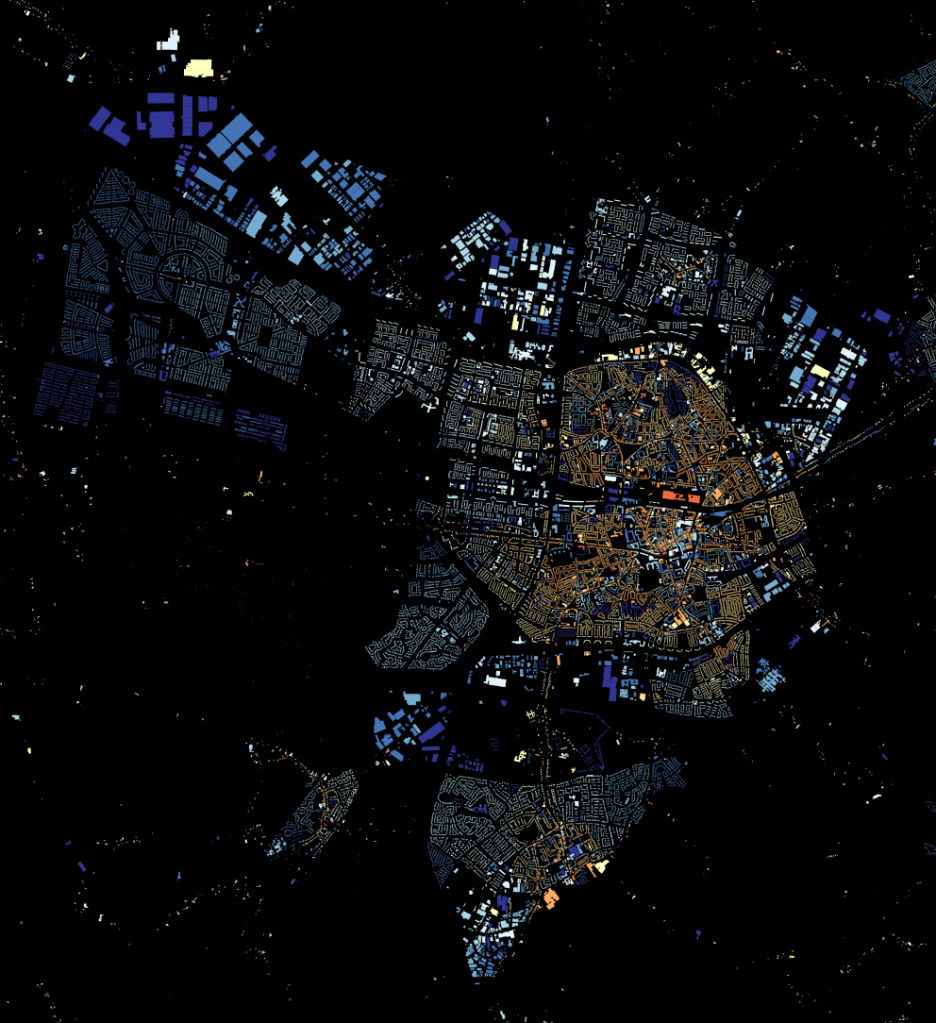
All buildings in the Netherlands, color coded by year of construction

All buildings in the Netherlands, color coded by year of construction

Could you guess that you are looking at Amsterdam?

Maybe you spotted the canals?

Bert Spaan colorcoded every building in the Netherlands according to their yaer of construction and visualized the resulting map of nearly 10 million buildings in a JavaScript leaflet webpage.

It resulted in this wonderful map, which my screenshots don’t do any honor. So have a look yourself!

https://github.com/waagsociety/buildings/tree/gh-pages/high-res

JavaScript for R — ebook

JavaScript for R — ebook

The R programming language has seen the integration of many languages; C, C++, Python, to name a few, can be seamlessly embedded into R so one can conveniently call code written in other languages from the R console. Little known to many, R works just as well with JavaScript—this book delves into the various ways both languages can work together.

https://book.javascript-for-r.com/

John Coene is an well-known R and JavaScript developer. He recently wrote a book on JavaScript for R users, of which he published an online version free to access here.

The book is definitely worth your while if you want to better learn how to develop front-end applications (in JavaScript) on top of your statistical R programs. Think of better understanding, and building, yourself Shiny modules or advanced data visualizations integrated right into webpages.

A nice step on your development path towards becoming a full stack developer by combining R and JavaScript!

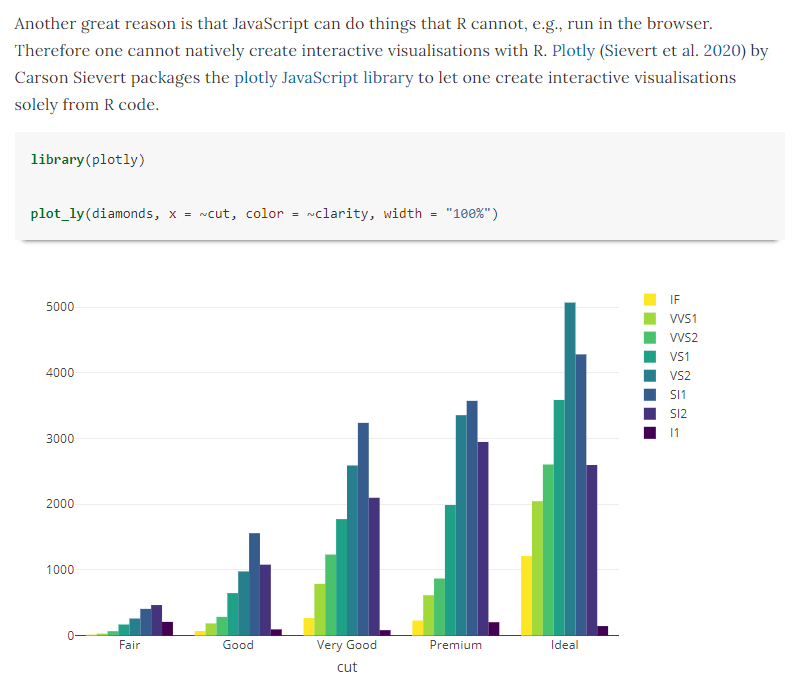
Yet most R developers are not familiar with one of web browsers’ core technology: JavaScript. This book aims to remedy that by revealing how much JavaScript can greatly enhance various stages of data science pipelines from the analysis to the communication of results.

https://book.javascript-for-r.com/

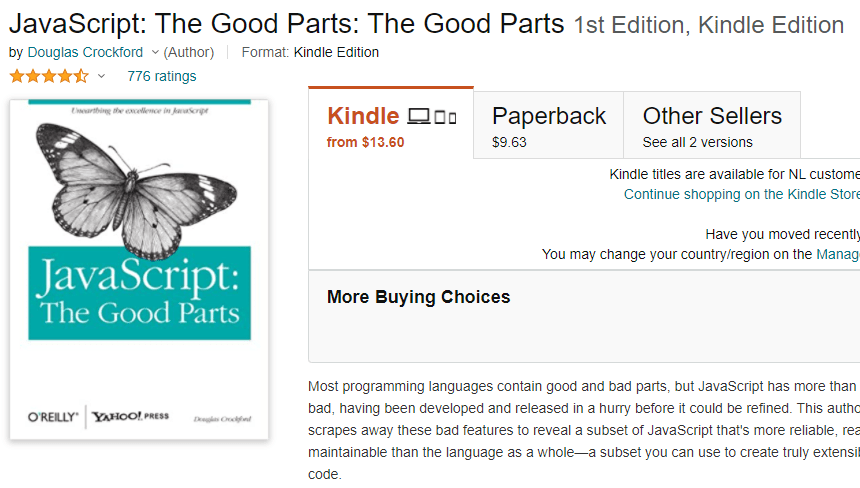
Want to learn more about JavaScript in general, then I recommend this book:

Book: What we know about people in the workplace?

Book: What we know about people in the workplace?

My former colleague at Tilburg University, dr. Brigitte Kroon, summarizes decades of scientific evidence in the field of human resource mangement in her new bookEvidence-based HRM.

She published it open access, so everyone can access it for free.

Brigitte explains what science can (and can not) tell us about the most effective ways to organize and treat people in the workplace. She was able to nicely distill the practical insights from the theoretical frameworks and perspectives.

Read the rest yourself!

Human Resource Management is about managing the labor side of organizations. As labor resides in people, managing labor involves managing people. Because people can think and act in response to management, effective management of people involves a good understanding of psychology, sociology, laws, and economics. Any person in a managerial position should therefore have some basic understanding of human resource management. However, since not every organization is the same, and because the challenges that organizations face are different, there is no ‘one best practice suits all’ recipe for doing HRM. Hence, organizations need people who know where to find the best HRM interventions for the issues that they face.

Brigitte Kroon, Evidence-based HRM
https://www.openpresstiu.org/catalog
Practical Tools for Human-Centered Design

Practical Tools for Human-Centered Design

Google’s guidebook to human-centered AI design refered to the Design Kit, containing numerous helpful tools to help you design products with user experience in mind.

The design kit website contains many practical methods, tools, case studies and much more resources to help you in the design process.

Screenshot of designkit.org/methods

Human-centered design is a practical, repeatable approach to arriving at innovative solutions. Think of these Methods as a step-by-step guide to unleashing your creativity, putting the people you serve at the center of your design process to come up with new answers to difficult problems.

The design kit methods section provides some seriously handy guidelines to help you design your products with the customer in mind. A step-by-step process guideline is offered, as well as neat worksheets to records the information you collect in the process, and a video explanation of the method.

Example method screenshot from designkit.org/methods/frame-your-design-challenge
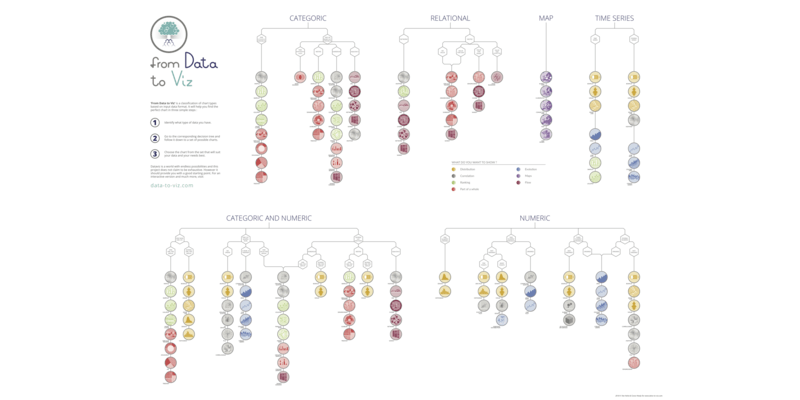
Select the right data visualization or chart type

Select the right data visualization or chart type

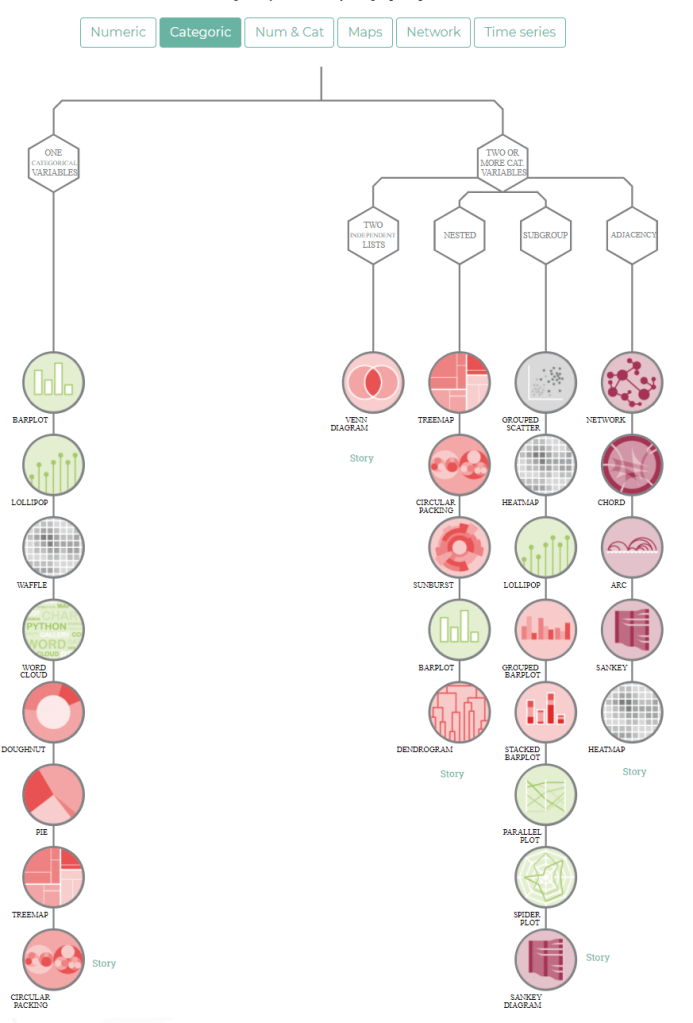
I found this amazing website data-to-viz.com that helps you select the right data visualization or chart type for your data.

Got numeric data? Two variables? No inherent order? Just a few data points? Pick a boxplot, histogram, or scatterplot!

Categorical data? There’s a seperate decision tree for those!

There’s a whole world of possible chart types you can choose from. The website explains you how they work and when to use which type.

The website also warns you for some common mistakes in data visualization.

The cover image is a poster you can buy to support the authors of data-viz.com!