Author: Paul van der Laken

Guidelines for Ethical AI

Guidelines for Ethical AI

As AI systems become more prevalent in society, we face bigger and tougher societal challenges. Given many of these challenges have not been faced before, practitioners will face scenarios that will require dealing with hard ethical and societal questions.

There has been a large amount of content published which attempts to address these issues through “Principles”, “Ethics Frameworks”, “Checklists” and beyond. However navigating the broad number of resources is not easy.

This repository aims to simplify this by mapping the ecosystem of guidelines, principles, codes of ethics, standards and regulation being put in place around artificial intelligence.

github.com/EthicalML/awesome-artificial-intelligence-guidelines/
🔍 High Level Frameworks & Principles🔏 Processes & Checklists🔨 Interactive & Practical Tools
📜 Industry standards initiatives📚 Online Courses🤖 Research and Industry Newsletters
⚔ Regulation and Policy
Links to Awesome Artificial Intelligence Guidelines

This overview of ethical guidelines for Artificial Intelligence is by the same author of the repository of Machine Learning production resources shared earlier this year.

Bayesian Statistics using R, Python, and Stan

Bayesian Statistics using R, Python, and Stan

For a year now, this course on Bayesian statistics has been on my to-do list. So without further ado, I decided to share it with you already.

Richard McElreath is an evolutionary ecologist who is famous in the stats community for his work on Bayesian statistics.

At the Max Planck Institute for Evolutionary Anthropology, Richard teaches Bayesian statistics, and he was kind enough to put his whole course on Statistical Rethinking: Bayesian statistics using R & Stan open access online.

You can find the video lectures here on Youtube, and the slides are linked to here:

Richard also wrote a book that accompanies this course:

For more information abou the book, click here.

For the Python version of the code examples, click here.

Google’s Responsible AI Practices

Google’s Responsible AI Practices

As a company that uses a lot of automation, optimization, and machine learning in their day-to-day business, Google is set on developing AI in a socially responsible way.

Fortunately for us, Google decided to share their principles and best practices for us to read.

Google’s Objectives for AI applications

The details behind the seven objectives below you can find here.

  1. Be socially beneficial.
  2. Avoid creating or reinforcing unfair bias.
  3. Be built and tested for safety.
  4. Be accountable to people.
  5. Incorporate privacy design principles.
  6. Uphold high standards of scientific excellence.
  7. Be made available for uses that accord with these principles.

Moreover, there are several AI technologies that Google will not build:

Google’s best practices for Responsible AI

For the details behind these six best practices, read more here.

  1. Use a Human-centered approach (see also here)
  2. Identify multiple metrics to assess training and monitoring
  3. When possible, directly examine your raw data
  4. Understand the limitations of your dataset and model
  5. Test, Test, Test,
  6. Continue to monitor and update the system after deployment
Big Book of R

Big Book of R

Oscar Baruffa collected over 100 books on the R programming language, in his Big Book of R.

Many of these books you will also find in my R resources list.

Yet, Oscar sectioned them in neat categories, such as:

Oscar could still use some help maintaining this resource, so have a look at its github to contribute.

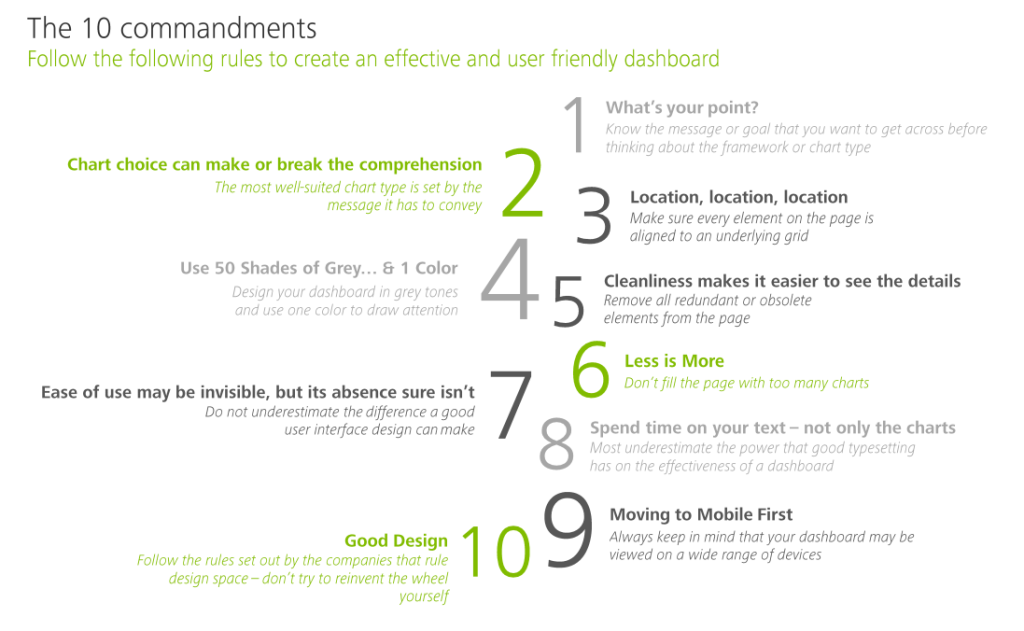
10 Tips for Effective Dashboard Design by Deloitte

10 Tips for Effective Dashboard Design by Deloitte

My colleague prof. Jack van Wijk pointed me towards these great guidelines by Deloitte on how to design an effective dashboard.

Some of these rules are more generally applicable to data visualization. Yet, the Deloitte 10 commandments form a good checklist when designing a dashboard.

Here’s my interpretation of the 10 rules:

  1. Know your message or goal
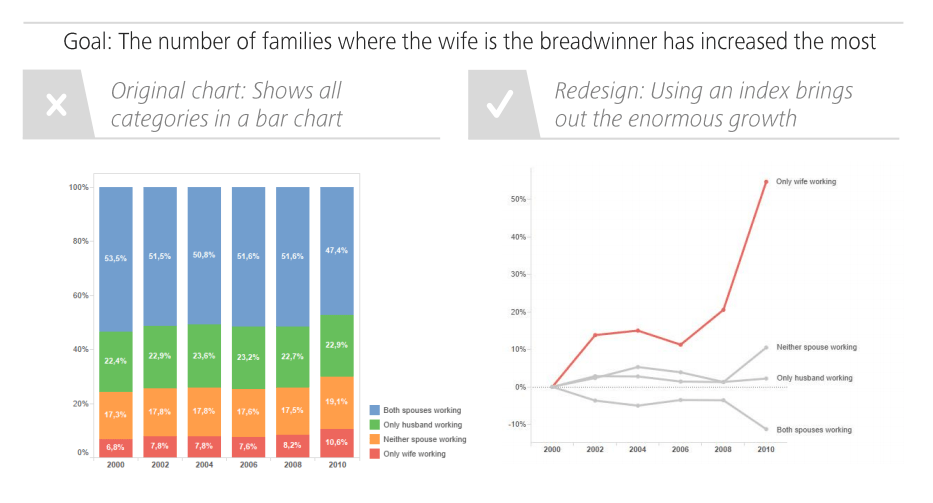
  2. Choose the chart that conveys your message best
  3. Use a grid to bring order to your dashboard
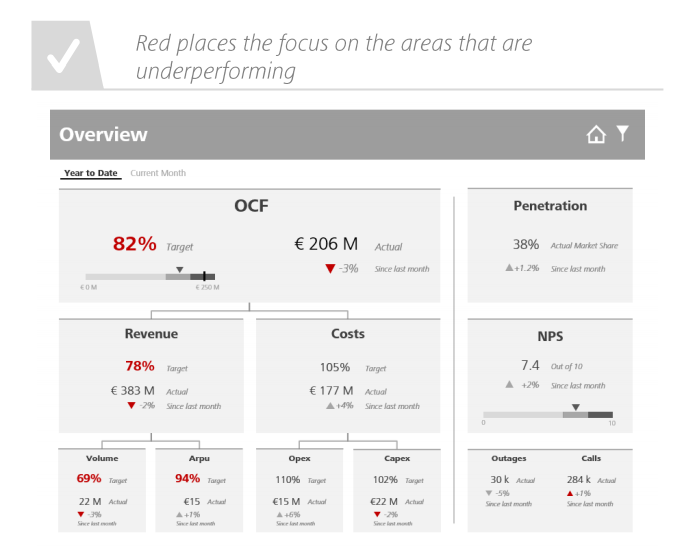
  4. Use color only to highlight and draw attention
  5. Remove unneccessary elements
  6. Avoid information overload
  7. Design for ease of use
  8. Text is as important as charts
  9. Design for multiple devices (desktop, tablet, mobile, …)
  10. Recycle good designs (by others)

In terms of recycling the good work by others operating in the data visualization field, check out:

I just love how Deloitte uses example visualizations to help convey what makes a good (dashboard) chart:

Screenshot from the Deloitte slidedeck