Tag: python

Python for R users

Python for R users

Wanting to broaden your scope and learn a new programming language? This great workshop was given at EARL 2018 by Mango Solutions and helps R programmers transition into Python building on their existing R knowledge. The workshop includes exercises that introduce you to the key concepts of Python and some of its most powerful packages for data science, including numpy, pandas, sklearn, and seaborn.

Have a look at the associated workshop guide that walk you through the assignments, or at the github repo with all materials in Jupyter notebooks.

E-Book: Probabilistic Programming & Bayesian Methods for Hackers

E-Book: Probabilistic Programming & Bayesian Methods for Hackers

The Bayesian method is the natural approach to inference, yet it is hidden from readers behind chapters of slow, mathematical analysis. Nevertheless, mathematical analysis is only one way to “think Bayes”. With cheap computing power, we can now afford to take an alternate route via probabilistic programming.

Cam Davidson-Pilon wrote the book Bayesian Methods for Hackers as a introduction to Bayesian inference from a computational and understanding-first, mathematics-second, point of view.

The book is available via Amazon, but you can access an online e-book for free. There’s also an associated GitHub repo.

The book explains Bayesian principles with code and visuals. For instance:

%matplotlib inline
from IPython.core.pylabtools import figsize
import numpy as np
from matplotlib import pyplot as plt
figsize(11, 9)

import scipy.stats as stats

dist = stats.beta
n_trials = [0, 1, 2, 3, 4, 5, 8, 15, 50, 500]
data = stats.bernoulli.rvs(0.5, size=n_trials[-1])
x = np.linspace(0, 1, 100)

for k, N in enumerate(n_trials):
    sx = plt.subplot(len(n_trials)/2, 2, k+1)
    plt.xlabel("$p$, probability of heads") \
        if k in [0, len(n_trials)-1] else None
    plt.setp(sx.get_yticklabels(), visible=False)
    heads = data[:N].sum()
    y = dist.pdf(x, 1 + heads, 1 + N - heads)
    plt.plot(x, y, label="observe %d tosses,\n %d heads" % (N, heads))
    plt.fill_between(x, 0, y, color="#348ABD", alpha=0.4)
    plt.vlines(0.5, 0, 4, color="k", linestyles="--", lw=1)

    leg = plt.legend()
    leg.get_frame().set_alpha(0.4)
    plt.autoscale(tight=True)


plt.suptitle("Bayesian updating of posterior probabilities",
             y=1.02,
             fontsize=14)

plt.tight_layout()

I can only recommend you start with the online version of Bayesian Methods for Hackers, but note that the print version helps sponsor the author ánd includes some additional features:

  • Additional Chapter on Bayesian A/B testing
  • Updated examples
  • Answers to the end of chapter questions
  • Additional explanation, and rewritten sections to aid the reader.

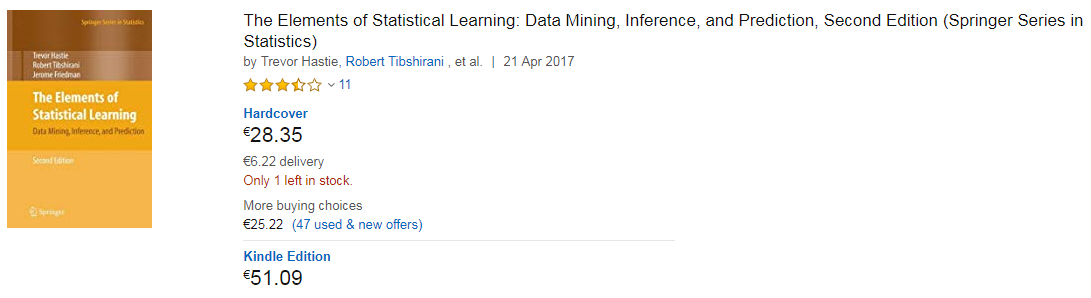
If you’re interested in learning more about Bayesian analysis, I recommend these other books:

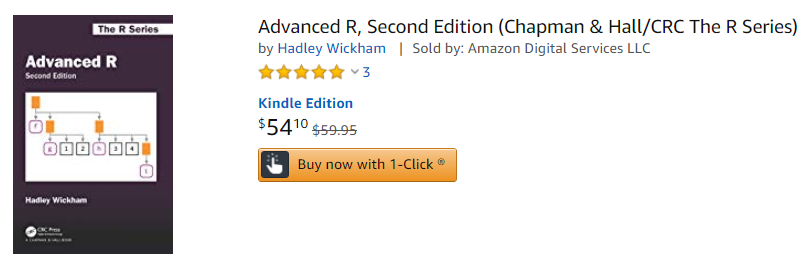
Putting R in Production, by Heather Nolis & Mark Sellors

Putting R in Production, by Heather Nolis & Mark Sellors

It is often said that R is hard to put into production. Fortunately, there are numerous talks demonstrating the contrary.

Here’s one by Heather Nolis, who productionizes R models at T-Mobile. Her teams even shares open-source version of some of their productionized Tensorflow models on github. Read more about that model here.

There’s another great talk on the RStudio website. In this talk, Mark Sellors discusses some of the misinformation around the idea of what “putting something into production” actually means, and provides some tips on overcoming obstacles.

Cover image via Fotolia.

Python vs. R for Data Science, by Norm Matloff

Python vs. R for Data Science, by Norm Matloff

Cover image via Hacker Noon.

Norm Matloff is a professor of Computer Science at University College Davis. He recently updated his viewpoint on whether R or Python is the best language for Data Science. While I normally hate those opinionated comparisons, Norm’s outline of the two languages’ (dis)advantages is actually quite balanced and well-versed.

I strongly recommend that you read Norm’s original piece here.

I can mostly agree with Norm, although the blog reads as if he has a (slight) bias in favor of R. In his original blog, Norm discusses many different programming topics and provides detailed information on why he considers certain topics big wins, slight edges, or ties between the two programming languages.

In the table below, I’ve tried to summarize Norm’s opinions by converting his words to 0-100 scores per topic for a quicker overview. I’ve converted Norm’s words to scores: his huge win became 100-0, a big win 80-20, a win 70-30, an edge 60-40, and a tie 50-50.

PythonR
Elegance100
Learning curve100
Data Science libraries4060
Machine Learning6040
Statistical correctness2080
Parallel computing5050
C/C++ interface4060
Object orientation,
metaprogramming
4060
Language unity100
Linked data structures7030
Online help2080

I personally started my career with R, so that’s definitely my favorite programming language. However, I think that Python is more convenient and faster on certain topics, and closer to more mainstream programming languages, which I why I’m currently learning it next to using R.

If you want to learn R, I can recommend you follow my quick 6-step guide to learning R programming. Alternatively, Norm points to his quick tutorial on R for non-programmers, and a tutorial on Python, for learners with a programming background.

Happy learning!

PS. This tweet by John summarizes the whole discussion quite well.

Free Python Tutorials & Courses, by CourseDuck

Free Python Tutorials & Courses, by CourseDuck

CourseDuck founder Michael Kuhlman was nice enough to point me to their overview of curated (&free!) Python courses and tutorials.

This overview is curated in the sense that all resources are rated by CourseDuck’s users. These ratings seem quite reliable, at least, I personally enjoyed their top-3 resources sometime the past years:

Note that all these courses, as well as the curated overview, come free of charge! A great resource for starting data scientists or upcoming pythonistas!

Free Programming Books (I still need to read)

Free Programming Books (I still need to read)

There are multiple unread e-mails in my inbox.

Links to books.

Just sitting there. Waiting to be opened, read. For months already.

The sender, you ask? Me. Paul van der Laken.

A nuisance that guy, I tell you. He keeps sending me reminders, of stuff to do, books to read. Books he’s sure a more productive me would enjoy.

Now, I could wipe my inbox. Be done with it. But I don’t wan’t to lose this digital to-do list… Perhaps I should put them here instead. So you can help me read them!

Each of the below links represents a formidable book on programming! (I hear)
And there are free versions! Have a quick peek. A peek won’t hurt you:

Disclaimer: This page contains one or more links to Amazon.
Any purchases made through those links provide us with a small commission that helps to host this blog.

The books listed above have a publicly accessible version linked. Some are legitimate. Other links are somewhat shady.
If you feel like you learned something from reading one of the books (which you surely will), please buy a hardcopy version. Or an e-book. At the very least, reach out to the author and share what you appreciated in his/her work.
It takes valuable time to write a book, and we should encourage and cherish those who take that time.

For more books on R programming, check out my R resources overview.

For books on data analytics and (behavioural) psychology in (HR) management, check out Books for the modern data-driven HR professional.