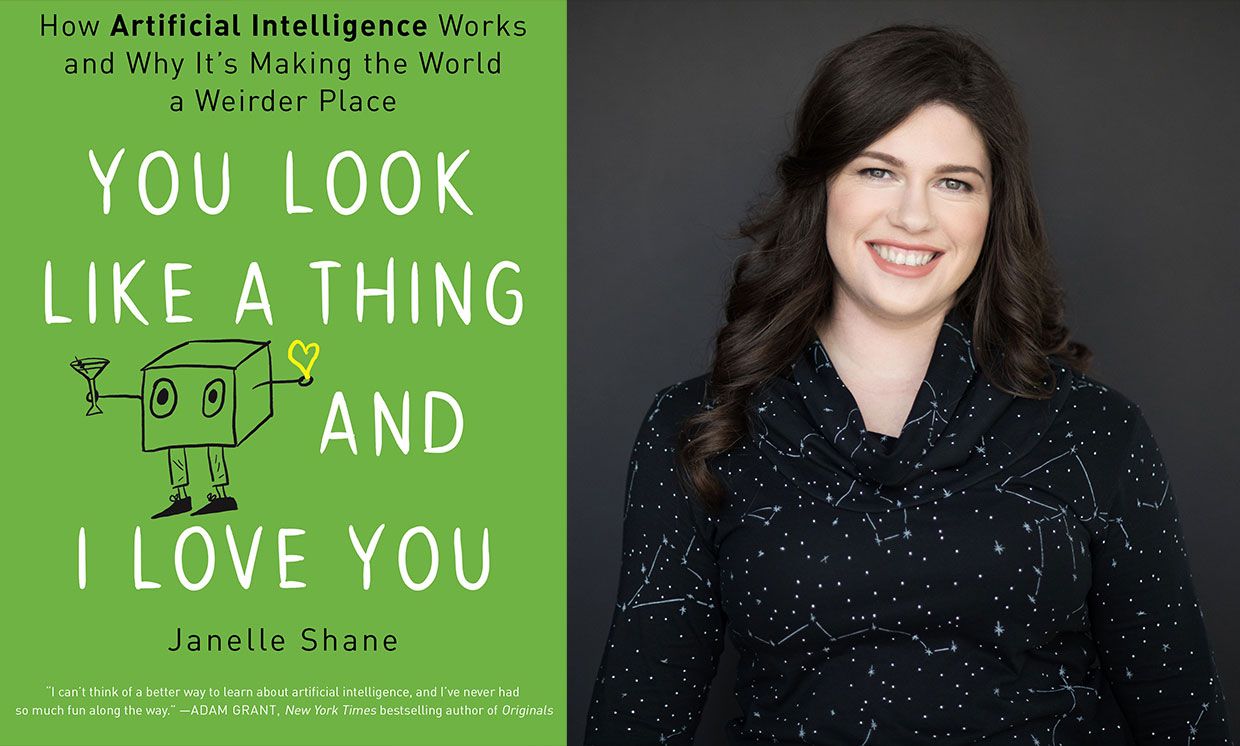
The following are my summary and take-aways from Janelle Shane’s 2019 book named You look like a thing and I love you. Most of the below are excerpts from Janelle’s book, combined, or rewritten by me. For the sake of copyright, just consider everything Janelle’s : )
AI weirdness
You look like a thing and I love you is about AI. More specifically, the book is about what AI can and can not do. And how and why AI often fails in miserably hilareous ways.
Janelle has spend her time foing fun experiments with AI. In this book, she shares those experiments along with many real life examples of AIs in practice. While explaining the technical details behind these AIs in an accesible though technically correct way, she informs the reader where, how, and why AIs fail.
Janelle took AIs out of their comfort zone and it produced some hilareously weird results. She proposes five principles of AI Weirdness:
The danger of AI is not that it’s too smart, but that it’s not smart enough
AI has the approximate brainpower of a worm
AI does not really understand the problem you want it to solve
But: AI will do exactly what you tell it to. Or at least it will try its best.
And AI willt ake the path of the least resistance
Definitions: What is (not) AI?
If it seems like AI is everywhere, it’s partly because Artificial Intelligence means lots of things, depending on whether you’re reading science fiction or selling a new app or doing academic research.
To spot an AI in the wild, it’s important to know the difference between machine learning algorithms (what Janelle calls AI in her book) and traditional, rules-based programs.
To solve a problem with a rules-based program, you have to know every step required to complete the program’s task and how to describe each one of those steps. But a machine learning algorithm figures out the rules for itself via trail and error, gauging its success on goals the programmer has specified. As the AI tries to reach this goal, it can discover rules and correlations that the programmer didn’t even know existed. This is what makes AIs attractive problem solvers and is particularly handy if the rules are really complicated or just plain mysterious.
Sometimes an AI’s brilliant problem-solving rules actually rely on mistaken assumptions. Rules that served it well in training but fail miserably when it encountered the real world. While training errors are common in complex AIs, the consequences of these mistakes can be serious.
It’s often not easy to tell when AIs make mistakes. Since we don’t write the rules, they come up with their own, and they don’t write them down or explain them the way a human would.
The difference between succesful AI problem solving and failure usually has a lot to do with the suitability of the task for an AI solution. And there are plenty of tasks for which AI solutions are more efficient than human solutions. But there are also plenty of cases where things go miserably wrong.
Janelle proposes four signs of “AI Doom”, contexts where machine learning will not produce the desired results:
The problem is too hard, broad, or complex
The problem is not what we thought it was
There are sneaky shortcuts to solving the problem
The AI tried to solve the problem learning from flawed data
Programming an AI is almost more like teaching a child than programming a computer.
Explaining how AI works
In her book, Janelle takes us through many example problems which she or others tried to solve using AIs. These example problems are increasingly hilareous, but I assure you that they are technically and didactically sound:
Playing tic-tac-toe
Managing a cockroach farm
Riding a bicycle
Rating sandwich deliciousness
Tossing a sandwich into a wall
Guiding people through a hallway
Answering questions regarding photo’s
Categorizing doodles
Categorizing fish
Tossing pancakes
Autonomous walking
Autonomous driving
Playing Pacman
The amazing thing is these ridiculous example problems actually serve a purpose. They are used to explain different algorithms and their applications, strengths, and limitations! Janelle covers a wide variety of algorithms in such a way that anyone new to machine learning would understand, while people with some experience will still be amused.
Janelle talks about artificial neural networks, random forests, and markov chains. Moreover, she explains how activation functions, recurrancy and long short-term memory, evolutionary algorithms and gradient descent work. And all in understandable though technically correct language.
Janelle herself seems particularly fond of generative algorithms. She’s elaborates on having deployed recurrent neural nets, generative adversial networks, and markov chains for a wide variety of generative tasks. In the book, Jabekke explains what went well and went wrong when coming up with new and original…
Janelle’s book is lingered with examples of failing AI. As a matter of fact, the whole book seems like an ode to how machine learning can and will inevitably fail. Particularly in the latter chapters, Janelle covers many limitations of and issues with AI in much detail:
I have yet to come across a book that explain AI in this much detail and in a manner as accessible and entertaining as Janelle Shane does in You look like a thing and I love you. Janelle makes machine learning and AI understandable for a wide public without passing on the deeper technical details. Taking a critical stance, she provides a good overview of the strenghts and weaknesses of AI, and a realistic outlook for the future to come. This book is not looking for sensation or hype, although reading it will be a most amusing experience for the more technical as well as the lay reader.
I highly recommend you reward yourself with a copy!
Robert Bosch is a professor of Natural Science at the department of Mathematics of Oberlin College and has found a creative way to elevate the travelling salesman problem to an art form.
For those who aren’t familiar with the travelling salesman problem (wiki), it is a classic algorithmic problem in the field of computer science and operations research. Basically, we want are looking for a mathematical solution that is cheapest, shortest, or fastest for a given problem. Most commonly, it is seen as a graph (network) describing the locations of a set of nodes (elements in that network). Wikipedia has a description I can’t improve on:
The Travelling Salesman Problem describes a salesman who must travel between N cities. The order in which he does so is something he does not care about, as long as he visits each once during his trip, and finishes where he was at first. Each city is connected to other close by cities, or nodes, by airplanes, or by road or railway. Each of those links between the cities has one or more weights (or the cost) attached. The cost describes how “difficult” it is to traverse this edge on the graph, and may be given, for example, by the cost of an airplane ticket or train ticket, or perhaps by the length of the edge, or time required to complete the traversal. The salesman wants to keep both the travel costs, as well as the distance he travels as low as possible.
Here’s a visual representation of the problem and some algorithmic approaches to solving it:
Now, Robert Bosch has applied the traveling salesman problem to well-know art pieces, trying to redraw them by connecting a series of points with one continuous line. Robert even turned it into a challenge so people can test out how well their travelling salesman algorithms perform on, for instance, the Mona Lisa, or Vincent van Gogh.
Just look at the detail on these awesome Dutch classics:
P.S. Why do Brits and Americans have this spelling feud?! As a non-native, I never know what to pick. Should I write modelling or modeling, travelling or traveling, tomato or tomato? I got taught the U.K. style, but the U.S. style pops up whenever I google stuff, so I am constantly confused! Now I subconciously intertwine both styles in a single text…
Case.law seems like a very interesting data source for a machine learning or text mining project:
The Caselaw Access Project (“CAP”) expands public access to U.S. law. Our goal is to make all published U.S. court decisions freely available to the public online, in a consistent format, digitized from the collection of the Harvard Law Library.
The capstone of the Caselaw Access Project is a robust set of tools which facilitate access to the cases and their associated metadata. We currently offer five ways to access the data: API, bulk downloads, search, browse, and a historical trends viewer.
Our open-source API is the best option for anybody interested in programmatically accessing our metadata, full-text search, or individual cases.
If you need a large collection of cases, you will probably be best served by our bulk data downloads. Bulk downloads for Illinois and Arkansas are available without a login, and unlimited bulk files are available to research scholars.
Case metadata, such as the case name, citation, court, date, etc., is freely and openly accessible without limitation. Full case text can be freely viewed or downloaded but you must register for an account to do so, and currently you may view or download no more than 500 cases per day. In addition, research scholars can qualify for bulk data access by agreeing to certain use and redistribution restrictions. You can request a bulk access agreement by creating an account and then visiting your account page.
Access limitations on full text and bulk data are a component of Harvard’s collaboration agreement with Ravel Law, Inc. (now part of Lexis-Nexis). These limitations will end, at the latest, in March of 2024. In addition, these limitations apply only to cases from jurisdictions that continue to publish their official case law in print form. Once a jurisdiction transitions from print-first publishing to digital-first publishing, these limitations cease. Thus far, Illinois and Arkansas have made this important and positive shift and, as a result, all historical cases from these jurisdictions are freely available to the public without restriction. We hope many other jurisdictions will follow their example soon.
A different project altogether is helping the team behind Caselaw improve its data quality:
Our data inevitably includes countless errors as part of the digitization process. The public launch of this project is only the start of discovering errors, and we hope you will help us in finding and fixing them.
Some parts of our data are higher quality than others. Case metadata, such as the party names, docket number, citation, and date, has received human review. Case text and general head matter has been generated by machine OCR and has not received human review.
You can report errors of all kinds at our Github issue tracker, where you can also see currently known issues. We particularly welcome metadata corrections, feature requests, and suggestions for large-scale algorithmic changes. We are not currently able to process individual OCR corrections, but welcome general suggestions on the OCR correction process.
A friend of mine pointed me to this great website where you can interactively practice and learn new programming skills by working through small coding challenges, like making a game.
CodinGame.com is an gamified learning community and website that allows you to learn new concepts by solving fun challenges. Pick from over 25 programming languages, including Python, C, C++, C#, Java, JavaScript, Go, and many more. In a matter of hours, you will work on hot programming topics, discover new languages, algorithms, and tricks in courses crafted by top developers.
Christopher of Neurotroph.de compiled this short list of data science podcastsworth listening to. See Chris’ original article for more details on the podcasts, but the links below take you to them directly:













 paulvanderlaken.com