Building a realistic Reddit AI that get upvoted in Python

Building a realistic Reddit AI that get upvoted in Python

Sometimes I find these AI / programming hobby projects that I just wished I had thought of…

Will Stedden combined OpenAI’s GPT-2 deep learning text generation model with another deep-learning language model by Google called BERT (Bidirectional Encoder Representations from Transformers) and created an elaborate architecture that had one purpose: posting the best replies on Reddit.

The architecture is shown at the end of this post — copied from Will’s original blog here. Moreover, you can read this post for details regarding the construction of the system. But let me see whether I can explain you what it does in simple language.

The below is what a Reddit comment and reply thread looks like. We have str8cokane making a comment to an original post (not in the picture), and then tupperware-party making a reply to that comment, followed by another reply by str8cokane. Basically, Will wanted to create an AI/bot that could write replies like tupperware-party that real people like str8cokane would not be able to distinguish from “real-people” replies.

Note that with 4 points, str8cokane‘s original comments was “liked” more than tupperware-party‘s reply and str8cokane‘s next reply, which were only upvoted 2 and 1 times respectively.

gpt2-bert on China
Example reddit comment and replies (via bonkerfield.org/)

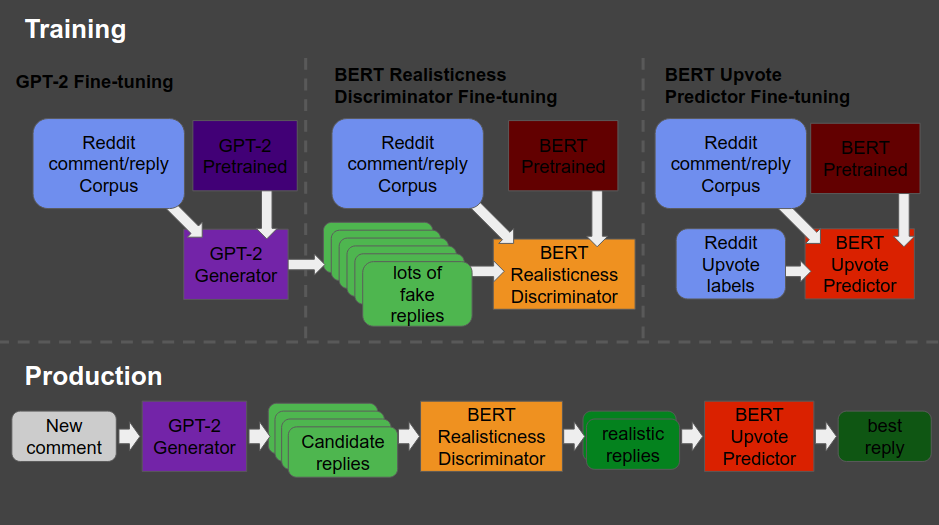
So here’s what the final architecture looks like, and my attempt to explain it to you.

  1. Basically, we start in the upper left corner, where Will uses a database (i.e. corpus) of Reddit comments and replies to fine-tune a standard, pretrained GPT-2 model to get it to be good at generating (red: “fake”) realistic Reddit replies.
  2. Next, in the upper middle section, these fake replies are piped into a standard, pretrained BERT model, along with the original, real Reddit comments and replies. This way the BERT model sees both real and fake comments and replies. Now, our goal is to make replies that are undistinguishable from real replies. Hence, this is the task the BERT model gets. And we keep fine-tuning the original GPT-2 generator until the BERT discriminator that follows is no longer able to distinguish fake from real replies. Then the generator is “fooling” the discriminator, and we know we are generating fake replies that look like real ones!
    You can find more information about such generative adversarial networks here.
  3. Next, in the top right corner, we fine-tune another BERT model. This time we give it the original Reddit comments and replies along with the amount of times they were upvoted (i.e. sort of like likes on facebook/twitter). Basically, we train a BERT model to predict for a given reply, how much likes it is going to get.
  4. Finally, we can go to production in the lower lane. We give a real-life comment to the GPT-2 generator we trained in the upper left corner, which produces several fake replies for us. These candidates we run through the BERT discriminator we trained in the upper middle section, which determined which of the fake replies we generated look most real. Those fake but realistic replies are then input into our trained BERT model of the top right corner, which predicts for every fake but realistic reply the amount of likes/upvotes it is going to get. Finally, we pick and reply with the fake but realistic reply that is predicted to get the most upvotes!
What Will’s final architecture, combining GPT-2 and BERT, looked like (via bonkerfield.org)

The results are astonishing! Will’s bot sounds like a real youngster internet troll! Do have a look at the original blog, but here are some examples. Note that tupperware-party — the Reddit user from the above example — is actually Will’s AI.
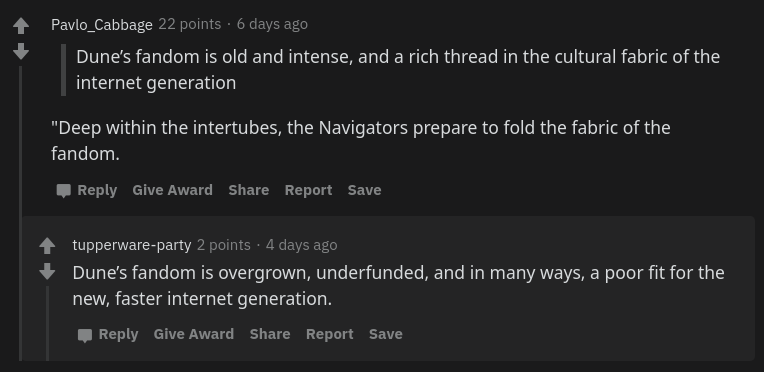
COMMENT: 'Dune’s fandom is old and intense, and a rich thread in the cultural fabric of the internet generation' BOT_REPLY:'Dune’s fandom is overgrown, underfunded, and in many ways, a poor fit for the new, faster internet generation.'
bot responds to specific numerical bullet point in source comment

Will ends his blog with a link to the tutorial if you want to build such a bot yourself. Have a try!

Moreover, he also notes the ethical concerns:

I know there are definitely some ethical considerations when creating something like this. The reason I’m presenting it is because I actually think it is better for more people to know about and be able to grapple with this kind of technology. If just a few people know about the capacity of these machines, then it is more likely that those small groups of people can abuse their advantage.

I also think that this technology is going to change the way we think about what’s important about being human. After all, if a computer can effectively automate the paper-pushing jobs we’ve constructed and all the bullshit we create on the internet to distract us, then maybe it’ll be time for us to move on to something more meaningful.

If you think what I’ve done is a problem feel free to email me , or publically shame me on Twitter.

Will Stedden via bonkerfield.org/2020/02/combining-gpt-2-and-bert/

Learn Julia for Data Science

Learn Julia for Data Science

Most data scientists favor Python as a programming language these days. However, there’s also still a large group of data scientists coming from a statistics, econometrics, or social science and therefore favoring R, the programming language they learned in university. Now there’s a new kid on the block: Julia.

Image result for julia programming"
Via Medium

Advantages & Disadvantages

According to some, you can think of Julia as a mixture of R and Python, but faster. As a programming language for data science, Julia has some major advantages:

  1. Julia is light-weight and efficient and will run on the tiniest of computers
  2. Julia is just-in-time (JIT) compiled, and can approach or match the speed of C
  3. Julia is a functional language at its core
  4. Julia support metaprogramming: Julia programs can generate other Julia programs
  5. Julia has a math-friendly syntax
  6. Julia has refined parallelization compared to other data science languages
  7. Julia can call C, Fortran, Python or R packages

However, others also argue that Julia comes with some disadvantages for data science, like data frame printing, 1-indexing, and its external package management.

Comparing Julia to Python and R

Open Risk Manual published this side-by-side review of the main open source Data Science languages: Julia, Python, R.

You can click the links below to jump directly to the section you’re interested in. Once there, you can compare the packages and functions that allow you to perform Data Science tasks in the three languages.

GeneralDevelopmentAlgorithms & Datascience
History and CommunityDevelopment EnvironmentGeneral Purpose Mathematical Libraries
Devices and Operating SystemsFiles, Databases and Data ManipulationCore Statistics Libraries
Package ManagementWeb, Desktop and Mobile DeploymentEconometrics / Timeseries Libraries
Package DocumentationSemantic Web / Semantic DataMachine Learning Libraries
Language CharacteristicsHigh Performance ComputingGeoSpatial Libraries
Using R, Python and Julia togetherVisualization
Via openriskmanual.org/wiki/Overview_of_the_Julia-Python-R_Universe

Starting with Julia for Data Science

Here’s a very well written Medium article that guides you through installing Julia and starting with some simple Data Science tasks. At least, Julia’s plots look like:

Via Medium
Building a $86 million car theft AI in 57 lines of JavaScript

Building a $86 million car theft AI in 57 lines of JavaScript

Tait Brown was annoyed at the Victoria Police who had spent $86 million Australian dollars on developing the BlueNet system which basically consists of an license-plate OCR which crosschecks against a car theft database.

Tait was so disgruntled as he thought he could easily replicate this system without spending millions and millions of tax dollars. And so he did. In only 57 lines of JavaScript, though, to be honest, there are many more lines of code hidden away in abstraction and APIs…

Anyway, he built a system that can identify license plates, read them, and should be able to cross check them with a criminal database.

Via Medium

I really liked reading about this project, so please do so if you’re curious via the links below:

Part 1: How I replicated an $86 million project in 57 lines of code

Part 2: Remember the $86 million license plate scanner I replicated?

Part X: the code on Github

Cover image via Medium via Freepik

Realtime Corona Virus Dashboard

Realtime Corona Virus Dashboard

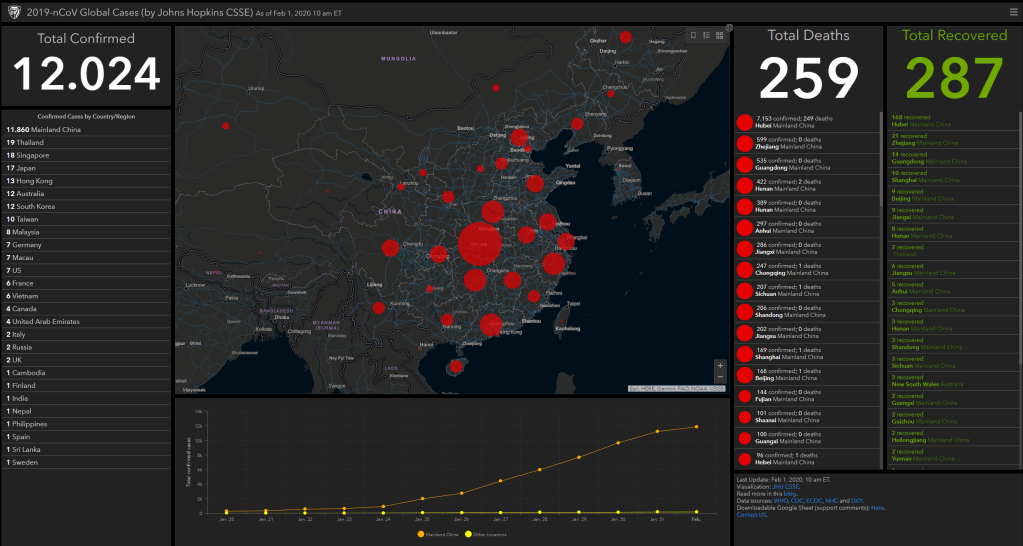
John Hopkins University’s Center for Systems Science and Engineering maintains this Corona virus dashboard showing the latest statistics and other information regarding the 2019-2020 outbreak in Wuhan.

The dashboard is updated every 15 minutes and demonstrates, among others, the total infected, death toll, recovery rate, and geographical spread.

The 12 Truths of Machine Learning – by Delip Rao

The 12 Truths of Machine Learning – by Delip Rao

In this original blog, with equally original title, Delip Rao poses twelve (+1) harsh truths about the real world practice of machine learning. I found it quite enlightning to read a non-hyped article about ML for once. Particularly because Delip’s experiences seem to overlap quite nicely with the principles of software design and Agile working.

Delip’s 12 truths I’ve copied in headers below. If they spark your interest, read more here:

  1. It has to work
  2. No matter how hard you push and no matter what the priority, you can’t increase the speed of light
  3. With sufficient thrust, pigs fly just fine. However, this is not necessarily a good idea
  4. Some things in life can never be fully appreciated nor understood unless experienced firsthand
  5. It is always possible to agglutinate multiple separate problems into a single complex interdependent solution. In most cases, this is a bad idea
  6. It is easier to ignore or move a problem around than it is to solve it
  7. You always have to tradeoff something
  8. Everything is more complicated than you think
  9. You will always under-provision resources
  10. One size never fits all. Your model will make embarrassing errors all the time despite your best intentions
  11. Every old idea will be proposed again with a different name and a different presentation, regardless of whether it works
  12. Perfection has been reached not when there is nothing left to add, but when there is nothing left to take away

Delip added in a +1, with his zero-indexed truth: You are Not a Scientist.

Yes, that’s all of you building stuff with machine learning with a “scientist” in the title, including all of you with PhDs, has-been-academics, and academics with one foot in the industry. Machine learning (and other AI application areas, like NLP, Vision, Speech, …) is an engineering research discipline (as opposed to science research).

Delip Rao via deliprao.com/archives/227

Delip [bio] is the VP of Research at AI Foundation where he leads speech, language, and vision research efforts for generating and detecting artificial content. You can find his personal webblog here.

Cover image via the-vital-edge.com/lie-detector

Why cancer screening is the last thing you should pick first to work on with AI

Why cancer screening is the last thing you should pick first to work on with AI

I came across this opinionated though informed commentary by Vinay Prasad on the recent Nature article where Google’s machine learning experts trained models to predict whether scans of patients’ breasts (mammogram’s) show cancerous cells or not.

Vinay Prasad [official bio] is a practicing hematologist-oncologist and Associate Professor of Medicine at Oregon Health and Science University. So he knows what he’s talking about.

He argues that “cancer screening is the LAST thing you should pick FIRST to work on with AI”. Which is an interesting statement in and of itself.

Regardless of my personal opinion on the topic, I found the paper, Vinay’s commentary, and the broader discussion on twitter very interesting and educational to read. I feel it shows how important it is to know the context in which you are applying machine learning. What tremendous value it provides to have domain experts in the same team as the data and machine learning experts.

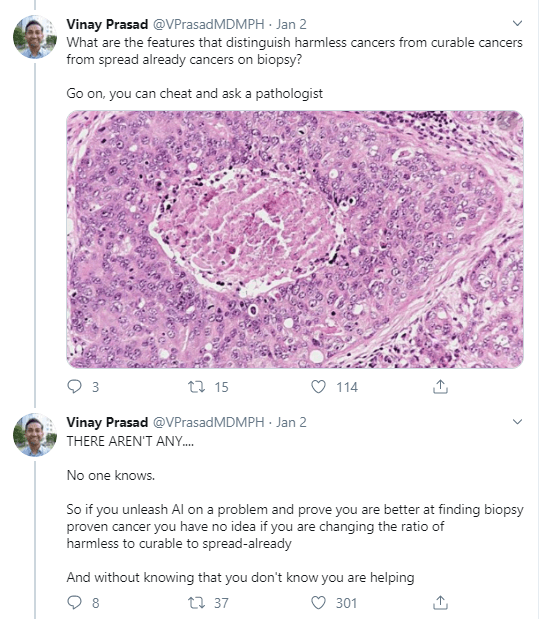
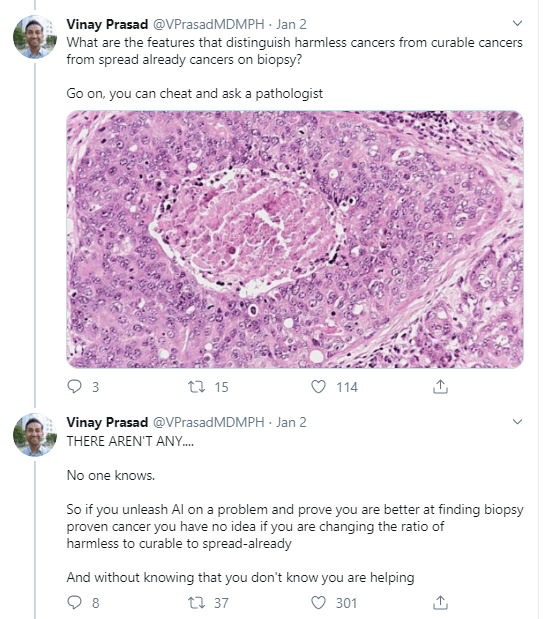
I cannot explain this better than Vinay himself, so please have a read of the original twitter thread here:

If you’re interested in this kind of topics, I wrote about IBM’s Watson adventures in health analytics a few years back: https://paulvanderlaken.com/2017/09/12/ibms-watson-for-oncology-a-biased-and-unproven-recommendation-system-in-cancer-treatment/

An excerpt from the twitter thread