Tag: deeplearning

Neural Networks play Super Mario Bros & Mario Kart

Neural Networks play Super Mario Bros & Mario Kart

Seth Bling calls himself a video game designer, a hacker and an engineer. You might know him from MarI/O: his neural network that got extremely good to at playing Super Mario Bros. The video below shows the genetic approach Seth used to train this neural network. Seth randomly generated a starting population of neural networks where the inputs – the current frame in the Mario video game – were randomly connected to the outputs – the eight buttons to press (jump, duck, up, down, right, left, etc). By giving the neural nets that made it furthest into the game a larger chance to pass on their genes (their input-output relations) to the next generation with slight mutations, Seth automatically generated neural networks that were more and more proficient in completing the game. In short, by evolution, Seth’s neural network learned the most effective response to the changing video game environment.

After MarI/O, Seth this week posted his newest creation: MariFlow. Here, Seth trained a neural network on 15 hours of training data, consisting of Seth himself playing Super Mario Kart. The neural network thus learned what buttons (output) Seth would most likely push when he encountered a certain Mario Kart parcours piece (input). However, due to random chance, the neural net would often get itself stuck in situations that Seth had not encountered in his training sessions (e.g., reversed, against a wall). The neural net would fail miserably in such situations because it had not learned how to behave. Accordingly, Seth had to generate new training data for these situations and he did so using Human-Computer Interactions in Machine Learning: Seth and the neural net would play alternatively for a while, thus generating training data for situations that Seth would not have encountered on its own. After the neural net was trained with these additional data, it became quite proficient in playing Mario Kart (like Seth) often even winning matches! If you want to know more, you can read the manual here or watch Seth’s video below. If you want to replicate or just play with the data, Seth made everything available here.

Seth has active YouTube, Twitch and Twitter channels and I recommend you check them out!

GAN: Generative Adversarial Networks

GAN: Generative Adversarial Networks

A Generative Adversarial Network, GAN in short, is a machine learning architecture where two neural networks compete against each other. One of them functions as a discriminator, seeking to optimize its classification of data (i.e., determine whether or not there is a cat in a picture). The other one functions as a generator, seeking to best generate new data to fool the discriminator (i.e., create realistic fake images of cats). Over time, the generator network will become increasingly good at simulating realistic data and being able to mimic real-life.

The concept of GAN was introduced by Ian Goodfellow in 2014, whom we know from the Machine Learning & Deep Learning book. Although GANs are computationally heavy and still undergoing major development, their potential implications are widespread. We can see these architectures taking over all sort of creative work, where generating new “data” is the main task. Think for instance of designing clothes, creating video footage, writing novels, animating movies, or even whole video games. One of my favorite Youtube channels discusses multiple of its recent applications, and here are a few of my favorites:

If you want to know more about GANs, Analytics Vidhya hosts a short introduction, but I personally prefer this one by Rob Miles via Computerphile:

If you want to try out these GANs yourself but do not have the programming experience: Reiichiro Nakano made a GAN playground in (what seems) JavaScript, where you can play around with the discriminator and the generator to create an adversarial network that identifies and generates images of numbers.

gan_playground.png

The Magic Sudoku App

The Magic Sudoku App

A few weeks ago, Magic Sudoku was released for iOS11. This app by a company named Hatchlings automatically solves sudoku puzzles using a combination of Computer Vision, Machine Learning, and Augmented Reality. The app works on iPad Pro’s and iPhone 6s or above and can be downloaded from the App Store.

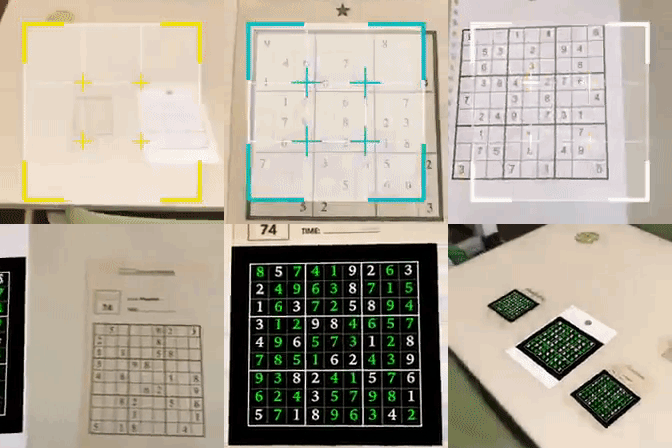
Magic Sudoku App in action.

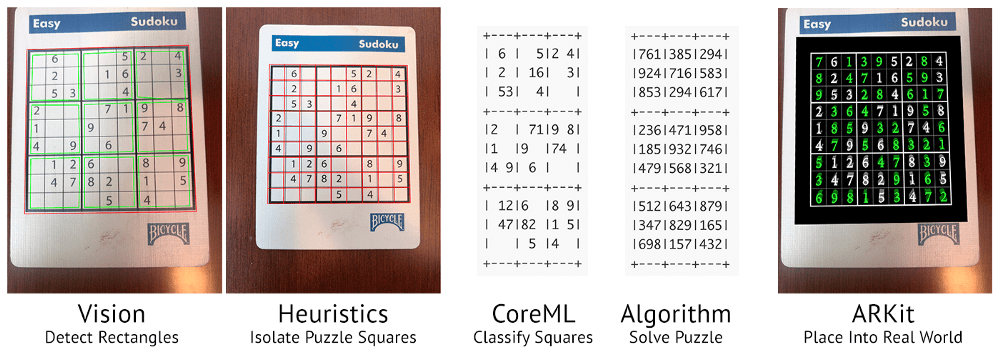
Magic Sudoku gives a magical experience when users point their phone at a Sudoku puzzle: the puzzle is instantaneously solved and displayed on their screen. In several seconds, the following occurs behind the scenes:

What happens in the ARKit app behind the scenes.

One of the original reasons I chose a Sudoku solver as our first AR app was that I knew classifying digits is basically the “hello world” of Machine Learning. I wanted to dip my toe in the water of Machine Learning while working on a real-world problem. This seemed like a realistic app to tackle.” – Brad Dwyer, Founder at Hatchlings

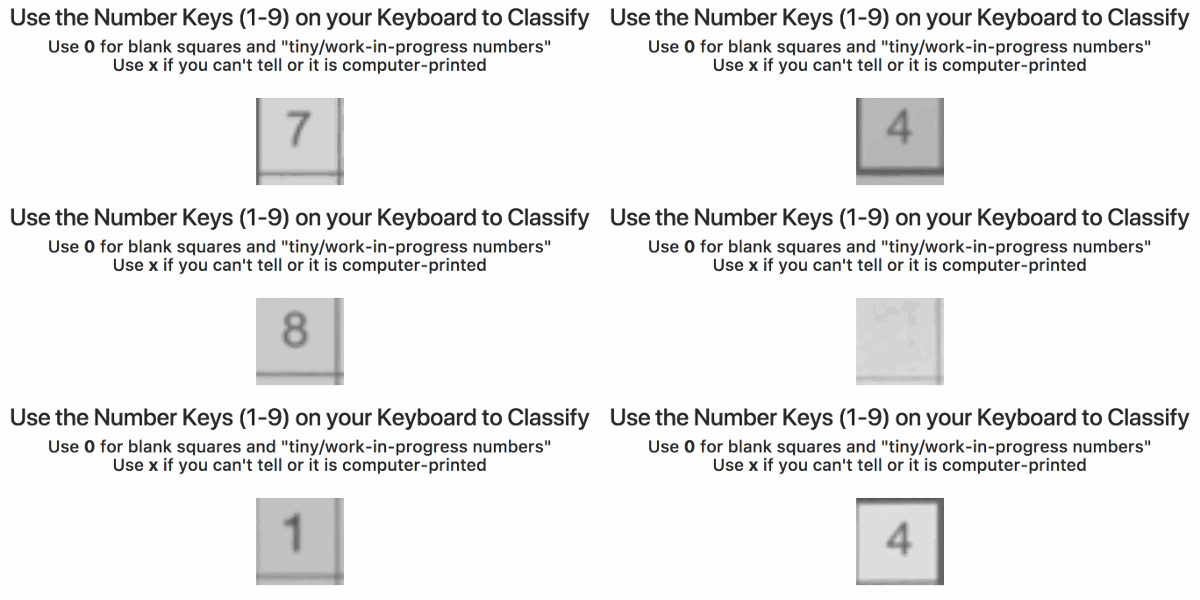
Particularly the training process of the app interested me. In his blog, Brad explains how they bought out the entire stock of Sudoku books of a specific bookstore and, with the help of his team, ripped each book apart to scan each small square with a number and upload in to a server. In the end, this server contained about 600,000 images, but all were completely unlabeled. Via a simple game, they asked Hatchlings users to classify these images by pressing the number keys on their keyboard. Within 24 hours, all 600,000 images were classified!

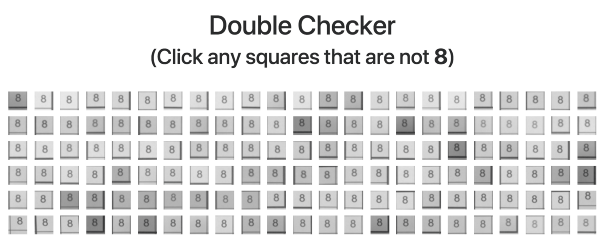
Nevertheless, some users had misunderstood the task (or just plainly ignored it) and as a consequence there were still a significant number of misidentified images. So Brad created a second tool that displayed 100 images of a single class to users, who where consequently asked to click the ones that didn’t match. These were subsequently thrown back into the first tool to be reclassified.

Quickly, the developers had enough verified data to add an automatic accuracy checker into both tools for future data runs. Funnily enough, they programmed it in such a way that users were periodically shown already known/classified images in order to check the validity of their inputs and determine how much to trust their answers going forward. This whole process reminds me on a blog I wrote recently, regarding human-computer interactions in reinforcement learning.

For several more weeks, users classified more scanned data so that, by the time the app was launched, it had been trained on over a million images of Sudoku squares. The results were amazing as the application had a 98.6% accuracy on launch (currently above 99% accuracy). One minor deficit was that the app was trained on paper Sudoku’s. However, when it aired, many users wanted to quickly test it and searched for Sudoku images on Google, which the app wouldn’t process that well.

“Problem number one was that our machine learning model was only trained on paper puzzles; it didn’t know what to think about pixels on a screen. I pulled an all nighter that first week and re-trained our model with puzzles on computer screens.

Problem number two was that ARKit only supports horizontal planes like tables and floors (not vertical planes like computer monitors). Solving this was a trickier problem but I did come up with a hacky workaround. I used a combination of some heuristics and FeaturePoint detection to place puzzles on non-horizontal planes.” – Brad Dwyer, Founder at Hatchlings

Brad and his colleagues at Hatchlings still need to work out the business model behind the ARKit Magic Sudoku app, but that’s in the meantime, download the app and let me and them know what you think: subscribe to his medium blog or follow Brad on twitter.

Neural Networks 101

Neural Networks 101

Last month, a video by 3Blue1Brown has been trending on YouTube, accumulating already over a quarter of a million views. It only lasts 10 minutes but provides a very good and intuitive explanation of the inner workings of Neural Networks (NN):

The Machine Learning & Deep Learning book I wrote about recently provides a more substantial explanation of the different NNs and their inner workings. Neural nets come in various different flavors and my list of Data Science, Machine Learning, & Statistics Resources includes useful cheatsheets and other information, such as the architecture map below.

If you still haven’t had enough, Daniel Shiffman demonstrates how to code Neural Networks in Processing (Java), and the video displays precisely what happens behind the scenes. Finally, MIT has made their AI course material open-source, and it includes two 45 minute lectures on NNs. The lecturing professor – Patrick Winston – isn’t much of a fan of these “bulldozer” algorithms. He has a stronger preference for “more sophisticated” mathematical learning through, for instance, Support Vector Machines.

Video: Human-Computer Interactions in Reinforcement Learning

Video: Human-Computer Interactions in Reinforcement Learning

Reinforcement learning is an area of machine learning inspired by behavioral psychology, concerned with how software agents ought to take actions in an environment so as to maximize some notion of cumulative reward (Wikipedia, 2017). Normally, reinforcement learning occurs autonomously. Here, algorithms will seek to minimize/maximize a score that is estimated via predefined constraints. As such, algorithms can thus learn to perform the most effective actions (those that minimize/maximize the score) by repeatedly experimenting and assessing strategies.

The approach in the video below is radically different. Instead of a pre-defined scoring, human-computer interaction is used to assign each action sequence (each iteration/experiment) a score. This approach is particularly useful for complex behaviors, such as a back-flip, for which it is hard to pre-define the constraints and actions that lead to the “most effective” back-flip. However, for us humans, it is relatively easy to recognize a good back-flip when we see one. The video below shows how the researchers therefore integrated a human-computer interaction in their reinforcement learning algorithm. After observing the algorithm perform a sequence of actions, a human actor indicates to what extent the goal (i.e., a backflip) is achieved or not. This human assessment thus functions as the score which the algorithm will try to minimize/maximize.

This approach can be really valuable for organizations seeking to improve their machine learning application. The paper on the principle (Deep Reinforcement Learning from Human Preferences) can be found here. The scholars conclude that this supervised approach based on human preferences has very good training results whereas the cost are similar the simple bulldozer approach of training a neural net from scratch using GPU servers.

Machine Learning & Deep Learning book

Machine Learning & Deep Learning book

The Deep Learning textbook helps students and practitioners enter the field of machine learning in general and deep learning in particular. Its online version is available online for free whereas a hardcover copy can be ordered here on Amazon. You can click on the topics below to be redirected to the book chapter:

Part I: Applied Math and Machine Learning Basics

Part II: Modern Practical Deep Networks

Part III: Deep Learning Research