Tag: video

Neural Networks play Super Mario Bros & Mario Kart

Neural Networks play Super Mario Bros & Mario Kart

Seth Bling calls himself a video game designer, a hacker and an engineer. You might know him from MarI/O: his neural network that got extremely good to at playing Super Mario Bros. The video below shows the genetic approach Seth used to train this neural network. Seth randomly generated a starting population of neural networks where the inputs – the current frame in the Mario video game – were randomly connected to the outputs – the eight buttons to press (jump, duck, up, down, right, left, etc). By giving the neural nets that made it furthest into the game a larger chance to pass on their genes (their input-output relations) to the next generation with slight mutations, Seth automatically generated neural networks that were more and more proficient in completing the game. In short, by evolution, Seth’s neural network learned the most effective response to the changing video game environment.

After MarI/O, Seth this week posted his newest creation: MariFlow. Here, Seth trained a neural network on 15 hours of training data, consisting of Seth himself playing Super Mario Kart. The neural network thus learned what buttons (output) Seth would most likely push when he encountered a certain Mario Kart parcours piece (input). However, due to random chance, the neural net would often get itself stuck in situations that Seth had not encountered in his training sessions (e.g., reversed, against a wall). The neural net would fail miserably in such situations because it had not learned how to behave. Accordingly, Seth had to generate new training data for these situations and he did so using Human-Computer Interactions in Machine Learning: Seth and the neural net would play alternatively for a while, thus generating training data for situations that Seth would not have encountered on its own. After the neural net was trained with these additional data, it became quite proficient in playing Mario Kart (like Seth) often even winning matches! If you want to know more, you can read the manual here or watch Seth’s video below. If you want to replicate or just play with the data, Seth made everything available here.

Seth has active YouTube, Twitch and Twitter channels and I recommend you check them out!

GAN: Generative Adversarial Networks

GAN: Generative Adversarial Networks

A Generative Adversarial Network, GAN in short, is a machine learning architecture where two neural networks compete against each other. One of them functions as a discriminator, seeking to optimize its classification of data (i.e., determine whether or not there is a cat in a picture). The other one functions as a generator, seeking to best generate new data to fool the discriminator (i.e., create realistic fake images of cats). Over time, the generator network will become increasingly good at simulating realistic data and being able to mimic real-life.

The concept of GAN was introduced by Ian Goodfellow in 2014, whom we know from the Machine Learning & Deep Learning book. Although GANs are computationally heavy and still undergoing major development, their potential implications are widespread. We can see these architectures taking over all sort of creative work, where generating new “data” is the main task. Think for instance of designing clothes, creating video footage, writing novels, animating movies, or even whole video games. One of my favorite Youtube channels discusses multiple of its recent applications, and here are a few of my favorites:

If you want to know more about GANs, Analytics Vidhya hosts a short introduction, but I personally prefer this one by Rob Miles via Computerphile:

If you want to try out these GANs yourself but do not have the programming experience: Reiichiro Nakano made a GAN playground in (what seems) JavaScript, where you can play around with the discriminator and the generator to create an adversarial network that identifies and generates images of numbers.

gan_playground.png

Neural Networks 101

Neural Networks 101

Last month, a video by 3Blue1Brown has been trending on YouTube, accumulating already over a quarter of a million views. It only lasts 10 minutes but provides a very good and intuitive explanation of the inner workings of Neural Networks (NN):

The Machine Learning & Deep Learning book I wrote about recently provides a more substantial explanation of the different NNs and their inner workings. Neural nets come in various different flavors and my list of Data Science, Machine Learning, & Statistics Resources includes useful cheatsheets and other information, such as the architecture map below.

If you still haven’t had enough, Daniel Shiffman demonstrates how to code Neural Networks in Processing (Java), and the video displays precisely what happens behind the scenes. Finally, MIT has made their AI course material open-source, and it includes two 45 minute lectures on NNs. The lecturing professor – Patrick Winston – isn’t much of a fan of these “bulldozer” algorithms. He has a stronger preference for “more sophisticated” mathematical learning through, for instance, Support Vector Machines.

AI at MIT (2010/2015): Part 1 – Introduction

AI at MIT (2010/2015): Part 1 – Introduction

Massachusetts Institute of Technology (MIT) hosts their entire 2010 course on artificial intelligence / machine learning by Professor Patrick Winston on YouTube. Although some parts seem already kind of dated seven years later, the videos on several evolving topics (e.g., Neural Networks) have been updated in the fall of 2015. The tutorial assignments you can find at the course website. Requirements for the course include experience with Python programming and an understanding of search algorithms (depth-first, breadth-first, uniform-cost, A*), basic probability, state estimation, the chain rule, partial derivatives, and dot products.

Below is the first, introductory lecture, which provides a short introduction to the history and concept of artificial intelligence:
AI is about algorithms enabled by constraints exposed by representations that support models targeted at loops that tie together thinking, perception and action.

Video: Bias in Machine Learning

Video: Bias in Machine Learning

Mainstream media have caught onto the difficulties of machine learning. Most saliently, they just love to report how AI and bots can be as racist, discriminatory, or biased as humans. Some examples:

Instead of arguing to shut down all bots, I would prefer news outlets to to explain what’s really happening. However, this can be quite difficult and complex, especially when the audience has no knowledge of machine learning. Fortunately, I found the video below, where some people at Google provide a really good laymen explanation as to how bias slips into our machine learning models. It covers interaction bias (where the human-machine interactions bias the learner)latent bias (where unobserved patterns in the learning data cause bias), and selection bias (where the selected learning sample isn’t representative of the population). Can you try and figure out which one(s) apply to the news articles above?


Generating images from scratch: Parallel Multiscale Autoregressive Density Estimation

Generating images from scratch: Parallel Multiscale Autoregressive Density Estimation

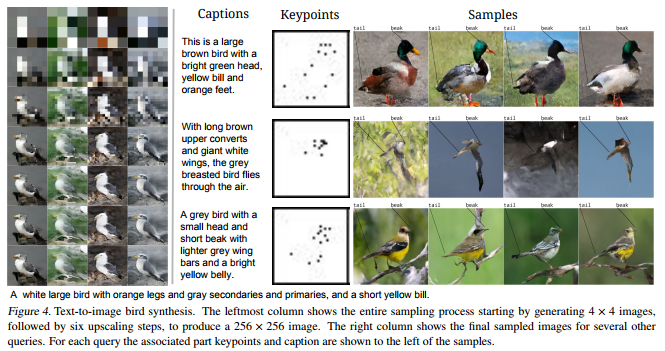
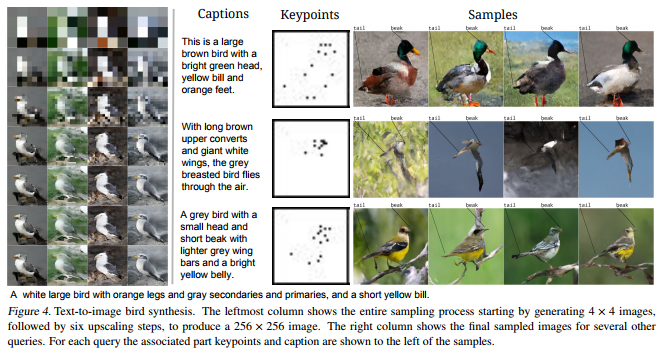
A while ago, I blogged about this new algorithm, pix2code, which takes in pictures of graphical user interfaces and outputs the underlying code. Today, I discovered another fantastic algorithm, by Scott Reed and his colleagues at Google Deepmind. txt2pix would be a catchy name for this algorithm, as it can take in a fairly complex sentence (e.g., “a grey bird with a black head, orange eyes, and a yellow beak“) and generate a completely new and unique image based on its content. In their recently published paper, they elaborate on the algorithms inner workings.

Deepmind.png
An example of the training and generation process reported in the paper

Scott and his team have been working on this project for quite some time. The early version of the algorithm generated an image one pixel at a time, but it had difficulties generating large or high-quality images. After picking a starting pixel to generate, any consecutively generated pixel the algorithm generates needs to align with its neighbours. For example, if pixel A is the first pixel in the generation of the yellow beak of a bird, any pixels that are created in the neighbourhood of that pixel should take into account that pixel A is trying to visualize a yellow beak, and behave accordingly: either continuing the beak, or ending the beak and starting on another element of the image.

The problem with such an iterative approach (i.e., pixel by pixel) is that it can take a very long time for a computer to generate an image. Considering that a fairly small image, say 256 by 256 pixels, already contains 65.536 pixels, each of which needs to be generated while considering all its neighbours and keeping in mind the bigger picture. In the most recent, updated version of the algorithm, Scott and his team have allowed the generation of multiple unrelated pixels simultaneously at different ‘zones’ of the image. Hence the Parallel in Parallel Multiscale Autoregressive Density Estimation. With this parallel approach, the algorithm can now generate the pixels representing the yellow beak in one area of the image, while simultaneously generating pixels for the bird’s wings and the branch it’s sitting on at different sections of the image. This speeds up the process quite extensively, demanding less computation time, thus allowing for quicker image generation.

I can definitely recommend that you check out Scott Reeds’ twitter feed for some amazing animated GIFs of the generation process:

If you want to know more details behind the algorithm but do not fancy reading the entire paper, I recommend this short explanation video by Károly Zsolnai-Fehér (what a name!) of Two Minute papers: