Four of the best professional poker players in the world – Dong Kim, Jason Les, Jimmy Chou, and Daniel McAulay – recently got beat by Libratus, a poker-playing AI developed at the Pittsburgh Supercomputing Center. During a period of 20 days of continuous play (10h/day), each of these four professionals lost to Libratus heads-up in a whopping total of 120.000 hands of No Limit Texas Hold-em Poker.
A player may face 10 to the power of 160 different situations in Texas Hold-em Poker: more than the number of atoms in the universe. It took extensive machine learning to compute and prioritize the computation of the most rewarding actions in these situations. Libratus works by running extensive simulations, taking into account the way the professionals play, and figuring out the best counter strategy. Although it is not without flaws, any “holes” the players found in Libratus’ strategy could not be exploited for long, as the algorithm would quickly learn and adapt to prevent further exploitation. The experience was completely different from playing a human player, the professionals argue, as Libratus would make both tiny and huge bets and would continuously change its strategy and plays.
The video below provides more detailed information and also shows the million-dollar margin by which Libratus won at the end of the twenty day poker (training) marathon:
Seth Bling calls himself a video game designer, a hacker and an engineer. You might know him from MarI/O: his neural network that got extremely good to at playing Super Mario Bros. The video below shows the genetic approach Seth used to train this neural network. Seth randomly generated a starting population of neural networks where the inputs – the current frame in the Mario video game – were randomly connected to the outputs – the eight buttons to press (jump, duck, up, down, right, left, etc). By giving the neural nets that made it furthest into the game a larger chance to pass on their genes (their input-output relations) to the next generation with slight mutations, Seth automatically generated neural networks that were more and more proficient in completing the game. In short, by evolution, Seth’s neural network learned the most effective response to the changing video game environment.
After MarI/O, Seth this week posted his newest creation: MariFlow. Here, Seth trained a neural network on 15 hours of training data, consisting of Seth himself playing Super Mario Kart. The neural network thus learned what buttons (output) Seth would most likely push when he encountered a certain Mario Kart parcours piece (input). However, due to random chance, the neural net would often get itself stuck in situations that Seth had not encountered in his training sessions (e.g., reversed, against a wall). The neural net would fail miserably in such situations because it had not learned how to behave. Accordingly, Seth had to generate new training data for these situations and he did so using Human-Computer Interactions in Machine Learning: Seth and the neural net would play alternatively for a while, thus generating training data for situations that Seth would not have encountered on its own. After the neural net was trained with these additional data, it became quite proficient in playing Mario Kart (like Seth) often even winning matches! If you want to know more, you can read the manual here or watch Seth’s video below. If you want to replicate or just play with the data, Seth made everything available here.
Seth has active YouTube, Twitch and Twitter channels and I recommend you check them out!
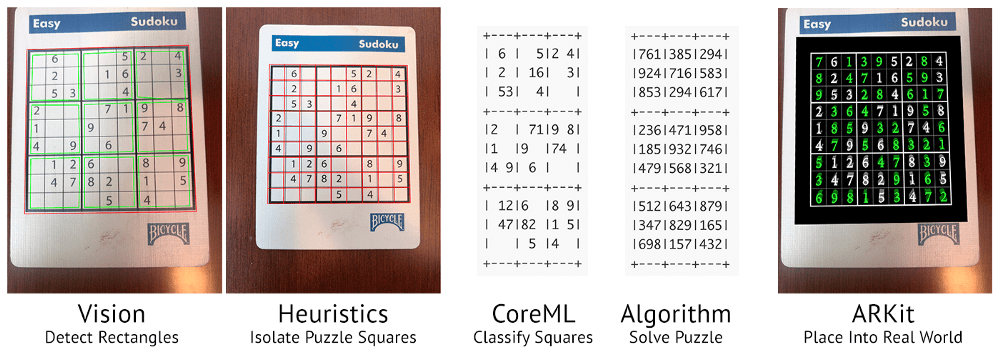
A few weeks ago, Magic Sudoku was released for iOS11. This app by a company named Hatchlings automatically solves sudoku puzzles using a combination of Computer Vision, Machine Learning, and Augmented Reality. The app works on iPad Pro’s and iPhone 6s or above and can be downloaded from the App Store.
Magic Sudoku gives a magical experience when users point their phone at a Sudoku puzzle: the puzzle is instantaneously solved and displayed on their screen. In several seconds, the following occurs behind the scenes:
“One of the original reasons I chose a Sudoku solver as our first AR app was that I knew classifying digits is basically the “hello world” of Machine Learning. I wanted to dip my toe in the water of Machine Learning while working on a real-world problem. This seemed like a realistic app to tackle.” – Brad Dwyer, Founder at Hatchlings
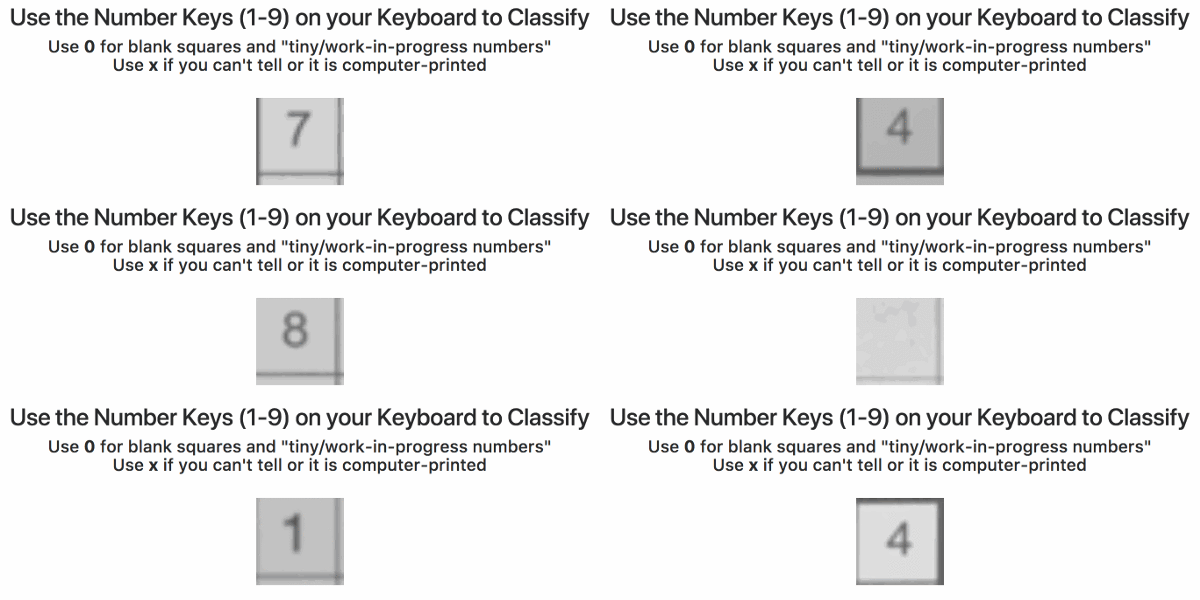
Particularly the training process of the app interested me. In his blog, Brad explains how they bought out the entire stock of Sudoku books of a specific bookstore and, with the help of his team, ripped each book apart to scan each small square with a number and upload in to a server. In the end, this server contained about 600,000 images, but all were completely unlabeled. Via a simple game, they asked Hatchlings users to classify these images by pressing the number keys on their keyboard. Within 24 hours, all 600,000 images were classified!
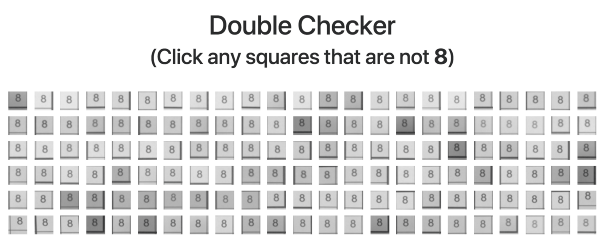
Nevertheless, some users had misunderstood the task (or just plainly ignored it) and as a consequence there were still a significant number of misidentified images. So Brad created a second tool that displayed 100 images of a single class to users, who where consequently asked to click the ones that didn’t match. These were subsequently thrown back into the first tool to be reclassified.
Quickly, the developers had enough verified data to add an automatic accuracy checker into both tools for future data runs. Funnily enough, they programmed it in such a way that users were periodically shown already known/classified images in order to check the validity of their inputs and determine how much to trust their answers going forward. This whole process reminds me on a blog I wrote recently, regarding human-computer interactions in reinforcement learning.
For several more weeks, users classified more scanned data so that, by the time the app was launched, it had been trained on over a million images of Sudoku squares. The results were amazing as the application had a 98.6% accuracy on launch (currently above 99% accuracy). One minor deficit was that the app was trained on paper Sudoku’s. However, when it aired, many users wanted to quickly test it and searched for Sudoku images on Google, which the app wouldn’t process that well.
“Problem number one was that our machine learning model was only trained on paper puzzles; it didn’t know what to think about pixels on a screen. I pulled an all nighter that first week and re-trained our model with puzzles on computer screens.
Problem number two was that ARKit only supports horizontal planes like tables and floors (not vertical planes like computer monitors). Solving this was a trickier problem but I did come up with a hacky workaround. I used a combination of some heuristics and FeaturePoint detection to place puzzles on non-horizontal planes.” – Brad Dwyer, Founder at Hatchlings
A regular expression (regex or regexp for short) is a special text string for describing a search pattern. You can think of regular expressions as wildcards on steroids. You are probably familiar with wildcard notations such as *.txt to find all text files in a file manager. The regex equivalent is .*\.txt$.
Last week I posted a first tutorial on Regular Expressions in R and I am working its sequels. You may find additional resources on Regular Expressions in the learning overviews (R, Python, Data Science).
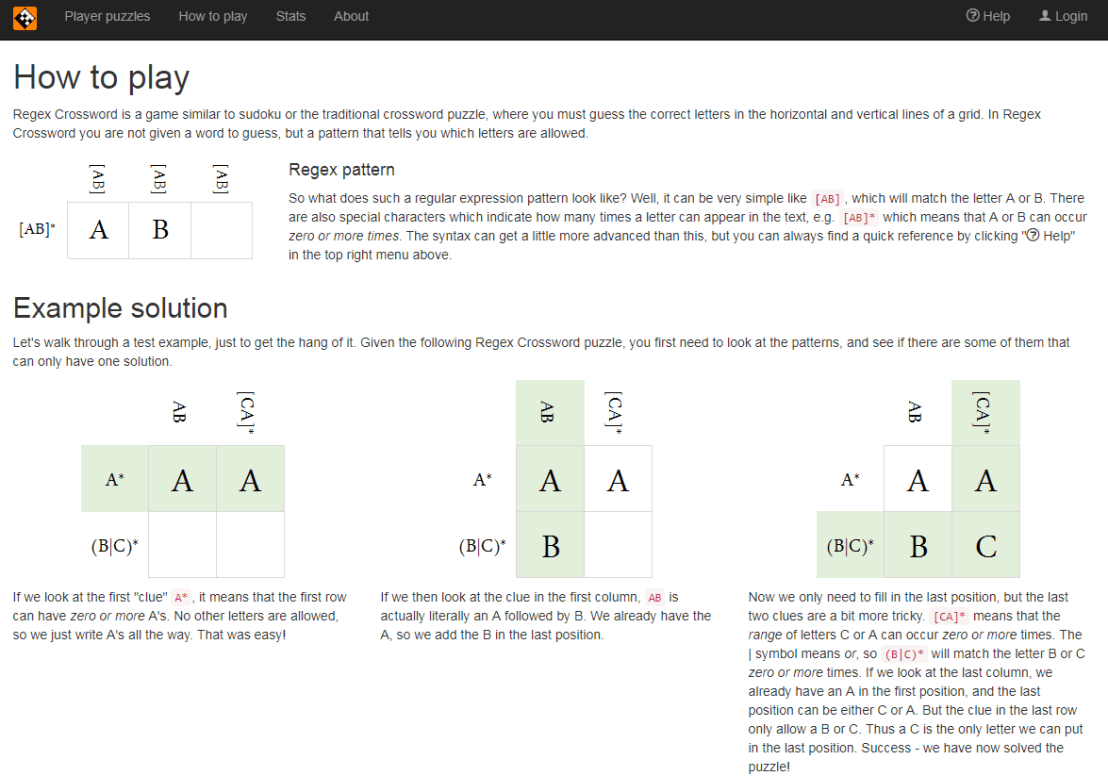
Today I came across this website of Regular Expression Crosswords, which proves a great resource to playfully master regular expression. All puzzles are validated live using the JavaScript regex engine. The figure below explains how it works
Via the links below you can jump puzzles that matches your expertise level:
Aaron Jackson, Adrian Bulat, Vasileios Argyriou and Georgios Tzimiropoulos
of the Computer Vision Laboratory of the University of Nottingham built a neural network that generates a full 3D image of a single portrait photograph. They turn a photograph like this…
… into an accurately creepy 3D image like this.
You can try it with your own or other photographs here. I found that images with white background get the best results. On their project website you can read more about the underlying convolutional neural network.
Update 21-10-2017: One of my favorite YouTube channels explains how the models were trained and the data used:
Unsurprisingly, nouns like asylum, repatriation, displacement, persecution, plight, and crisis appear significantly more often in UNHCR speeches on refugees than in general English texts. The first visualization below shows the action-oriented verbs most commonly used in combination with these nouns.
This second visualization shows the most occurring verb-noun pairs.
Hannah used newsflash to retrieve the GDELT data on US TV news. Some channels seem to cover refugees more than others. I would have loved to see which topics occurred on each channel, but unfortunately she did not report on this.









 paulvanderlaken.com