Category: machine learning

Neural Networks play Super Mario Bros & Mario Kart

Neural Networks play Super Mario Bros & Mario Kart

Seth Bling calls himself a video game designer, a hacker and an engineer. You might know him from MarI/O: his neural network that got extremely good to at playing Super Mario Bros. The video below shows the genetic approach Seth used to train this neural network. Seth randomly generated a starting population of neural networks where the inputs – the current frame in the Mario video game – were randomly connected to the outputs – the eight buttons to press (jump, duck, up, down, right, left, etc). By giving the neural nets that made it furthest into the game a larger chance to pass on their genes (their input-output relations) to the next generation with slight mutations, Seth automatically generated neural networks that were more and more proficient in completing the game. In short, by evolution, Seth’s neural network learned the most effective response to the changing video game environment.

After MarI/O, Seth this week posted his newest creation: MariFlow. Here, Seth trained a neural network on 15 hours of training data, consisting of Seth himself playing Super Mario Kart. The neural network thus learned what buttons (output) Seth would most likely push when he encountered a certain Mario Kart parcours piece (input). However, due to random chance, the neural net would often get itself stuck in situations that Seth had not encountered in his training sessions (e.g., reversed, against a wall). The neural net would fail miserably in such situations because it had not learned how to behave. Accordingly, Seth had to generate new training data for these situations and he did so using Human-Computer Interactions in Machine Learning: Seth and the neural net would play alternatively for a while, thus generating training data for situations that Seth would not have encountered on its own. After the neural net was trained with these additional data, it became quite proficient in playing Mario Kart (like Seth) often even winning matches! If you want to know more, you can read the manual here or watch Seth’s video below. If you want to replicate or just play with the data, Seth made everything available here.

Seth has active YouTube, Twitch and Twitter channels and I recommend you check them out!

Hierarchical Linear Models 101

Hierarchical Linear Models 101

Multilevel models (also known as hierarchical linear models, nested data models, mixed models, random coefficient, random-effects models, random parameter models, or split-plot designs) are statistical models of parameters that vary at more than one level (Wikipedia). They are very useful in Social Sciences, where we are often interested in individuals that reside in nations, organizations, teams, or other higher-level units. Next to their individuals characteristics, the characteristics of these units they belong to may also have effects. To take into account effects from variables residing at multiple levels, we can use multilevel or hierarchical models.

Michael Freeman, a faculty member at the University of Washington Information School. made this amazing visual introduction to hierarchical modeling:

hlm

If you want to practice hierarchical modeling in R, I recommend the lesson by Page Paccini (first video) or the more elaborate video series by Statistics of DOOM (second):

GAN: Generative Adversarial Networks

GAN: Generative Adversarial Networks

A Generative Adversarial Network, GAN in short, is a machine learning architecture where two neural networks compete against each other. One of them functions as a discriminator, seeking to optimize its classification of data (i.e., determine whether or not there is a cat in a picture). The other one functions as a generator, seeking to best generate new data to fool the discriminator (i.e., create realistic fake images of cats). Over time, the generator network will become increasingly good at simulating realistic data and being able to mimic real-life.

The concept of GAN was introduced by Ian Goodfellow in 2014, whom we know from the Machine Learning & Deep Learning book. Although GANs are computationally heavy and still undergoing major development, their potential implications are widespread. We can see these architectures taking over all sort of creative work, where generating new “data” is the main task. Think for instance of designing clothes, creating video footage, writing novels, animating movies, or even whole video games. One of my favorite Youtube channels discusses multiple of its recent applications, and here are a few of my favorites:

If you want to know more about GANs, Analytics Vidhya hosts a short introduction, but I personally prefer this one by Rob Miles via Computerphile:

If you want to try out these GANs yourself but do not have the programming experience: Reiichiro Nakano made a GAN playground in (what seems) JavaScript, where you can play around with the discriminator and the generator to create an adversarial network that identifies and generates images of numbers.

gan_playground.png

The Magic Sudoku App

The Magic Sudoku App

A few weeks ago, Magic Sudoku was released for iOS11. This app by a company named Hatchlings automatically solves sudoku puzzles using a combination of Computer Vision, Machine Learning, and Augmented Reality. The app works on iPad Pro’s and iPhone 6s or above and can be downloaded from the App Store.

Magic Sudoku App in action.

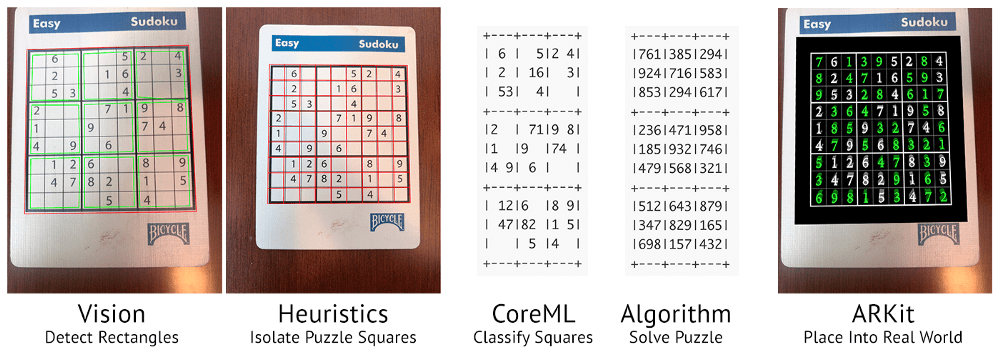
Magic Sudoku gives a magical experience when users point their phone at a Sudoku puzzle: the puzzle is instantaneously solved and displayed on their screen. In several seconds, the following occurs behind the scenes:

What happens in the ARKit app behind the scenes.

One of the original reasons I chose a Sudoku solver as our first AR app was that I knew classifying digits is basically the “hello world” of Machine Learning. I wanted to dip my toe in the water of Machine Learning while working on a real-world problem. This seemed like a realistic app to tackle.” – Brad Dwyer, Founder at Hatchlings

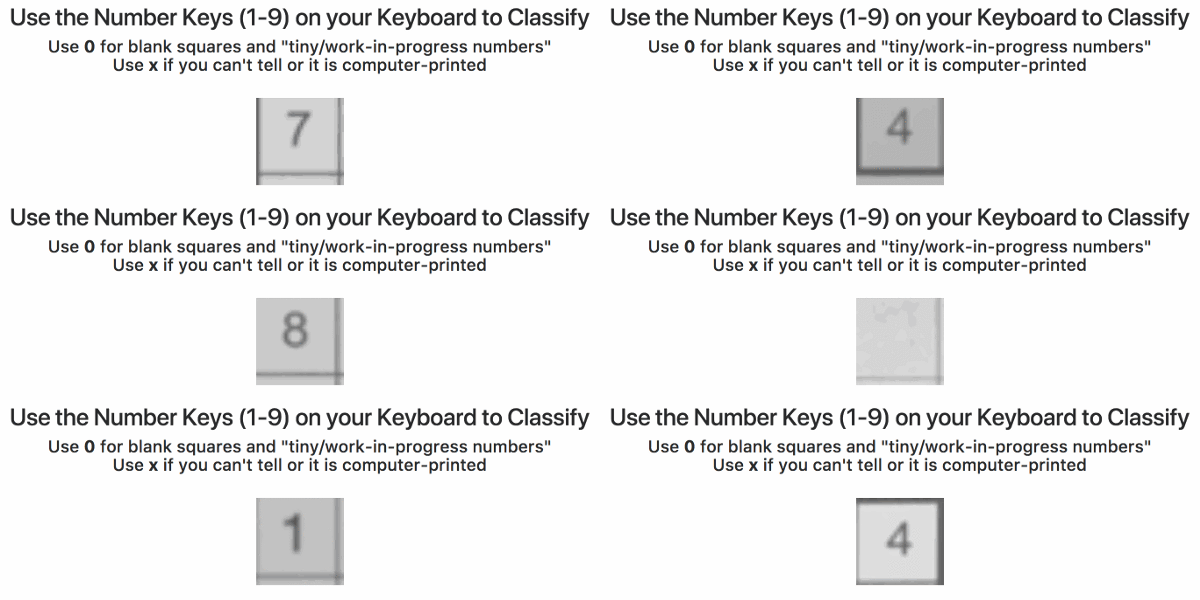
Particularly the training process of the app interested me. In his blog, Brad explains how they bought out the entire stock of Sudoku books of a specific bookstore and, with the help of his team, ripped each book apart to scan each small square with a number and upload in to a server. In the end, this server contained about 600,000 images, but all were completely unlabeled. Via a simple game, they asked Hatchlings users to classify these images by pressing the number keys on their keyboard. Within 24 hours, all 600,000 images were classified!

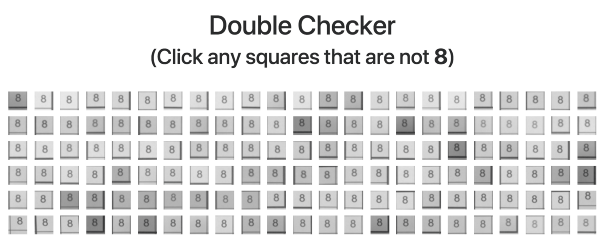
Nevertheless, some users had misunderstood the task (or just plainly ignored it) and as a consequence there were still a significant number of misidentified images. So Brad created a second tool that displayed 100 images of a single class to users, who where consequently asked to click the ones that didn’t match. These were subsequently thrown back into the first tool to be reclassified.

Quickly, the developers had enough verified data to add an automatic accuracy checker into both tools for future data runs. Funnily enough, they programmed it in such a way that users were periodically shown already known/classified images in order to check the validity of their inputs and determine how much to trust their answers going forward. This whole process reminds me on a blog I wrote recently, regarding human-computer interactions in reinforcement learning.

For several more weeks, users classified more scanned data so that, by the time the app was launched, it had been trained on over a million images of Sudoku squares. The results were amazing as the application had a 98.6% accuracy on launch (currently above 99% accuracy). One minor deficit was that the app was trained on paper Sudoku’s. However, when it aired, many users wanted to quickly test it and searched for Sudoku images on Google, which the app wouldn’t process that well.

“Problem number one was that our machine learning model was only trained on paper puzzles; it didn’t know what to think about pixels on a screen. I pulled an all nighter that first week and re-trained our model with puzzles on computer screens.

Problem number two was that ARKit only supports horizontal planes like tables and floors (not vertical planes like computer monitors). Solving this was a trickier problem but I did come up with a hacky workaround. I used a combination of some heuristics and FeaturePoint detection to place puzzles on non-horizontal planes.” – Brad Dwyer, Founder at Hatchlings

Brad and his colleagues at Hatchlings still need to work out the business model behind the ARKit Magic Sudoku app, but that’s in the meantime, download the app and let me and them know what you think: subscribe to his medium blog or follow Brad on twitter.

Talent Works: Data Science to improve Job Application Chances

Talent Works: Data Science to improve Job Application Chances

Searching and applying to jobs can be a costly activity, requiring many hours upon hours of perfecting your motivation letter and CV. Hence, it can be very frustrating to get ghosted (not receiving a reply) for a job. Luckily, Talent Works is able to give us some general tips when it comes to improving the success of your applications. You might remember them from their Interactive Map of the US Job Market.

Using a sample of about 1600 job applications, Talent Works recently conducted all kinds of statistical analyses to look at the hiring process. For instance, they examined the time it takes to get from the application stage to your first day on the job. Split out for various jobs, it seems Mechanical Engineers spend quite a while in the interview stage whereas Software developers are put to work within three weeks.

estimated.mdf.png
The numbers of days spent in each application stage per job (Talent.Works)

In a different analysis, Talent Works examined how to minimize your risk of getting ghosted on a job application. For instance, they found that during the “Golden Hours” (the first 96 hours after a job gets posted), your chances of getting an invitation for an interview are up to 8 times higher than afterwards.

If you submit a job application in the first 96 hours, you’re up to 8x more likely to get an interview. After that, every day you wait reduces your chances by 28% (Talent.Works)

Based on the above they come to the following three timeframes in the application cycle:

  1. “Golden Hours”: Applications submitted between 2-4 days after a job is posted have the highest chance of getting an interview. Not only is there a difference, there’s a big difference: you have up to an 8x higher chance of getting an interview during this period, even if you’re submitting the same application.
  2. Twilight Zone: Chances quickly decrease from OK to really bad: every day you wait after the “Golden Hours” reduces your chances by 28%. The longer you wait, the higher the risk that employers have already checked their inboxes and setup interviews with candidates that met their “good enough”-bar.
  3. Resume Blackhole: According to Talent.Works it’s nearly not worth applying after 10 days. On average, job applications during this phase have a meager ~1.5% of getting an interview. Put another way, if you send out 50 job applications, you might hear back from one (if you’re lucky).

Next, Talent.Works investigated on a more granular level what would then be the best time to apply for a job.This resulted in the following figure

what-best-time-apply-for-job
The best time to apply for a job is between 6am and 10am. During this time, you have an 13% chance of getting an interview — nearly 5x as if you applied to the same job after work. Whatever you do, don’t apply after 4pm (Talent.Works)

Again, they provide a summary of their conclusions:

  • The best time to apply for a job is between 6am and 10am. During this time, you have an 13% chance of getting an interview.
  • After that morning window, your interview odds start falling by 10% every 30 minutes. If you’re late, you’re going to pay dearly.
  • There’s a brief reprieve during lunchtime, where your odds climb back up to 11% at around 12:30pm but then start falling precipitously again.
  • The single-worst time to apply for a job is after work — if you apply at 7:30pm, you have less than a 3% chance of getting an interview.

If you want to see more, please visit Talent.Works. Here, you can let them process your CV and help you improve your hiring chances (see also this blog post).

Datasets to practice and learn Programming, Machine Learning, and Data Science

Datasets to practice and learn Programming, Machine Learning, and Data Science

Many requests have come in regarding “training datasets” – to practice programming. Fortunately, the internet is full of open-source datasets! I compiled a selected list of datasets and repositories below. If you have any additions, please comment or contact me! For information on programming languages or algorithms, visit the overviews for RPython, SQL, or Data Science, Machine Learning, & Statistics resources.

This list is no longer being maintained. There are other, more frequently updated repositories of useful datasets included in bold below:

LAST UPDATED: 2019-12-23
A Million News Headlines: News headlines published over a period of 14 years.
AggData | Datasets
Aligned Hansards of the 36th Parliament of Canada
Amazon Web Services: Public Datasets
American Community Survey
ArcGIS Hub Open Data
arXiv.org help – arXiv Bulk Data Access – Amazon S3
Asset Macro: Financial & Macroeconomic Historical Data
Awesome JSON Datasets
Awesome Public Datasets
Behavioral Risk Factor Surveillance System
British Oceanographic Data Center
Bureau of Justice
Canada
Causality | Data Repository
CDC Wonder Online Database
Census Bureau Home Page
Center for Disease Control
ChEMBLdb
ChemDB
City of Chicago
Click Dataset | Center for Complex Networks and Systems Research
CommonCrawl 2013 Web Crawl
Consumer Finance: Mortgage Database
CRCNS – Collaborative Research in Computational Neuroscience
Data Download
Data is Plural
Data.gov
Data.gov.au
Data.gov.nz
Data.gov.sg
Data.gov.uk
Data.Seattle.Gov | Seattle’s Data Site
Data.world
Data.World datasets
DataHub
Datasets for Data Mining
DataSF
Dataverse
DELVE datasets
DMOZ open directory (mirror)
DRYAD
Enigma Public
Enron Email Dataset
European Environment Agency (EEA) | Data and maps
Eurostat
Eurostat Database
Eurovision YouTube Comments: YouTube comments on entries from the 2003-2008 Eurovision Song Contests
FAA Data
Face Recognition Homepage – Databases
FAOSTAT Data
FBI Crime Data Explorer
FEMA Data Feeds
Figshare
FiveThirthyEight.com
Flickr personal taxonomies
FlowingData
Fraudulent E-mail Corpus: CLAIR collection of “Nigerian” fraud emails
Freebase (last datadump)
Gapminder.org
Gene Expression Omnibus (GEO) Main page
GeoJSON files for real-time Virginia transportation data.
Golem Dataset
Google Books n-gram dataset
Google Public Data Explorer
Google Research: A Web Research Corpus Annotated with Freebase Concepts
Health Intelligence
Healthcare Cost and Utilization Project
HealthData.gov
Human Fertility Database
Human Mortality Database
ICPRS Social Science Studies 
ICWSM Spinnr Challenge 2011 dataset
IIE.org Open Doors Data Portal
ImageNet
IMDB dataset
IMF Data and Statistics
Informatics Lab Open Data
Inside AirBnB
Internet Archive: Digital Library
IPUMS
Ironic Corpus: 1950 sentences labeled for ironic content
Kaggle Datasets
KAPSARC Energy Data Portal
KDNuggets Datasets
Knoema
Lahman’s Baseball Database
Lending Club Loan Data
Linking Open Data
London Datastore
Makeover Monday
Medical Expenditure Panel Survey
Million Song Dataset | scaling MIR research
MLDATA | Machine Learning Dataset Repository
MLvis Scientific Data Repository
MovieLens Data Sets | GroupLens Research
NASA
NASA Earth Data
National Health and Nutrition Examination Survey
National Hospital Ambulatory Medical Care Survey Data
New York State
NYPD Crash Data Band-Aid
ODI Leeds
OECD Data
OECD.Stat
Office for National Statistics
Old Newspapers: A cleaned subset of HC Corpora newspapers
Open Data Inception Portals
Open Data Nederland
Open Data Network
OpenDataSoft Repository
Our World in Data
Pajek datasets
PermID from Thomson Reuters
Pew Research Center
Plenar.io
PolicyMap
Princeton University Library
Project Gutenberg
Quandl
re3data.org
Reddit Datasets
Registry of Research Data Repositories
Retrosheet.org
Satori OpenData
SCOTUS Opinions Corpus: Lots of Big, Important Words
Sharing PyPi/Maven dependency data « RTFB
SMS Spam Collection
Socrata
St. Louis Federal Reserve
Stanford Large Network Dataset Collection
State of the Nation Corpus (1990 – 2017): Full texts of the South African State of the Nation addresses
Statista
Substance Abuse and Mental Health Services Administration 
Swiss Open Government Data
Tableau Public
The Association of Religious Data Archives
The Economist
The General Social Survey
The Huntington’s Early California Population Project
The World Bank | Data
The World Bank Data Catalog
Toronto Open Data
Translation Task Data
Transport for London
Twitter Data 2010
Ubuntu Dialogue Corpus: 26 million turns from natural two-person dialogues
UC Irvine Knowledge Discovery in Databases Archive
UC Irvine Machine Learning Repository –
UC Irvine Network Data Repository
UN Comtrade Database
UN General Debates:Transcriptions of general debates at the UN from 1970 to 2016
UNdata
Uniform Crime Reporting
UniGene
United States Exam Data
University of Michigan ICPSR
University of Rochester LibGuide “Data-Stats”
US Bureau of Labor Statistics
US Census Bureau Data
US Energy Information Administration
US Government Web Services and XML Data Sources
USA Facts
USENET corpus (2005-2011)
Utah Open Data
Varieties of Democracy.
Western Pennsylvania Regional Data Center
WHO Data Repository
Wikipedia List of Datasets for Machine Learning
WordNet
World Values Survey
World Wealth & Income Database
World Wide Web: 3.5 billion web pages and their relations
Yahoo Data for Researchers
YouTube Network 2007-2008