Google has announced to provide open access to its artificial intelligence and machine learning courses. On their overview page, you will find many educational resources from machine learning experts at Google. They announced to share AI and machine learning lessons, tutorials and hands-on exercises for people at all experience levels. Simply filter through the resources and start learning, building and problem-solving.
For instance, up your game straight away with this 15-hour Machine Learning crash course. Zuri Kemp – who leads Google’s machine learning education program – said that over 18,000 Googlers have already enrolled in the course. Designed by the engineering education team, the courses explores loss functions and gradient descent and teached you to build your own neural network in Tensorflow.
The field of computer vision tries to replicate our human visual capabilities, allowing computers to perceive their environment in a same way as you and I do. The recent breakthroughs in this field are super exciting and I couldn’t but share them with you.
In the TED talk below by Joseph Redmon (PhD at the University of Washington) showcases the latest progressions in computer vision resulting, among others, from his open-source research on Darknet – neural network applications in C. Most impressive is the insane speed with which contemporary algorithms are able to classify objects. Joseph demonstrates this by detecting all kinds of random stuff practically in real-time on his phone! Moreover, you’ve got to love how well the system works: even the ties worn in the audience are classified correctly!
The second talk, below, is more scientific and maybe even a bit dry at the start. Blaise Aguera y Arcas (engineer at Google) starts with a historic overview brain research but, fortunately, this serves a cause, as ~6 minutes in Blaise provides one of the best explanations I have yet heard of how a neural network processes images and learns to perceive and classify the underlying patterns. Blaise continues with a similarly great explanation of how this process can be reversed to generate weird, Asher-like images, one could consider creative art:
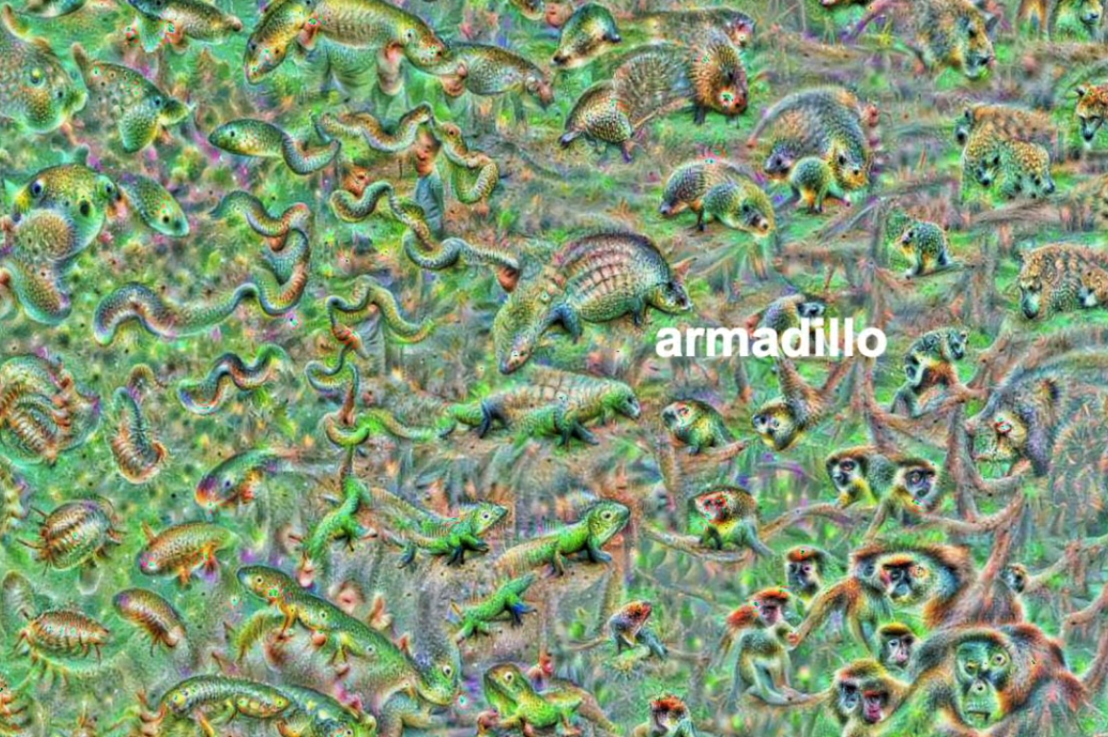
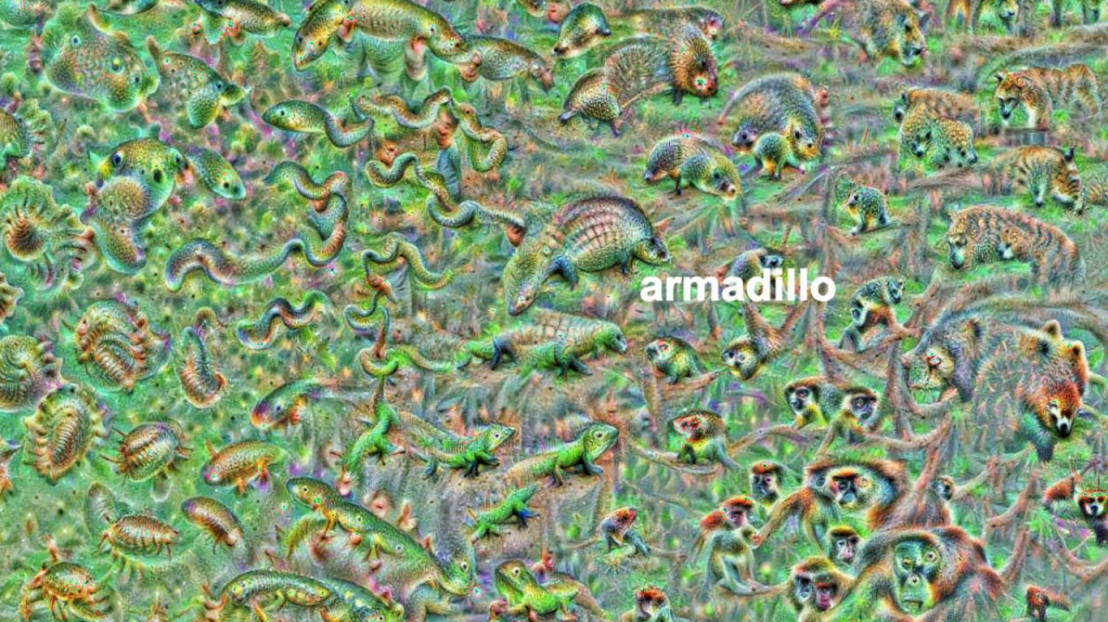
An example of a reversed neural network thus “estimating” an image of a bird [via Youtube]Blaise’s colleagues at Google took this a step further and used t-SNE to visualize the continuous space of animal concepts as perceived by their neural network, here a zoomed in part on the Armadillo part of the map, apparently closely located to fish, salamanders, and monkeys?
A zoomed view of part of a t-SNE map of latent animal concepts generated by reversing a neural network [via Youtube]We’ve seen these latent spaces/continua before. This example Andrej Karpathy shared immediately comes to mind:
If you want to learn more about this process of image synthesis through deep learning, I can recommend the scientific papers discussed by one of my favorite Youtube-channels, Two-Minute Papers. Karoly’s videos, such as the ones below, discuss many of the latest developments:
Let me know if you have any other video’s, papers, or materials you think are worthwhile!
Four of the best professional poker players in the world – Dong Kim, Jason Les, Jimmy Chou, and Daniel McAulay – recently got beat by Libratus, a poker-playing AI developed at the Pittsburgh Supercomputing Center. During a period of 20 days of continuous play (10h/day), each of these four professionals lost to Libratus heads-up in a whopping total of 120.000 hands of No Limit Texas Hold-em Poker.
A player may face 10 to the power of 160 different situations in Texas Hold-em Poker: more than the number of atoms in the universe. It took extensive machine learning to compute and prioritize the computation of the most rewarding actions in these situations. Libratus works by running extensive simulations, taking into account the way the professionals play, and figuring out the best counter strategy. Although it is not without flaws, any “holes” the players found in Libratus’ strategy could not be exploited for long, as the algorithm would quickly learn and adapt to prevent further exploitation. The experience was completely different from playing a human player, the professionals argue, as Libratus would make both tiny and huge bets and would continuously change its strategy and plays.
The video below provides more detailed information and also shows the million-dollar margin by which Libratus won at the end of the twenty day poker (training) marathon:
The below reiterates and summarizes this Stat article.
Recently, I addressed how bias may slip into Machine Learning applications and this weekend I came across another real-life example: IBM’s Watson, specifically Watson for Oncology. With a single machine, IBM intended to tackle humanity’s most vexing diseases and revolutionize medicine and they quickly zeroed in on a high-profile target: cancer.
However, three years later now, a STAT investigation has found that the supercomputer isn’t living up to the lofty expectations IBM created for it. IBM claims that, through Artificial Intelligence, Watson for Oncology can generate new insights and identify “new approaches” to cancer care. However, the STAT investigation (video below) concludes that the system doesn’t create new knowledge and is artificially intelligent only in the most rudimentary sense of the term. Similarly, cancer specialists using the product argue Watson is still in its “toddler stage” when it comes to oncology.
Let’s start with the positive side. For specific treatments, Watson can scan academic literature, immediately providing the “best data” about a treatment — survival rates, for example — thereby relieving doctors of tedious literature searches. Due to this transparency, Watson may level the hierarchy commonly found in hospital settings, by holding (senior) doctors accountable to the data and empowering junior physicians to back up their arguments. Furthermore, Watson’s information may empower patients as they can be offered a comprehensive packet of treatment options, including potential treatment plans along with relevant scientific articles. Patients can do their own research about these treatments, and maybe even disagree with the doctor about the right course of action.
Although study results demonstrate that Watson saves doctors time and can have a high concordance rate with their treatment recommendations, much more research is needed. The studies were all conference abstracts, which haven’t been published in peer-reviewed journals — and all but one was either conducted by a paying customer or included IBM staff on the author list, or both. More importantly, IBM has failed to exposed Watson for Oncology to critical review by outside scientists nor have they conducted clinical trials to assess its effectiveness. It would be very interesting to examine whether Watson’s implementation is actually saving lives or making healthcare more efficient/effective.
IBM Watson HealthSuch validation is especially necessary because several issues are identified. First, the actual capabilities of Watson for Oncology are not well-understood by the public, and even by some of the hospitals that use it. It’s taken nearly six years of painstaking work by data engineers and doctors to train Watson in just seven types of cancer, and keep the system updated with the latest knowledge. Moreover, because of the complexity of the underlying machine learning algorithms, the recommendations Watson puts out are a black box, and Watson can not provide the specific reasons for picking treatment A over treatment B.
Second, the system is essentially Memorial Sloan Kettering in a portable box. IBM celebrates Memorial Sloan Kettering’s role as the only trainer of Watson. After all, who better to educate the system than doctors at one of the world’s most renowned cancer hospitals? However, doctors claim that Memorial Sloan Kettering’s training has caused bias in the system, because the treatment recommendations it puts into Watson don’t always comport with the practices of doctors elsewhere in the world. When users ask Watson for advice, the system also searches published literature — some of which is curated by Memorial Sloan Kettering — to provide relevant studies and background information to support its recommendation. But the recommendation itself is derived from the training provided by the hospital’s doctors, not the outside literature.
Doctors at Memorial Sloan Kettering acknowledged their influence on Watson. “We are not at all hesitant about inserting our bias, because I think our bias is based on the next best thing to prospective randomized trials, which is having a vast amount of experience,” said Dr. Andrew Seidman, one of the hospital’s lead trainers of Watson. “So it’s a very unapologetic bias.”
However, this bias causes serious problems when Watson for Oncology is implemented in other countries/hospitals. The generally affluent population treated at Memorial Sloan Kettering doesn’t reflect the diversity of people around the world. According to Martijn van Oijen, an epidemiologist and associate professor at Academic Medical Center in the Netherlands, Watson has not been implemented in because of country level differences in treatment approaches. Similarly, oncologists at one hospital in Denmark said they have dropped implementation altogether after finding that local doctors agreed with Watson in only about 33 percent of cases. Different problems occurred in South Korea, where researchers reported that the treatment Watson most often recommended for breast cancer patients simply wasn’t covered by their national insurance system.
Kris, the lead trainer at Memorial Sloan Kettering, says nobody wants to hear the problems. “All they want to hear is that Watson is the answer. And it always has the right answer, and you get it right away, and it will be cheaper. But like anything else, it’s kind of human.”



![imaging-video[1].jpg](https://paulvanderlaken.com/wp-content/uploads/2017/09/imaging-video1.jpg?w=1108)
 paulvanderlaken.com