Category: machine learning

Building a realistic Reddit AI that get upvoted in Python

Building a realistic Reddit AI that get upvoted in Python

Sometimes I find these AI / programming hobby projects that I just wished I had thought of…

Will Stedden combined OpenAI’s GPT-2 deep learning text generation model with another deep-learning language model by Google called BERT (Bidirectional Encoder Representations from Transformers) and created an elaborate architecture that had one purpose: posting the best replies on Reddit.

The architecture is shown at the end of this post — copied from Will’s original blog here. Moreover, you can read this post for details regarding the construction of the system. But let me see whether I can explain you what it does in simple language.

The below is what a Reddit comment and reply thread looks like. We have str8cokane making a comment to an original post (not in the picture), and then tupperware-party making a reply to that comment, followed by another reply by str8cokane. Basically, Will wanted to create an AI/bot that could write replies like tupperware-party that real people like str8cokane would not be able to distinguish from “real-people” replies.

Note that with 4 points, str8cokane‘s original comments was “liked” more than tupperware-party‘s reply and str8cokane‘s next reply, which were only upvoted 2 and 1 times respectively.

gpt2-bert on China
Example reddit comment and replies (via bonkerfield.org/)

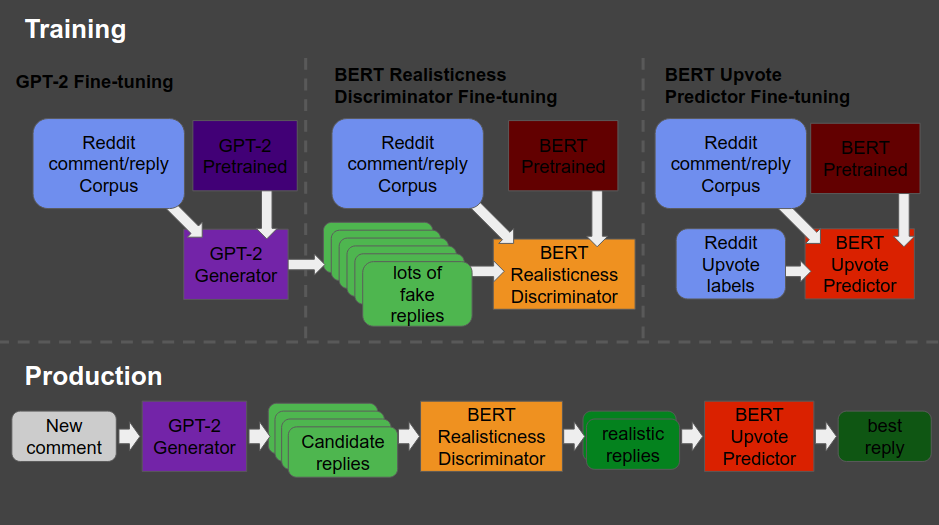
So here’s what the final architecture looks like, and my attempt to explain it to you.

  1. Basically, we start in the upper left corner, where Will uses a database (i.e. corpus) of Reddit comments and replies to fine-tune a standard, pretrained GPT-2 model to get it to be good at generating (red: “fake”) realistic Reddit replies.
  2. Next, in the upper middle section, these fake replies are piped into a standard, pretrained BERT model, along with the original, real Reddit comments and replies. This way the BERT model sees both real and fake comments and replies. Now, our goal is to make replies that are undistinguishable from real replies. Hence, this is the task the BERT model gets. And we keep fine-tuning the original GPT-2 generator until the BERT discriminator that follows is no longer able to distinguish fake from real replies. Then the generator is “fooling” the discriminator, and we know we are generating fake replies that look like real ones!
    You can find more information about such generative adversarial networks here.
  3. Next, in the top right corner, we fine-tune another BERT model. This time we give it the original Reddit comments and replies along with the amount of times they were upvoted (i.e. sort of like likes on facebook/twitter). Basically, we train a BERT model to predict for a given reply, how much likes it is going to get.
  4. Finally, we can go to production in the lower lane. We give a real-life comment to the GPT-2 generator we trained in the upper left corner, which produces several fake replies for us. These candidates we run through the BERT discriminator we trained in the upper middle section, which determined which of the fake replies we generated look most real. Those fake but realistic replies are then input into our trained BERT model of the top right corner, which predicts for every fake but realistic reply the amount of likes/upvotes it is going to get. Finally, we pick and reply with the fake but realistic reply that is predicted to get the most upvotes!
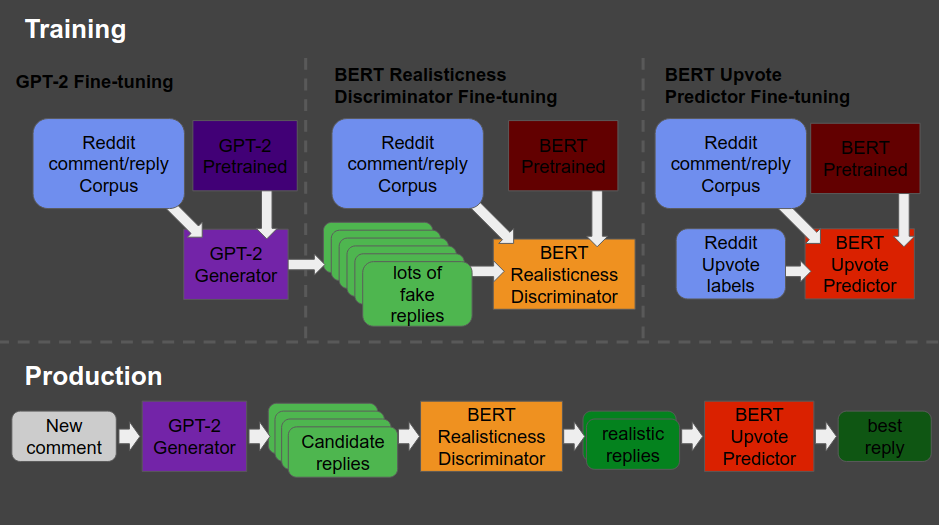
What Will’s final architecture, combining GPT-2 and BERT, looked like (via bonkerfield.org)

The results are astonishing! Will’s bot sounds like a real youngster internet troll! Do have a look at the original blog, but here are some examples. Note that tupperware-party — the Reddit user from the above example — is actually Will’s AI.
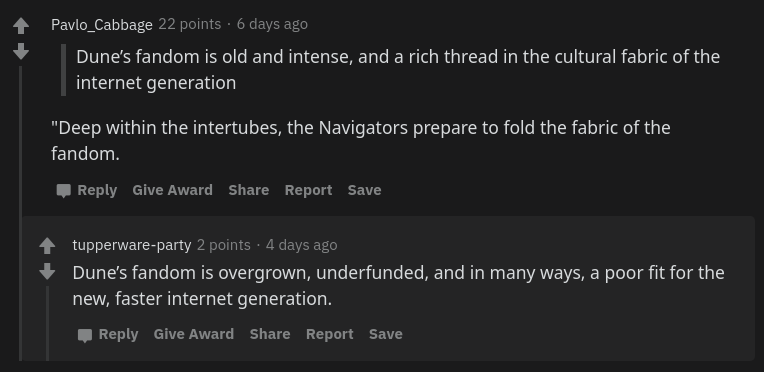
COMMENT: 'Dune’s fandom is old and intense, and a rich thread in the cultural fabric of the internet generation' BOT_REPLY:'Dune’s fandom is overgrown, underfunded, and in many ways, a poor fit for the new, faster internet generation.'
bot responds to specific numerical bullet point in source comment

Will ends his blog with a link to the tutorial if you want to build such a bot yourself. Have a try!

Moreover, he also notes the ethical concerns:

I know there are definitely some ethical considerations when creating something like this. The reason I’m presenting it is because I actually think it is better for more people to know about and be able to grapple with this kind of technology. If just a few people know about the capacity of these machines, then it is more likely that those small groups of people can abuse their advantage.

I also think that this technology is going to change the way we think about what’s important about being human. After all, if a computer can effectively automate the paper-pushing jobs we’ve constructed and all the bullshit we create on the internet to distract us, then maybe it’ll be time for us to move on to something more meaningful.

If you think what I’ve done is a problem feel free to email me , or publically shame me on Twitter.

Will Stedden via bonkerfield.org/2020/02/combining-gpt-2-and-bert/

Building a $86 million car theft AI in 57 lines of JavaScript

Building a $86 million car theft AI in 57 lines of JavaScript

Tait Brown was annoyed at the Victoria Police who had spent $86 million Australian dollars on developing the BlueNet system which basically consists of an license-plate OCR which crosschecks against a car theft database.

Tait was so disgruntled as he thought he could easily replicate this system without spending millions and millions of tax dollars. And so he did. In only 57 lines of JavaScript, though, to be honest, there are many more lines of code hidden away in abstraction and APIs…

Anyway, he built a system that can identify license plates, read them, and should be able to cross check them with a criminal database.

Via Medium

I really liked reading about this project, so please do so if you’re curious via the links below:

Part 1: How I replicated an $86 million project in 57 lines of code

Part 2: Remember the $86 million license plate scanner I replicated?

Part X: the code on Github

Cover image via Medium via Freepik

The 12 Truths of Machine Learning – by Delip Rao

The 12 Truths of Machine Learning – by Delip Rao

In this original blog, with equally original title, Delip Rao poses twelve (+1) harsh truths about the real world practice of machine learning. I found it quite enlightning to read a non-hyped article about ML for once. Particularly because Delip’s experiences seem to overlap quite nicely with the principles of software design and Agile working.

Delip’s 12 truths I’ve copied in headers below. If they spark your interest, read more here:

  1. It has to work
  2. No matter how hard you push and no matter what the priority, you can’t increase the speed of light
  3. With sufficient thrust, pigs fly just fine. However, this is not necessarily a good idea
  4. Some things in life can never be fully appreciated nor understood unless experienced firsthand
  5. It is always possible to agglutinate multiple separate problems into a single complex interdependent solution. In most cases, this is a bad idea
  6. It is easier to ignore or move a problem around than it is to solve it
  7. You always have to tradeoff something
  8. Everything is more complicated than you think
  9. You will always under-provision resources
  10. One size never fits all. Your model will make embarrassing errors all the time despite your best intentions
  11. Every old idea will be proposed again with a different name and a different presentation, regardless of whether it works
  12. Perfection has been reached not when there is nothing left to add, but when there is nothing left to take away

Delip added in a +1, with his zero-indexed truth: You are Not a Scientist.

Yes, that’s all of you building stuff with machine learning with a “scientist” in the title, including all of you with PhDs, has-been-academics, and academics with one foot in the industry. Machine learning (and other AI application areas, like NLP, Vision, Speech, …) is an engineering research discipline (as opposed to science research).

Delip Rao via deliprao.com/archives/227

Delip [bio] is the VP of Research at AI Foundation where he leads speech, language, and vision research efforts for generating and detecting artificial content. You can find his personal webblog here.

Cover image via the-vital-edge.com/lie-detector

Why cancer screening is the last thing you should pick first to work on with AI

Why cancer screening is the last thing you should pick first to work on with AI

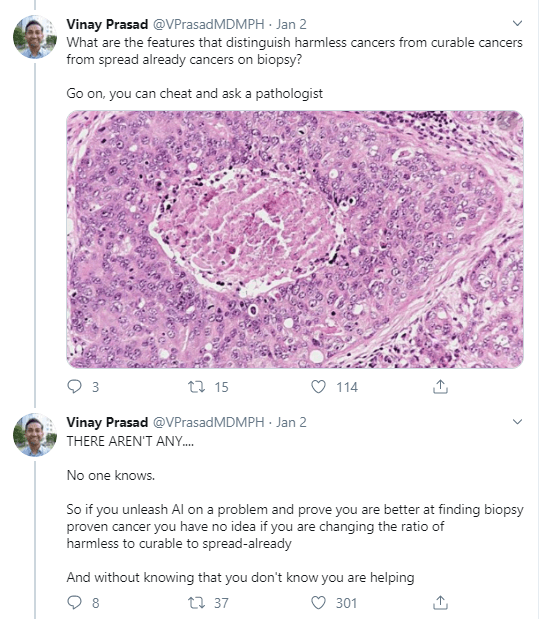
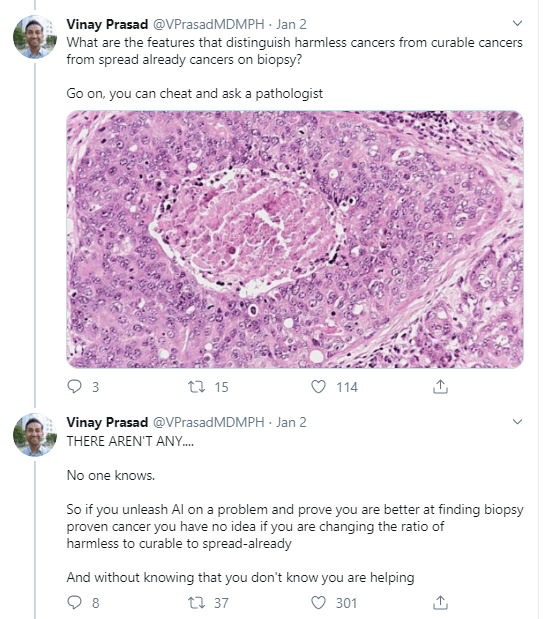
I came across this opinionated though informed commentary by Vinay Prasad on the recent Nature article where Google’s machine learning experts trained models to predict whether scans of patients’ breasts (mammogram’s) show cancerous cells or not.

Vinay Prasad [official bio] is a practicing hematologist-oncologist and Associate Professor of Medicine at Oregon Health and Science University. So he knows what he’s talking about.

He argues that “cancer screening is the LAST thing you should pick FIRST to work on with AI”. Which is an interesting statement in and of itself.

Regardless of my personal opinion on the topic, I found the paper, Vinay’s commentary, and the broader discussion on twitter very interesting and educational to read. I feel it shows how important it is to know the context in which you are applying machine learning. What tremendous value it provides to have domain experts in the same team as the data and machine learning experts.

I cannot explain this better than Vinay himself, so please have a read of the original twitter thread here:

If you’re interested in this kind of topics, I wrote about IBM’s Watson adventures in health analytics a few years back: https://paulvanderlaken.com/2017/09/12/ibms-watson-for-oncology-a-biased-and-unproven-recommendation-system-in-cancer-treatment/

An excerpt from the twitter thread
Animated Machine Learning Classifiers

Animated Machine Learning Classifiers

Ryan Holbrook made awesome animated GIFs in R of several classifiers learning a decision rule boundary between two classes. Basically, what you see is a machine learning model in action, learning how to distinguish data of two classes, say cats and dogs, using some X and Y variables.

These visuals can be great to understand these algorithms, the models, and their learning process a bit better.

Here’s the original tweet, with the logistic regression animation. If you follow it, you will find a whole thread of classifier GIFs. These I extracted, pasted, and explained below.

Below is the GIF which I extracted using EZgif.com.

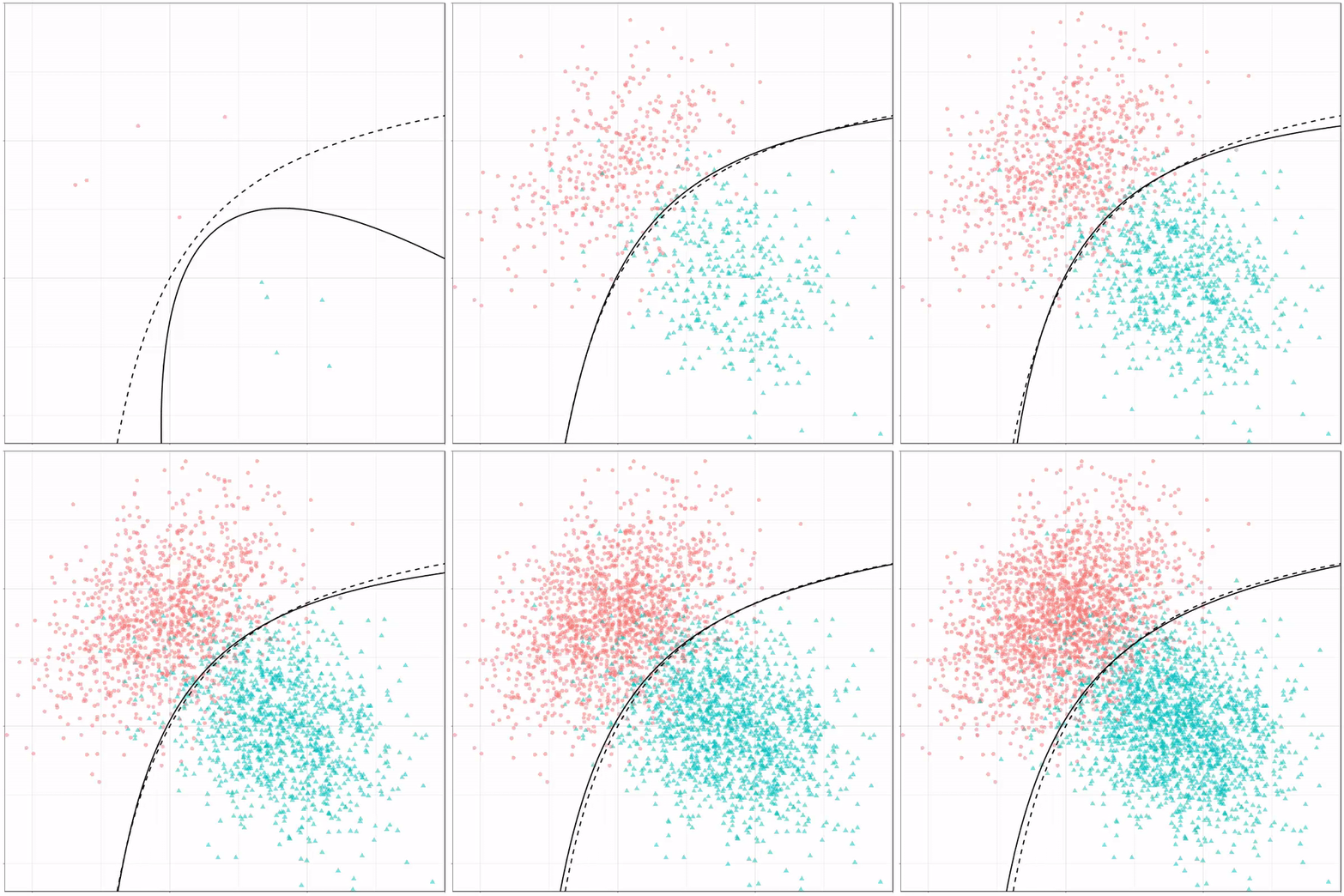
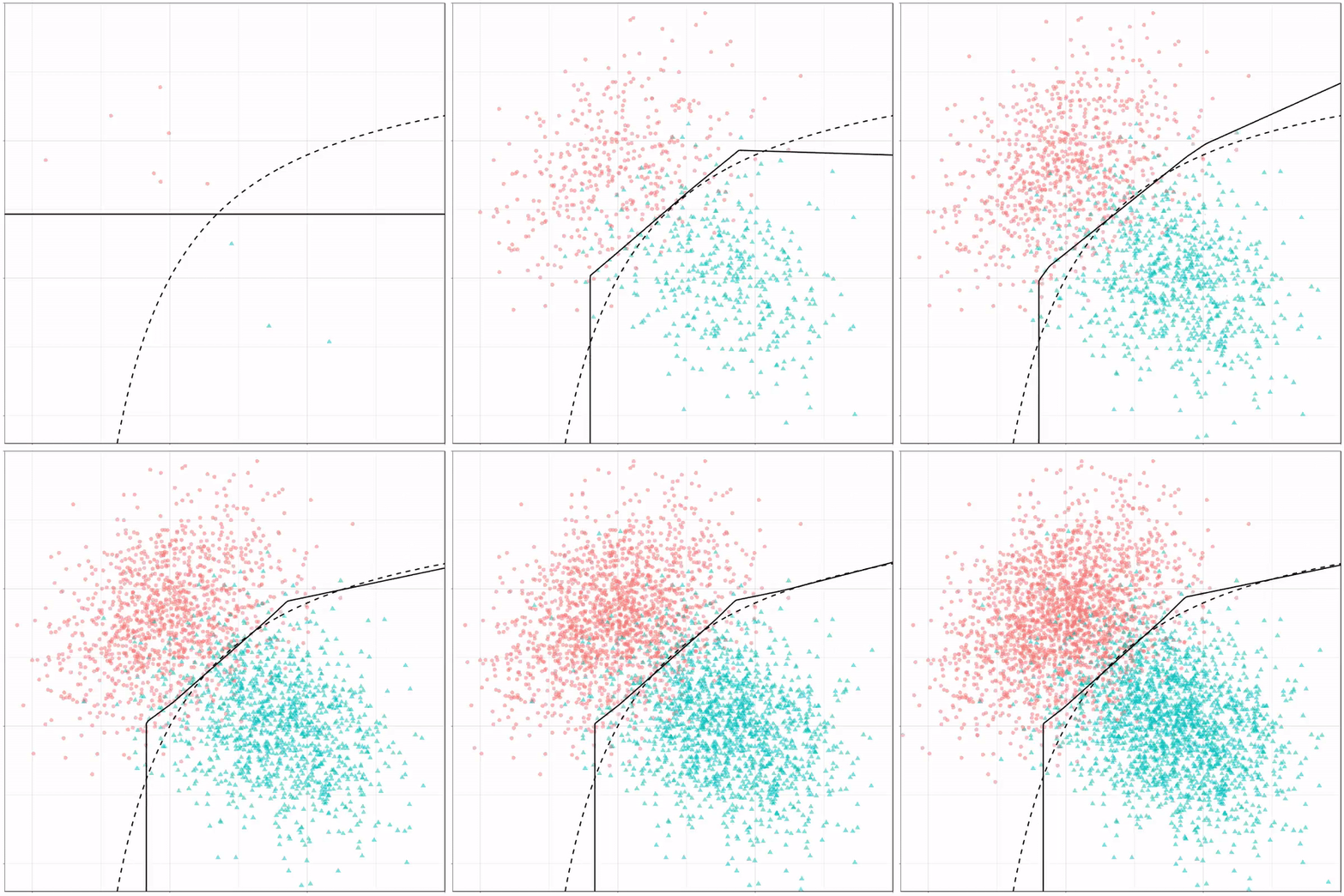
What you see is observations from two classes, say cats and dogs, each represented using colored dots. The dots are placed along X and Y axes, which represent variables about the observations. Their tail lengths and their hairyness, for instance.

Now there’s an optimal way to seperate these classes, which is the dashed line. That line best seperates the cats from the dogs based on these two variables X and Y. As this is an optimal boundary given this data, it is stable, it does not change.

However, there’s also a solid black line, which does change. This line represents the learned boundary by the machine learning model, in this case using logistic regression. As the model is shown more data, it learns, and the boundary is updated. This learned boundary represents the best line with which the model has learned to seperate cats from dogs.

Anything above the boundary is predicted to be class 1, a dog. Everything below predicted to be class 2, a cat. As logistic regression results in a linear model, the seperation boundary is very much linear/straight.

Logistic regression gif by Ryan Holbrook

These animations are great to get a sense of how the models come to their boundaries in the back-end.

For instance, other machine learning models are able to use non-linear boundaries to dinstinguish classes, such as this quadratic discriminant analysis (qda). This “learned” boundary is much closer to the optimal boundary:

Quadratic discriminant analysis gif by Ryan Holbrook

Models using multivariate adaptive regression splines (or MARS) seem to result in multiple linear boundaries pasted together:

Multivariate adaptive regression splines gif by Ryan Holbrook

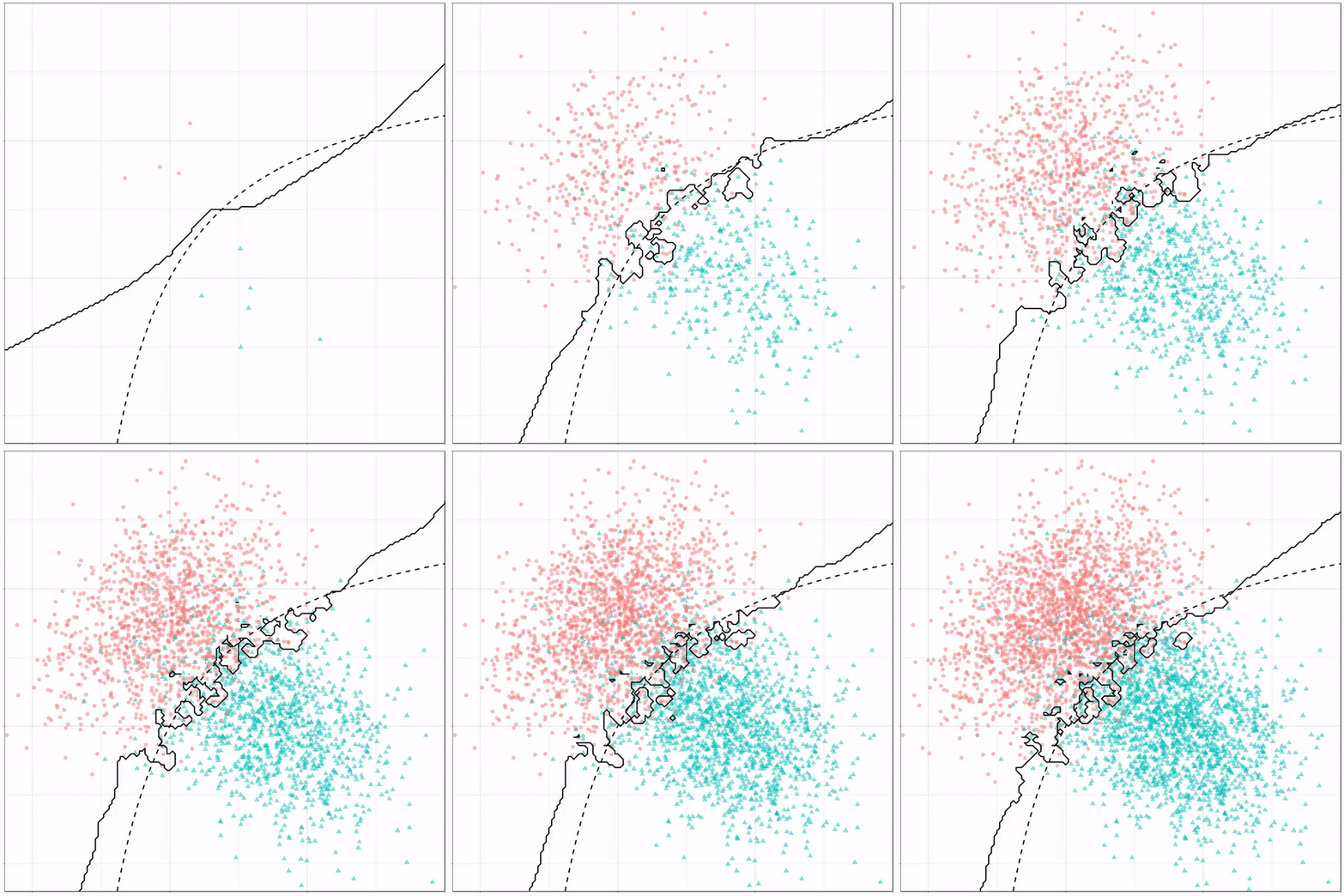
Next, we have the k-nearest neighbors algorithm, which predicts for each point (animal) the class (cat/dog) based on the “k” points closest to it. As you see, this results in a highly fluctuating, localized boundary.

K-nearest neighbors gif by Ryan Holbrook

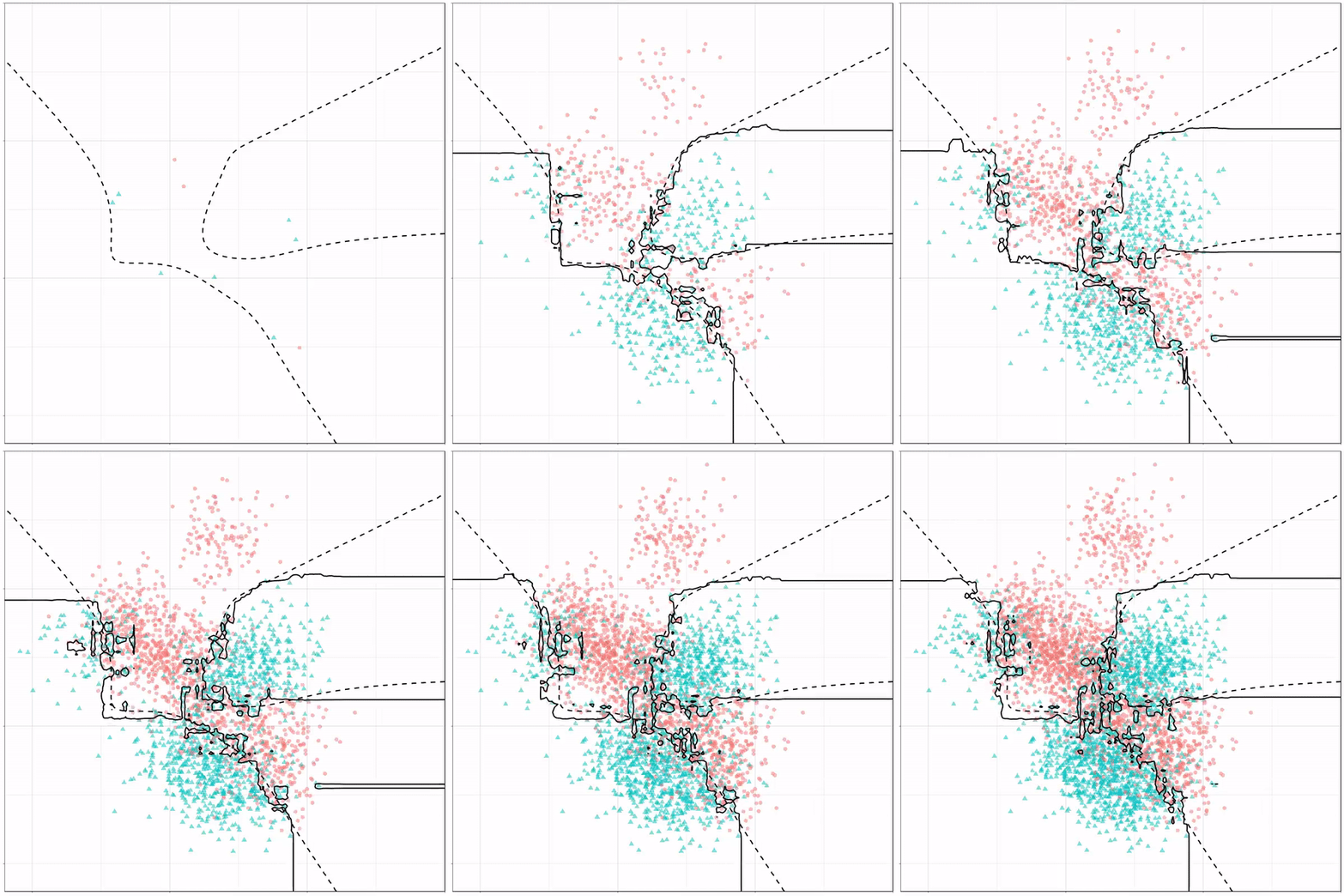
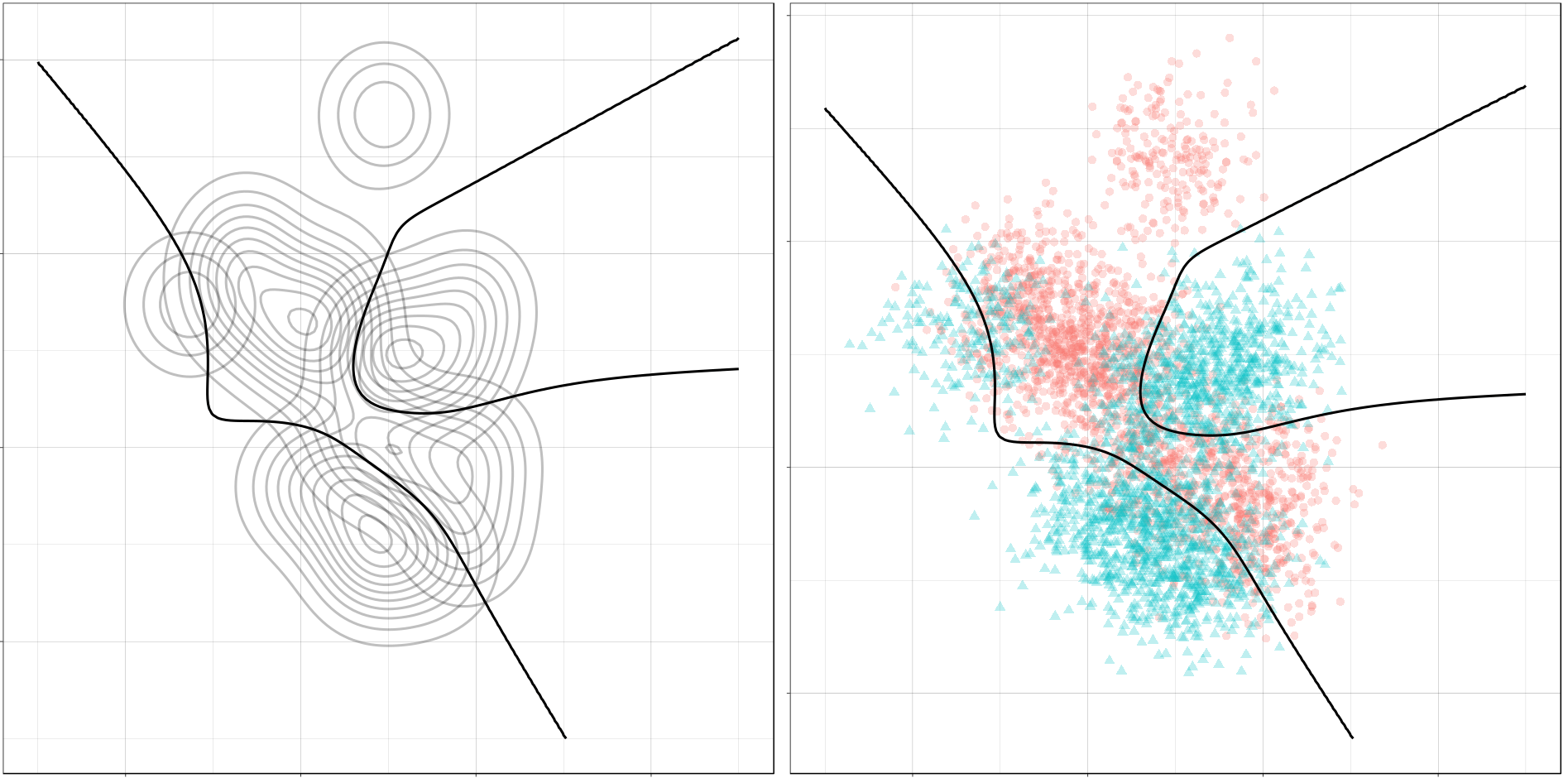
Now, Ryan decided to push the challenge, and simulate new data for two classes with a more difficult decision boundary. The new data and optimal boundaries look like this:

The optimal decision boundary.
Via https://mathformachines.com/posts/decision/

On these data, Ryan put a whole range of non-linear models to work.

Like this support-vector machine, which tries to create optimal boundaries built of support vectors around all the cats and all the dohs (this is definitely not a technical, error-free explanation of what’s happening here).

Support vector machine gif by Ryan Holbrook

Generalized additive models are also cool to see in action. Why Ryan’s versions render so slowly, I don’t know. To learn more about GAMs, I strongly advise this tutorial here.

Generalized additive model gif by Ryan Holbrook

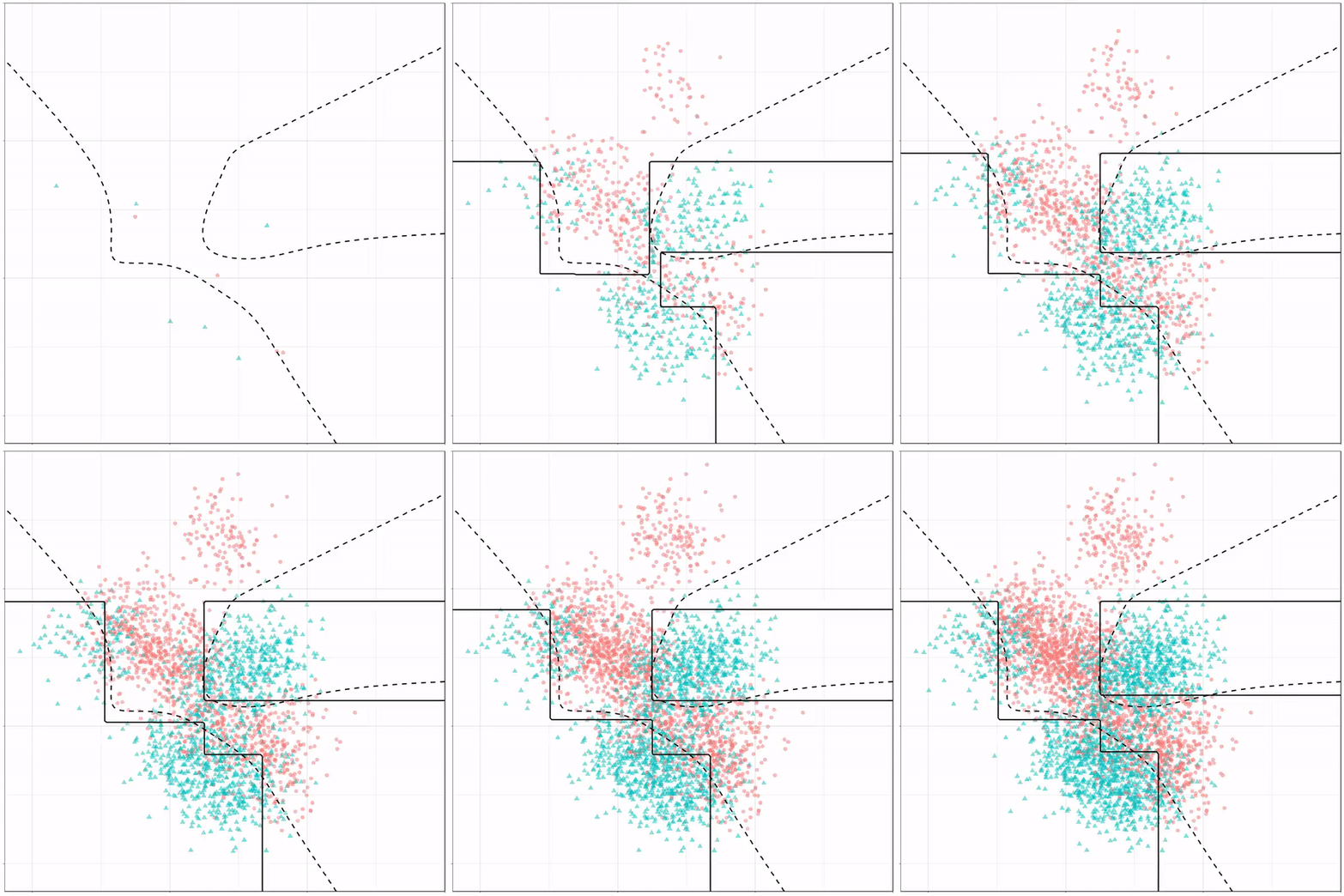
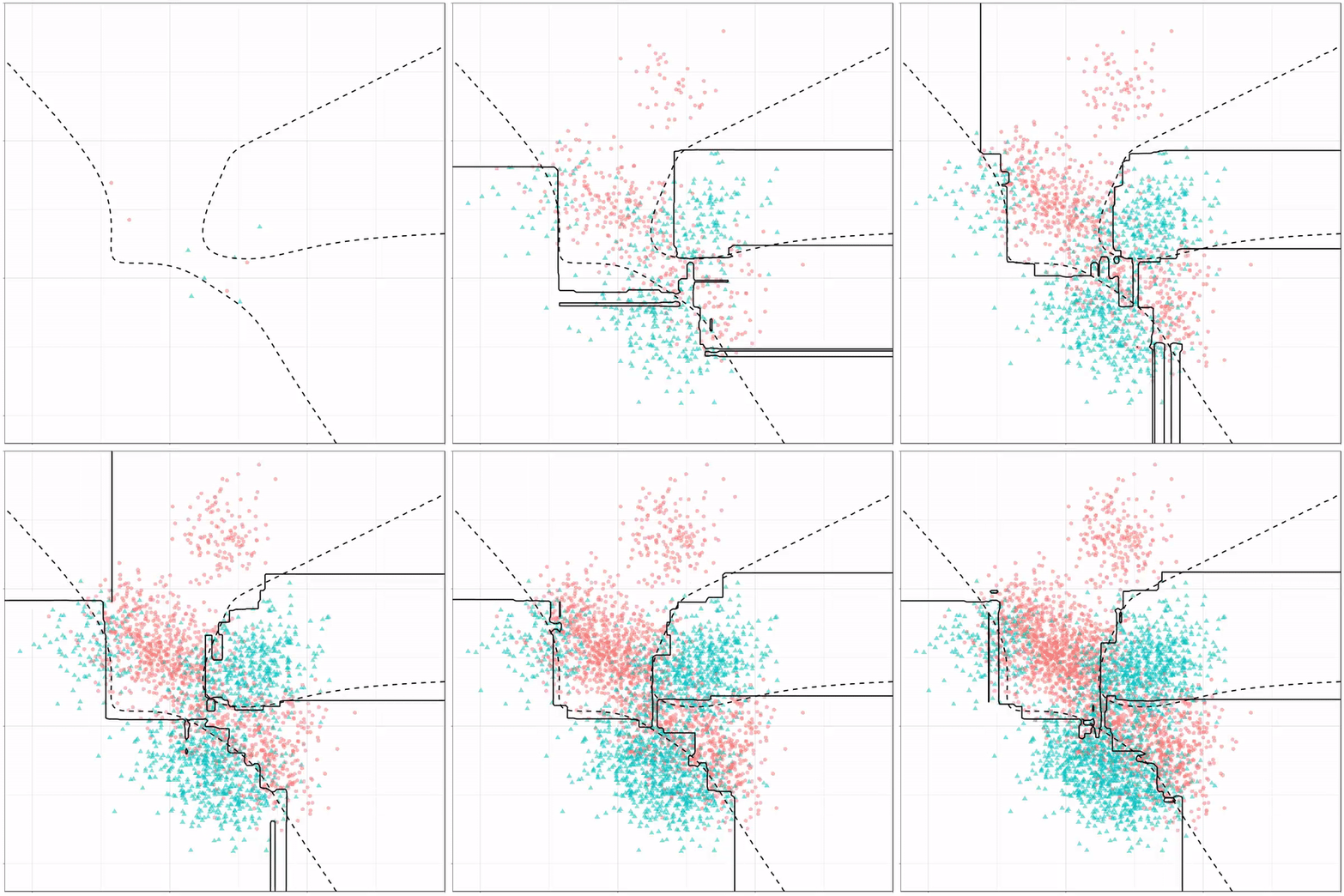
Let’s jump into some tree-based algorithms and the resulting models. A decision tree classifies data based on multiple, sequential, binary splits. Here, Ryan trained a simple decision tree:

Decision tree gif by Ryan Holbrook

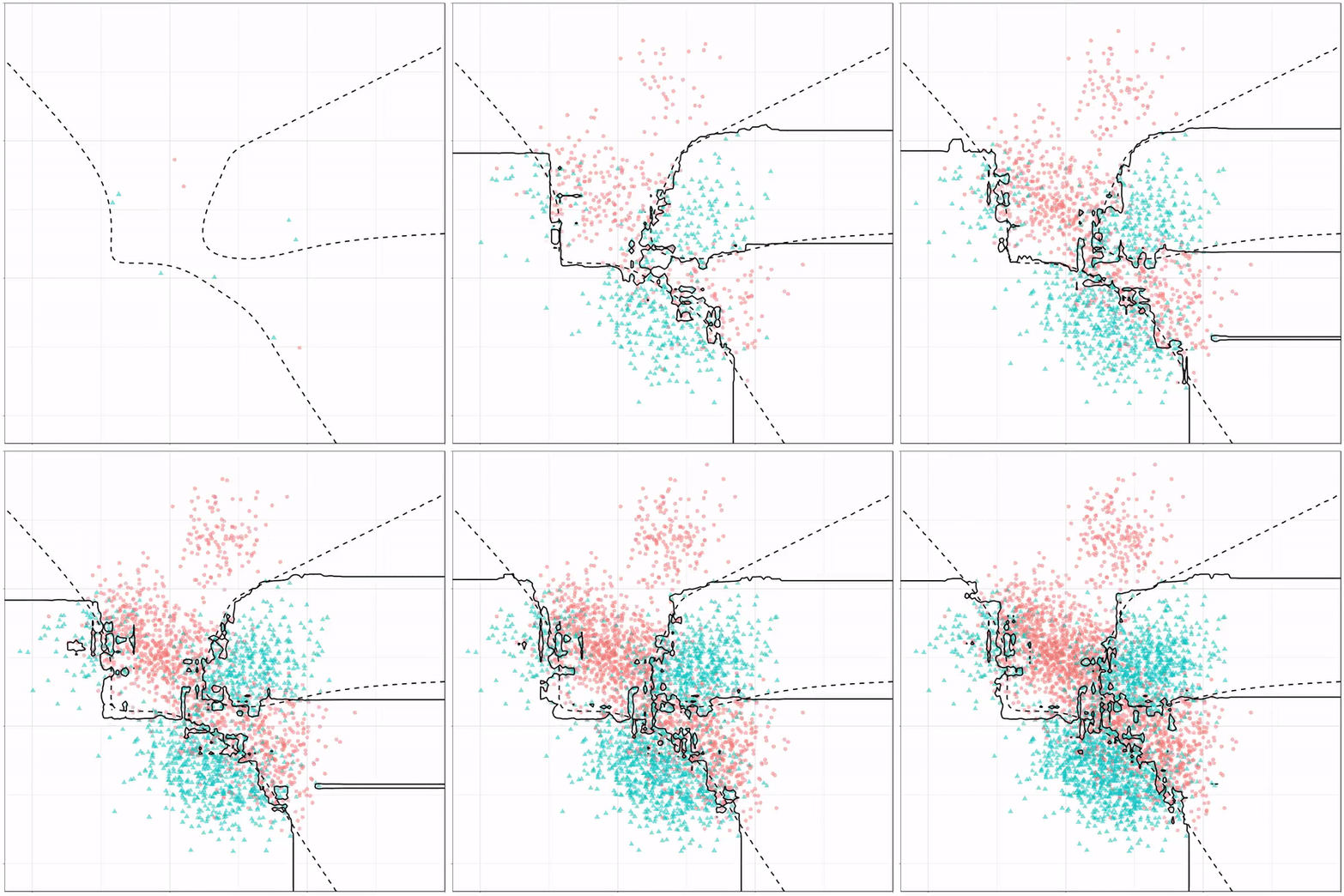
As well as it’s big brother, a random forest, which uses hundreds of trees in the back end and thus results in a more flexible boundary:

Random forest gif by Ryan Holbrook

Extreme gradient boosting is also a tree-based algorithm, which leverages many machine learning techniques to optimize the bias-variance tradeoff. Here’s an earlier blog on how to get started with Xgboost in Python or R:

Extreme gradient boosting gif by Ryan Holbrook

Finally, a machine learning project is not complete without an artificial neural network. Learn more on these here:

Artificial neural network gif by Ryan Holbrook

If you want to know more about this project of Ryan Holbrook, do have a look at his accompanying blog here. You can also find Ryan’s code here on github.

AI Book Review: You look like a thing and I love you

AI Book Review: You look like a thing and I love you

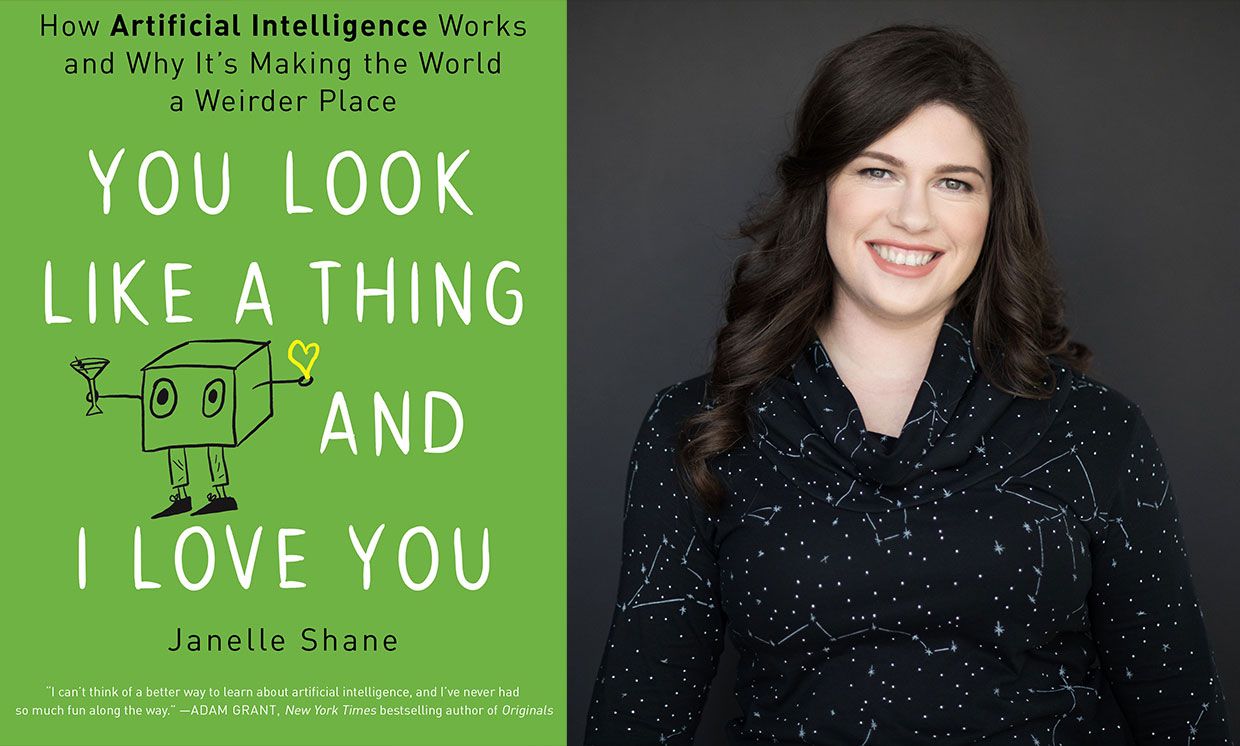
The following are my summary and take-aways from Janelle Shane’s 2019 book named You look like a thing and I love you. Most of the below are excerpts from Janelle’s book, combined, or rewritten by me. For the sake of copyright, just consider everything Janelle’s : )

Image result for things called ai janelle shane

AI weirdness

You look like a thing and I love you is about AI. More specifically, the book is about what AI can and can not do. And how and why AI often fails in miserably hilareous ways.

Janelle has spend her time foing fun experiments with AI. In this book, she shares those experiments along with many real life examples of AIs in practice. While explaining the technical details behind these AIs in an accesible though technically correct way, she informs the reader where, how, and why AIs fail.

Janelle took AIs out of their comfort zone and it produced some hilareously weird results. She proposes five principles of AI Weirdness:

  1. The danger of AI is not that it’s too smart, but that it’s not smart enough
  2. AI has the approximate brainpower of a worm
  3. AI does not really understand the problem you want it to solve
  4. But: AI will do exactly what you tell it to. Or at least it will try its best.
  5. And AI willt ake the path of the least resistance

Definitions: What is (not) AI?

If it seems like AI is everywhere, it’s partly because Artificial Intelligence means lots of things, depending on whether you’re reading science fiction or selling a new app or doing academic research.

To spot an AI in the wild, it’s important to know the difference between machine learning algorithms (what Janelle calls AI in her book) and traditional, rules-based programs.

To solve a problem with a rules-based program, you have to know every step required to complete the program’s task and how to describe each one of those steps. But a machine learning algorithm figures out the rules for itself via trail and error, gauging its success on goals the programmer has specified. As the AI tries to reach this goal, it can discover rules and correlations that the programmer didn’t even know existed. This is what makes AIs attractive problem solvers and is particularly handy if the rules are really complicated or just plain mysterious.

Sometimes an AI’s brilliant problem-solving rules actually rely on mistaken assumptions. Rules that served it well in training but fail miserably when it encountered the real world. While training errors are common in complex AIs, the consequences of these mistakes can be serious.

It’s often not easy to tell when AIs make mistakes. Since we don’t write the rules, they come up with their own, and they don’t write them down or explain them the way a human would.

The difference between succesful AI problem solving and failure usually has a lot to do with the suitability of the task for an AI solution. And there are plenty of tasks for which AI solutions are more efficient than human solutions. But there are also plenty of cases where things go miserably wrong.

Janelle proposes four signs of “AI Doom”, contexts where machine learning will not produce the desired results:

  1. The problem is too hard, broad, or complex
  2. The problem is not what we thought it was
  3. There are sneaky shortcuts to solving the problem
  4. The AI tried to solve the problem learning from flawed data

Programming an AI is almost more like teaching a child than programming a computer.

Explaining how AI works

In her book, Janelle takes us through many example problems which she or others tried to solve using AIs. These example problems are increasingly hilareous, but I assure you that they are technically and didactically sound:

  • Playing tic-tac-toe
  • Managing a cockroach farm
  • Riding a bicycle
  • Rating sandwich deliciousness
  • Tossing a sandwich into a wall
  • Guiding people through a hallway
  • Answering questions regarding photo’s
  • Categorizing doodles
  • Categorizing fish
  • Tossing pancakes
  • Autonomous walking
  • Autonomous driving
  • Playing Pacman

The amazing thing is these ridiculous example problems actually serve a purpose. They are used to explain different algorithms and their applications, strengths, and limitations! Janelle covers a wide variety of algorithms in such a way that anyone new to machine learning would understand, while people with some experience will still be amused.

Janelle talks about artificial neural networks, random forests, and markov chains. Moreover, she explains how activation functions, recurrancy and long short-term memory, evolutionary algorithms and gradient descent work. And all in understandable though technically correct language.

Janelle herself seems particularly fond of generative algorithms. She’s elaborates on having deployed recurrent neural nets, generative adversial networks, and markov chains for a wide variety of generative tasks. In the book, Jabekke explains what went well and went wrong when coming up with new and original…

  • pick-up lines
  • knock-knock jokes
  • names for species of birds
  • perfumes names
  • ice-cream flavors
  • cooking recipes
  • dream descriptions
  • horse drawings
  • Harry Potter scripts
  • cat names
  • Halloween costumes
  • elementary school blueprints
  • names for Benedict Cumberbatch
  • Dungeons and Dragons spells
  • pie recipes

Where does AI fail?

Janelle’s book is lingered with examples of failing AI. As a matter of fact, the whole book seems like an ode to how machine learning can and will inevitably fail. Particularly in the latter chapters, Janelle covers many limitations of and issues with AI in much detail:

  • class imbalance
  • overfitting
  • unrealistic simulation conditions
  • data quality issues
  • self-fullfilling prophecies
  • undesirable reward function optimization
  • missing the obvious
  • catastrophic forgetting
  • human biases in the data
  • machine bias
  • math-washing / bias laundering
  • bias amplification
  • adversarial attacks

Definite recommendation

I have yet to come across a book that explain AI in this much detail and in a manner as accessible and entertaining as Janelle Shane does in You look like a thing and I love you. Janelle makes machine learning and AI understandable for a wide public without passing on the deeper technical details. Taking a critical stance, she provides a good overview of the strenghts and weaknesses of AI, and a realistic outlook for the future to come. This book is not looking for sensation or hype, although reading it will be a most amusing experience for the more technical as well as the lay reader.

I highly recommend you reward yourself with a copy!