Category: python

Dynamic Programming MIT Course

Dynamic Programming MIT Course

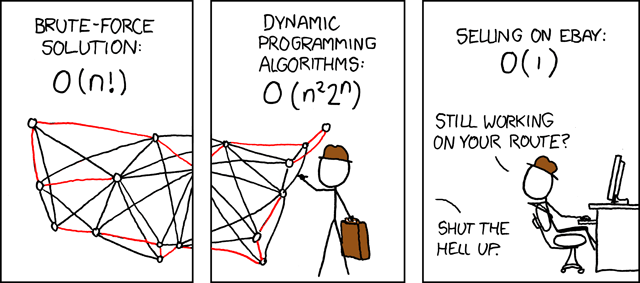
Cover image by xkcd

Over the last months I’ve been working my way through Project Euler in my spare time. I wanted to learn Python programming, and what better way than solving mini-problems and -projects?!

Well, Project Euler got a ton of these, listed in increasing order of difficulty. It starts out simple: to solve the first problem you need to write a program to identify multiples of 3 and 5. Next, in problem two, you are asked to sum the first thousand even Fibonacci numbers. Each problem, the task at hand gets slighly more difficult…
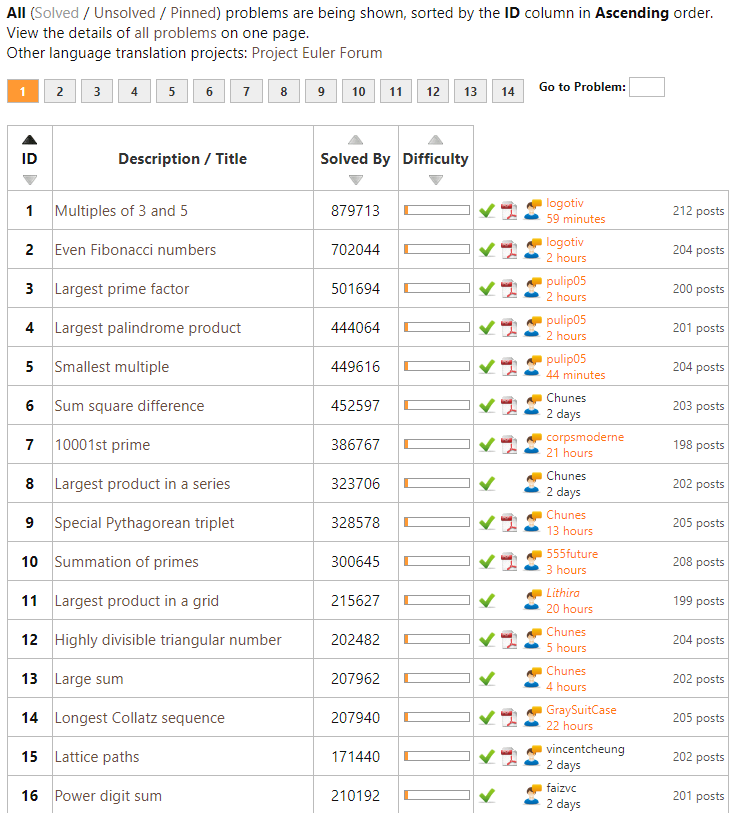
For me, Project Euler combines math, programming, and stats in a way that really keeps me motivated to continue and learn new concepts and programming / problem-solving approaches.

However, at problem 31, I really got stuck. For several hours, I struggled to solve it in a satisfactory fashion, even though most other problems only take 5-90 minutes.
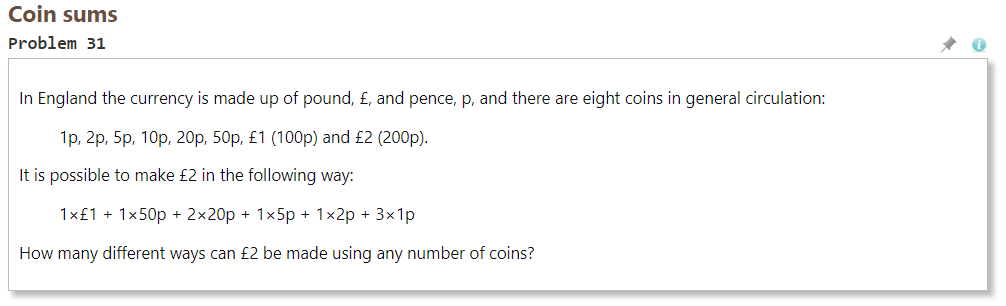
After hours of struggling, I pretty much gave up, and googled some potential solutions. Aparently, the way to solve problem 31, is to take a so-called dynamic programming approach.

Dynamic programming is both a mathematical optimization method and a computer programming method. The method was developed by Richard Bellman in the 1950s and has found applications in numerous fields, from aerospace engineering to economics. In both contexts it refers to simplifying a complicated problem by breaking it down into simpler sub-problems in a recursive manner. While some decision problems cannot be taken apart this way, decisions that span several points in time do often break apart recursively. Likewise, in computer science, if a problem can be solved optimally by breaking it into sub-problems and then recursively finding the optimal solutions to the sub-problems, then it is said to have optimal substructure.

https://en.wikipedia.org/wiki/Dynamic_programming

Now, this sounded like something I’d like to learn more about! I was already quite familiar with recursive problems and solutions, but this dynamic programming sounded next-level.

So I googled and googled for tutorials and other resources, and I finally came across this free 2011 MIT course that I intend to view over the coming weeks.

There’s even a course website with additional materials and assignments (in Python).

ASSN #TOPICSPROBLEM SETSSOLUTIONS
1Asymptotic complexity, recurrence relations, peak findingProblem Set 1 (PDF)
Problem Set 1 Code (ZIP)
Problem Set 1 Solutions (PDF)
2Fractal rendering, digital circuit simulationProblem Set 2 (PDF)
Problem Set 2 Code (ZIP)
Problem Set 2 Solutions (PDF)
Problem Set 2 Code Solutions (ZIP – 7.7MB)
3Range queries, digital circuit layoutProblem Set 3 (PDF)
Problem Set 3 Code (ZIP – 3.2MB)
Problem Set 3 Solutions (PDF)
Problem Set 3 Code Solutions (ZIP – 15.7MB)
4Hash functions, Python dictionaries, matching DNA sequencesProblem Set 4 (PDF)
Problem Set 4 Code (GZ – 12.4MB) (kfasta.py courtesy of Kevin Kelley, and used with permission.)
Problem Set 4 Solutions (PDF)
Problem Set 4 Code Solutions (ZIP)
5The Knight’s Shield, RSA public key encryption, image decryptionProblem Set 5 (PDF)
Problem Set 5 Code (ZIP)
Problem Set 5 Grading Explanation (PDF)
Problem Set 5 Solutions (PDF)
Problem Set 5 Code Solutions (ZIP)
6Social networks, Rubik’s Cube, DijkstraProblem Set 6 (PDF)
Problem Set 6 Code (ZIP – 2.9MB) (nhpn.py courtesy of Punyashloka Biswal and Michael Lieberman; Pocket Cube Solver courtesy of Huan Liu and Anh Nguyen. Used with permission.)
Problem Set 6 Solutions (PDF)
Problem Set 6 Code Solutions (ZIP)
7Seam carving, stock purchasing and knapsackProblem Set 7 (PDF)
Seam Carving for Content-Aware Image ResizingProblem Set 7 Code (ZIP) (Sunset image © source unknown. All rights reserved. This content is excluded from our Creative Commons license. For more information, see http://ocw.mit.edu/fairuse.)Problem Set 7 Answer Template (ZIP)Problem Set 7 Grading Explanation (PDF)
Problem Set 7 Solutions (PDF)
Problem Set 7 Code Solutions (ZIP)

Will you join me? And let me know what you think!

For those less interested in (dynamic) programming but mostly in machine learning, there’s this other great MIT OpenCourseWare youtube playlist of their Artificial Intelligence course. I absolutely loved that course and I really powered through it in a matter of weeks (which is why I am already psyched about this new one). I learned so much new concepts, and I strongly recommend it. Unfortunately, the professor recently passed away.

Learn Programming Project-Based: Build-Your-Own-X

Learn Programming Project-Based: Build-Your-Own-X

Last week, this interesting reddit thread was filled with overviews for cool projects that may help you learn a programming language. The top entries are:

There’s a wide range of projects you can get started on building:

If you want to focus on building stuff in a specific programming language, you can follow these links:

If you’re really into C, then follow these links to build your own:

Artificial Stupidity – by Vincent Warmerdam @PyData 2019 London

Artificial Stupidity – by Vincent Warmerdam @PyData 2019 London

PyData is famous for it’s great talks on machine learning topics. This 2019 London edition, Vincent Warmerdam again managed to give a super inspiring presentation. This year he covers what he dubs Artificial Stupidity™. You should definitely watch the talk, which includes some great visual aids, but here are my main takeaways:

Vincent speaks of Artificial Stupidity, of machine learning gone HorriblyWrong™ — an example of which below — for which Vincent elaborates on three potential fixes:

Image result for paypal but still learning got scammed
Example of a model that goes HorriblyWrong™, according to Vincent’s talk.

1. Predict Less, but Carefully

Vincent argues you shouldn’t extrapolate your predictions outside of your observed sampling space. Even better: “Not predicting given uncertainty is a great idea.” As an alternative, we could for instance design a fallback mechanism, by including an outlier detection model as the first step of your machine learning model pipeline and only predict for non-outliers.

I definately recommend you watch this specific section of Vincent’s talk because he gives some very visual and intuitive explanations of how extrapolation may go HorriblyWrong™.

Be careful! One thing we should maybe start talking about to our bosses: Algorithms merely automate, approximate, and interpolate. It’s the extrapolation that is actually kind of dangerous.

Vincent Warmerdam @ Pydata 2019 London

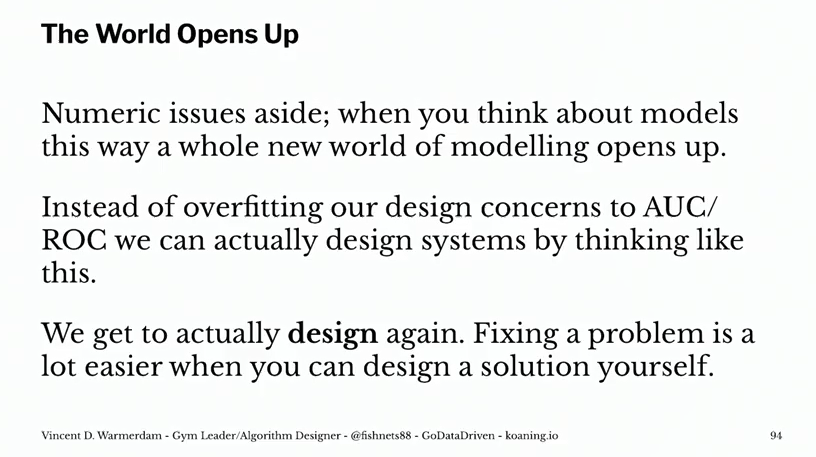
Basically, we can choose to not make automated decisions sometimes.

2. Constrain thy Features

What we feed to our models really matters. […] You should probably do something to the data going into your model if you want your model to have any sort of fairness garantuees.

Vincent Warmerdam @ Pydata 2019 London

Often, simply removing biased features from your data does not reduce bias to the extent we may have hoped. Fortunately, Vincent demonstrates how to remove biased information from your variables by applying some cool math tricks.

Unfortunately, doing so will often result in a lesser predictive accuracy. Unsurprisingly though, as you are not closely fitting the biased data any more. What makes matters more problematic, Vincent rightfully mentions, is that corporate incentives often not really align here. It might feel that you need to pick: it’s either more accuracy or it’s more fairness.

However, there’s a nice solution that builds on point 1. We can now take the highly accurate model and the highly fair model, make predictions with both, and when these predictions differ, that’s a very good proxy where you potentially don’t want to make a prediction. Hence, there may be observations/samples where we are comfortable in making a fair prediction, whereas in most other situations we may say “right, this prediction seems unfair, we need a fallback mechanism, a human being should look at this and we should not automate this decision”.

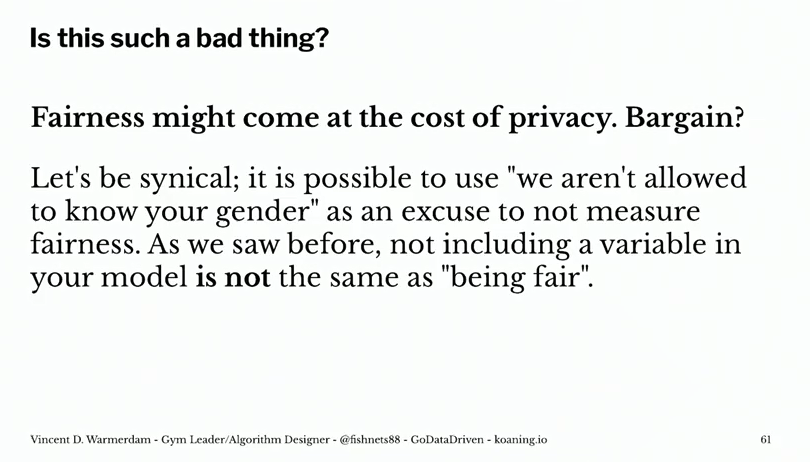
Vincent does not that this is only one trick to constrain your model for fairness, and that fairness may often only be fair in the eyes of the beholder. Moreover, in order to correct for these biases and unfairness, you need to know about these unfair biases. Although outside of the scope of this specific topic, Vincent proposes this introduces new ethical issues:

Basically, we can choose to put our models on a controlled diet.

3. Constrain thy Model

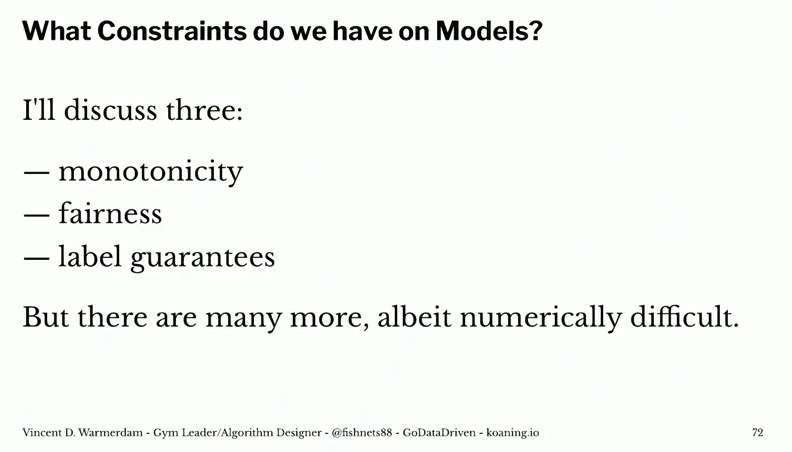
Vincent argues that we should include constraints (based on domain knowledge, or common sense) into our models. In his presentation, he names a few. For instance, monotonicity, which implies that the relationship between X and Y should always be either entirely non-increasing, or entirely non-decreasing. Incorporating the previously discussed fairness principles would be a second example, and there are many more.

If we every come up with a model where more smoking leads to better health, that’s bad. I have enough domain knowledge to say that that should never happen. So maybe I should just make a system where I can say “look this one column with relationship to Y should always be strictly negative”.

Vincent Warmerdam @ Pydata 2019 London

Basically, we can integrate domain knowledge or preferences into our models.

Conclusion: Watch the talk!

Python for R users

Python for R users

Wanting to broaden your scope and learn a new programming language? This great workshop was given at EARL 2018 by Mango Solutions and helps R programmers transition into Python building on their existing R knowledge. The workshop includes exercises that introduce you to the key concepts of Python and some of its most powerful packages for data science, including numpy, pandas, sklearn, and seaborn.

Have a look at the associated workshop guide that walk you through the assignments, or at the github repo with all materials in Jupyter notebooks.

E-Book: Probabilistic Programming & Bayesian Methods for Hackers

E-Book: Probabilistic Programming & Bayesian Methods for Hackers

The Bayesian method is the natural approach to inference, yet it is hidden from readers behind chapters of slow, mathematical analysis. Nevertheless, mathematical analysis is only one way to “think Bayes”. With cheap computing power, we can now afford to take an alternate route via probabilistic programming.

Cam Davidson-Pilon wrote the book Bayesian Methods for Hackers as a introduction to Bayesian inference from a computational and understanding-first, mathematics-second, point of view.

The book is available via Amazon, but you can access an online e-book for free. There’s also an associated GitHub repo.

The book explains Bayesian principles with code and visuals. For instance:

%matplotlib inline
from IPython.core.pylabtools import figsize
import numpy as np
from matplotlib import pyplot as plt
figsize(11, 9)

import scipy.stats as stats

dist = stats.beta
n_trials = [0, 1, 2, 3, 4, 5, 8, 15, 50, 500]
data = stats.bernoulli.rvs(0.5, size=n_trials[-1])
x = np.linspace(0, 1, 100)

for k, N in enumerate(n_trials):
    sx = plt.subplot(len(n_trials)/2, 2, k+1)
    plt.xlabel("$p$, probability of heads") \
        if k in [0, len(n_trials)-1] else None
    plt.setp(sx.get_yticklabels(), visible=False)
    heads = data[:N].sum()
    y = dist.pdf(x, 1 + heads, 1 + N - heads)
    plt.plot(x, y, label="observe %d tosses,\n %d heads" % (N, heads))
    plt.fill_between(x, 0, y, color="#348ABD", alpha=0.4)
    plt.vlines(0.5, 0, 4, color="k", linestyles="--", lw=1)

    leg = plt.legend()
    leg.get_frame().set_alpha(0.4)
    plt.autoscale(tight=True)


plt.suptitle("Bayesian updating of posterior probabilities",
             y=1.02,
             fontsize=14)

plt.tight_layout()

I can only recommend you start with the online version of Bayesian Methods for Hackers, but note that the print version helps sponsor the author ánd includes some additional features:

  • Additional Chapter on Bayesian A/B testing
  • Updated examples
  • Answers to the end of chapter questions
  • Additional explanation, and rewritten sections to aid the reader.

If you’re interested in learning more about Bayesian analysis, I recommend these other books:

Python vs. R for Data Science, by Norm Matloff

Python vs. R for Data Science, by Norm Matloff

Cover image via Hacker Noon.

Norm Matloff is a professor of Computer Science at University College Davis. He recently updated his viewpoint on whether R or Python is the best language for Data Science. While I normally hate those opinionated comparisons, Norm’s outline of the two languages’ (dis)advantages is actually quite balanced and well-versed.

I strongly recommend that you read Norm’s original piece here.

I can mostly agree with Norm, although the blog reads as if he has a (slight) bias in favor of R. In his original blog, Norm discusses many different programming topics and provides detailed information on why he considers certain topics big wins, slight edges, or ties between the two programming languages.

In the table below, I’ve tried to summarize Norm’s opinions by converting his words to 0-100 scores per topic for a quicker overview. I’ve converted Norm’s words to scores: his huge win became 100-0, a big win 80-20, a win 70-30, an edge 60-40, and a tie 50-50.

PythonR
Elegance100
Learning curve100
Data Science libraries4060
Machine Learning6040
Statistical correctness2080
Parallel computing5050
C/C++ interface4060
Object orientation,
metaprogramming
4060
Language unity100
Linked data structures7030
Online help2080

I personally started my career with R, so that’s definitely my favorite programming language. However, I think that Python is more convenient and faster on certain topics, and closer to more mainstream programming languages, which I why I’m currently learning it next to using R.

If you want to learn R, I can recommend you follow my quick 6-step guide to learning R programming. Alternatively, Norm points to his quick tutorial on R for non-programmers, and a tutorial on Python, for learners with a programming background.

Happy learning!

PS. This tweet by John summarizes the whole discussion quite well.